
ESG-Bench Catches GPT-4o Hallucinating on Sustainability Docs Over 53% of the Time
A new benchmark exposes how badly LLMs hallucinate on sustainability filings and shows that structured chain-of-thought fine-tuning fixes most of it.
 Pro
Takeaways
- ESG-Bench introduces a human-annotated benchmark for hallucination detection in long-context ESG report QA.
- Baseline GPT-4o produces 15.6% hallucinated and 34.8% incomplete answers on real sustainability filings.
- Dataset covers 94 reports, 270 curated QA pairs, plus 26,874 items for mitigation training.
- Four-step chain-of-thought fine-tuning raises LLaMA balanced accuracy from 76% to 96% on ESG-Bench.
- Gains transfer to HaluEval and BioASQ, hitting up to 99.5% balanced accuracy with Gemma.
- Code and data are open source at GateNLP/ESG_Bench, accepted at AAAI 2026.
Sustainability filings have quietly become one of the hardest document-understanding tasks in the wild. They routinely run hundreds of pages, mix text, tables and charts, and are now legally required in many jurisdictions. Ask an LLM a specific question about one, and there is a good chance it will confidently fabricate the answer. A new benchmark called ESG-Bench quantifies exactly how often that happens and proposes a training recipe that cuts the problem substantially.
Why sustainability reports break LLMs
ESG stands for Environmental, Social, and Governance, the three pillars companies use to disclose sustainability practices. As corporate responsibility increasingly incorporates ESG criteria, ESG reporting is becoming a legal requirement in many regions and a key channel for documenting sustainability practices and assessing firms' long-term and ethical performance. The problem is that these documents are painful to parse.

The authors identify four reasons LLMs struggle with them: companies engage in greenwashing that muddies the ground truth, reports contain heavy qualitative content requiring regulatory context, they mix text with tables and graphics, and they often span hundreds of pages. On top of that, models lean on parametric knowledge that can directly conflict with what a specific report actually says, producing what the authors split into two failure modes: additive hallucinations (making up unsupported claims) and omissive hallucinations (refusing to answer when the evidence is right there in the document).
Building the benchmark
The team pulled 94 real ESG reports published between 2020 and 2024 from ResponsibilityReports.com, spanning finance, energy, technology, healthcare, consumer goods and manufacturing. They then generated candidate answers using GPT-4o and had PhD-level annotators in economics and sustainability review each response using human-annotated question-answer (QA) pairs grounded in real-world ESG report contexts, with fine-grained labels indicating whether model outputs are factually supported or hallucinated.
Each answer was tagged with one of four labels:
- Correct: fully supported by context
- Hallucination: contains fabricated or unsupported information
- Incomplete: partially accurate but missing key info
- Answer Not Found: model refused despite a valid answer existing
Two annotators reviewed each item independently, with a third breaking ties. Inter-annotator agreement measured by Cohen's Kappa ranged from 68.89% to 86.67% across three groups. The baseline distribution of GPT-4o's raw answers is telling: 46.7% correct, 34.8% incomplete, 15.6% outright hallucinated, and 3.0% wrongly refused. In other words, more than half of one of the strongest commercial models' answers on ESG documents were flawed in some way.

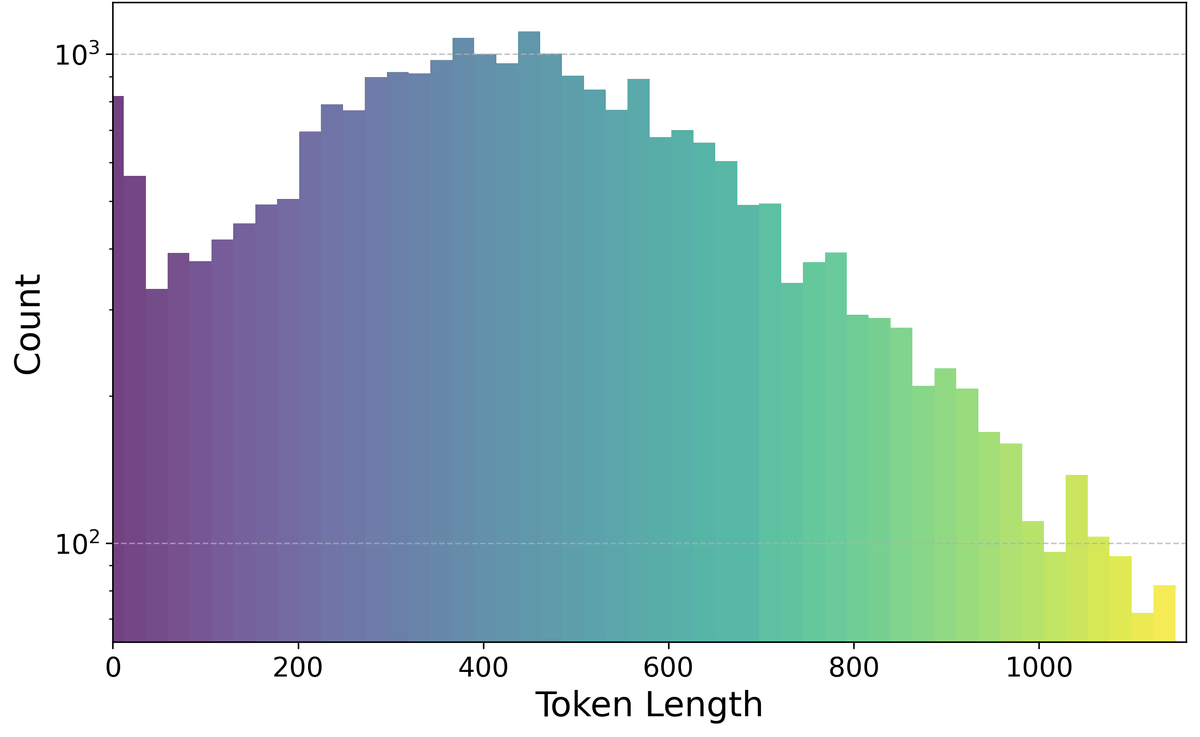
The release actually ships two datasets. A curated report-based version contains 270 QA instances tied to full reports. A much larger hallucination mitigation version contains 1,358 correct responses and 25,516 hallucinated ones, with context passages that stretch up to 46,562 tokens (average 2,604).
The chain-of-thought fix
The interesting engineering contribution is a three-stage training pipeline that gets models to actually read before answering. It layers supervised fine-tuning on grounded QA, then chain-of-thought prompting, then fine-tuning on CoT-annotated rationales. Two prompt templates were tested. The two-step version asks the model to first decide whether the report contains an answer, then produce it. The four-step version adds explicit topic identification and evidence retrieval as intermediate hops before the answerability check.
The team fine-tuned Llama-3.2-3B, Gemma-2-2B, and Mistral-7B on ESG-Bench, HaluEval, and BioASQ, and evaluated on two axes: WA accuracy (getting the answer right when one exists) and WoA accuracy (correctly abstaining when it doesn't).
The numbers
Four-step CoT fine-tuning was the clear winner. On ESG-Bench, LLaMA jumped from 76.00% balanced accuracy zero-shot to 96.00% with 4-step CoT. Gemma went from 71.00% to 92.00%. On BioASQ, Gemma with 4-step CoT hit 99.50% balanced accuracy. Crucially, the gains transferred: Mistral on HaluEval climbed to 97.50%, showing the technique is not just an ESG trick.
One counterintuitive finding: plain supervised fine-tuning sometimes made things worse. Gemma's balanced accuracy on HaluEval actually dropped from 90.00% to 67.00% under SFT, likely because the model overfit to producing answers and lost its ability to abstain. Explicit reasoning steps fixed that behavior.
What is actually available
The code and benchmark are open-sourced at GateNLP/ESG_Bench. The paper is published in the AAAI 2026 proceedings. If you are building anything that touches sustainability disclosures, financial compliance, or long-document QA where getting the answer wrong has legal consequences, this is a useful benchmark for stress-testing your pipeline. The main caveat is scale: the report-based split is only 270 questions, and the underlying answer generator was GPT-4o, so the hallucination distribution reflects that model's failure modes more than a general-purpose oracle.
The bigger takeaway is methodological. Groundedness judgments, essentially a yes/no signal about whether an answer is supported by the passage, work well as proxy supervision for hallucination-aware training, and structured multi-step prompts consistently beat both zero-shot inference and direct supervised fine-tuning on long-context QA.