
ESA's EVE Beats Qwen3-30B and Llama4 on Earth Science Tasks
The European Space Agency's Phi-lab releases a 24B parameter model, curated corpora, benchmarks, and a deployed RAG system for Earth Observation science.
 Pro
Takeaways
- ESA Phi-lab releases EVE, an open-source end-to-end framework for domain-specialized Earth Observation LLMs.
- Core model EVE-Instruct is a 24B fine-tune of Mistral Small 3.2, available at huggingface.co/eve-esa.
- Beats comparable 24-30B models on new EO benchmarks while gaining +1.8 points on general capabilities.
- Ships 2.8B-token curated corpus, 10.7B-token synthetic instruction dataset, and 5,693 manually-created benchmark samples.
- Includes deployed RAG pipeline with self-fact-checking hallucination detection using Qwen3-Embedding-4B and Qdrant.
- Already served 350 pilot users over six months with dynamic GPU scaling on A100/H100 infrastructure.
A team from the European Space Agency's Phi-lab, Pi School, Mistral AI, and Translated has released EVE (Earth Virtual Expert), an end-to-end open-source stack for building domain-specialized language models for Earth Observation and Earth Sciences. It bundles a fine-tuned 24B parameter model, a 2.8B-token curated corpus, the first systematic benchmarks in the domain, and a production RAG deployment that has already served 350 pilot users.
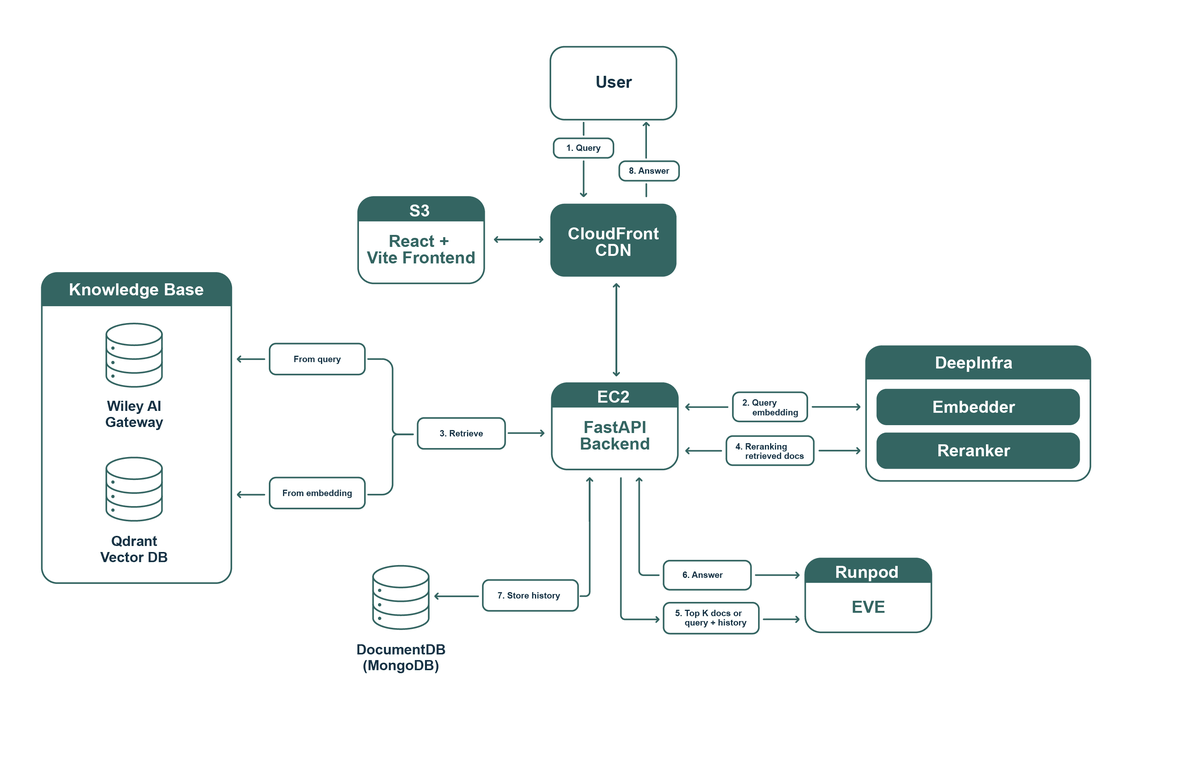
What makes the release unusual is that it doesn't just drop weights. It ships the full pipeline: scraping, cleaning, synthetic data generation, fine-tuning recipes, evaluation benchmarks, a retrieval system with hallucination detection, and the deployed frontend/backend architecture. That makes it a reference implementation for anyone adapting a general LLM to a technical scientific domain.
The knowledge fragmentation problem
Earth Observation refers to gathering data about the planet through satellites and remote sensors, and the resulting knowledge base is enormous. That knowledge sits scattered across heterogeneous sources and formats, creating a barrier for practitioners and decision makers. Experts also have to continually broaden their understanding across adjacent fields given the interdisciplinary nature of modern environmental challenges, and accessing this information typically requires deep expertise.
General-purpose LLMs can talk about climate and satellites, yet they lack the domain rigor needed for scientific decision support, and there was no standardized way to even measure how well they perform on EO-specific reasoning. EVE targets both gaps at once.