
ERR Surgically Rewires Graph Neural Networks to Fix Long-Range Blindness
A parameter-free graph rewiring method uses effective resistance as a global bottleneck detector, outperforming curvature-based approaches on heterophilic graphs.
 Pro
Takeaways
- ERR is a parameter-free graph rewiring method that uses effective resistance as a global bottleneck signal to fight over-squashing in GNNs.
- Adds edges between the highest-resistance node pairs and removes edges with the lowest resistance, under a fixed edge budget.
- Extends to directed graphs via a Lyapunov-based directed resistance, restricted to strongly connected components with DirGCN.
- Consistently outperforms curvature-based rewiring on heterophilic benchmarks (Cornell, Texas); modest gains on homophilic Cora and CiteSeer.
- Reveals a trade-off: fixing over-squashing can accelerate oversmoothing, and pairing ERR with PairNorm stabilizes deep models.
- Limitations include compute cost of pairwise resistance at scale and a task-agnostic criterion that can add harmful edges in heterophilic settings.
Message passing in graph neural networks has a persistent bug that no amount of depth seems to fix: information from far-away nodes gets crushed into a fixed-size vector as it squeezes through structural bottlenecks. A new paper introduces Effective Resistance Rewiring (ERR), a topology-editing method that treats the graph like an electrical circuit and surgically edits the edges that are choking long-range communication.
The bottleneck nobody can architect away
The problem is known as over-squashing. As depth increases, the receptive field of a node can grow rapidly, but that information must traverse graph connectivity and be repeatedly aggregated into fixed-size vectors, meaning signals from distant nodes end up with vanishing influence. Recent theoretical work has shown that the interplay of depth, width and the topology of the graph all matter, but topology is the dominant driver.
Prior fixes have leaned heavily on local signals. Curvature-based rewiring, for instance, identifies negatively curved edges that act as local bridges between poorly connected neighborhoods, then adds or removes edges around them. The trouble is that a local criterion can miss the actual global chokepoints where an entire region has to funnel its messages through two or three intermediary nodes.
Treating the graph like a circuit
ERR swaps the local view for a global one using effective resistance, the same quantity you would compute if you replaced every edge with a one-ohm resistor and measured how hard it is to push current between two nodes. Unlike shortest-path distance, resistance aggregates the contribution of every route in parallel, which makes it a natural measure of multi-path connectivity. Black et al. proved that the information passed from one node to another by any number of layers of a GNN is upper bounded by a quantity related to the effective resistance between the nodes, giving the metric direct theoretical grounding as an over-squashing proxy.
The algorithm itself is refreshingly simple and operates under a fixed edge budget:
- Compute pairwise effective resistance across the graph (or within each strongly connected component, for directed graphs).
- Find the pair of nodes with the largest resistance and add an edge between them. If they are already connected, add edges linking each node to a neighbor of the other.
- Find the edge with the smallest resistance and remove it, provided that removal does not break connectivity.
- Repeat until the budget is exhausted.
The only knob is the budget itself, expressed as a fraction of the original edge count (the paper tests 1%, 5%, 10%, 15%). For directed graphs, the authors adopt a directed generalization of effective resistance based on solving a Lyapunov equation, restricted to node pairs within the same strongly connected component.

What the numbers show
Experiments cover two homophilic citation graphs (Cora, CiteSeer) and two heterophilic node classification benchmarks (Cornell, Texas), using both standard GCN and DirGCN for directed settings. A few patterns stand out from the depth sweeps:
- On homophilic graphs, shallow models already do well and rewiring provides limited gains; depth degradation looks more like oversmoothing than a reachability problem.
- On heterophilic graphs, resistance-guided rewiring consistently beats the baseline at shallow and moderate depths, suggesting bottlenecks were indeed limiting early information flow.
- Combining ERR with PairNorm, a normalization layer that keeps pairwise embedding distances stable, stabilizes deep models across the board.
The authors also introduce a resistance-per-hop variant that normalizes by shortest-path distance, which tends to pick out pairs that are poorly connected relative to how close they actually are. On directed Cornell with DirGCN, resistance-per-hop rewiring reaches roughly 89% accuracy at higher budgets, meaningfully above the curvature baseline.
The trade-off the paper actually surfaces
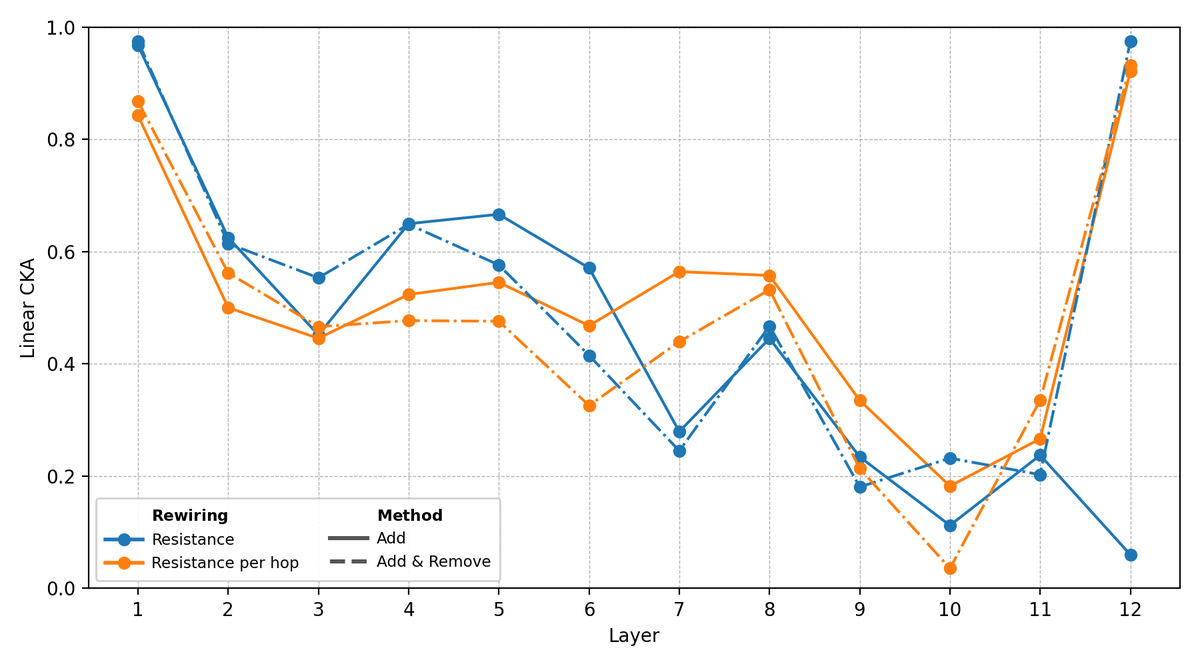
The more interesting contribution beyond raw accuracy is a representation-level analysis. Using linear probes on penultimate embeddings, class-conditional cosine similarity, and Centered Kernel Alignment, the authors show that curvature and resistance rewiring can hit similar test accuracy while producing meaningfully different internal representations.
They also make a trade-off explicit: adding edges to relieve bottlenecks creates alternative message routes, but those same routes accelerate representation mixing across classes at depth. Reducing over-squashing can amplify oversmoothing if the topology edits are not controlled. This is why ERR pairs well with PairNorm, one attacks the topology, the other keeps embeddings from collapsing.

When to reach for it
ERR is worth trying when your graph is heterophilic or has known structural bottlenecks, and when you are training message passing models rather than dense graph transformers. It is a preprocessing step, not an architectural change, so it drops into an existing PyTorch Geometric pipeline. The paper does not release code alongside the arXiv version, and the authors flag two limitations to weigh before adopting it: pairwise effective resistance is nontrivial to compute at scale, especially in the directed case, and the criterion is task-agnostic, so lowering resistance in a heterophilic graph can accidentally connect nodes from different classes and hurt performance.
The bigger takeaway is methodological. Effective resistance is emerging as the right lens for reasoning about which edges in a graph are actually load-bearing for long-range message passing, and ERR shows you can get most of the benefit from a rewiring rule that is essentially two lines of pseudocode plus a budget.