
ERBA Reframes Enzyme Speed Prediction and Nearly Doubles AI Accuracy
A staged adapter that first recognizes the substrate and then adapts pocket geometry pushes protein language models past shallow-fusion baselines on enzyme kinetics.
 Pro
Takeaways
- ERBA reframes enzyme kinetics prediction as staged conditioning: substrate recognition, then geometric adaptation.
- Molecular Recognition Cross-Attention injects substrate semantics; Geometry-aware MoE routes to pocket-specialized experts.
- ESDA distribution alignment in RKHS prevents geometry features from overwriting pretrained PLM biochemical priors.
- On ESM2-3B: R² 0.54 for k_cat, 0.61 for K_m, 0.61 for K_i, beating CatPred across the board.
- Out-of-distribution R² for k_cat jumps from 0.27 to 0.50 on the EITLEM mutant-enzyme test set.
- Full paper on arXiv; no public code release yet.
Predicting how fast an enzyme actually turns a molecule into a product is one of the hardest quantitative problems in computational biology, and most machine learning pipelines still treat it like a matching game between two static vectors. A new method called ERBA reframes it as a two-step biochemical process and squeezes noticeably better numbers out of the same protein language model backbones everyone is already using.
The paper, Multimodal Protein Language Models for Enzyme Kinetic Parameters, targets three constants that biochemists actually care about: k_cat (turnover number), K_m (Michaelis constant), and K_i (inhibition constant). Many learning pipelines simplify this process to a static compatibility problem between the enzyme and substrate, fusing their representations through shallow operations and regressing a single value, and such formulations overlook the staged nature of catalysis, which involves both substrate recognition and conformational adaptation.
Why concat-and-MLP was leaving accuracy on the table
Enzymes do not just bind a substrate in one shot. They first recognize it, then physically rearrange their active site to stabilize the transition state, a mechanism biochemists call induced fit. Prior systems like DLKcat, UniKP, CataPro, and CatPred encode the enzyme with a protein language model, encode the substrate as SMILES or a graph, then concatenate and regress. That works, but it flattens two very different biophysical steps into one operation.

The authors also flag a second issue: naively injecting 3D structural evidence can dominate training and erode the biochemical semantics learned during PLM pretraining. In other words, if you dump geometry features straight into a fine-tuning loop, the strong structural signal drowns out the sequence prior the PLM spent millions of proteins learning.
Two stages, one distribution anchor
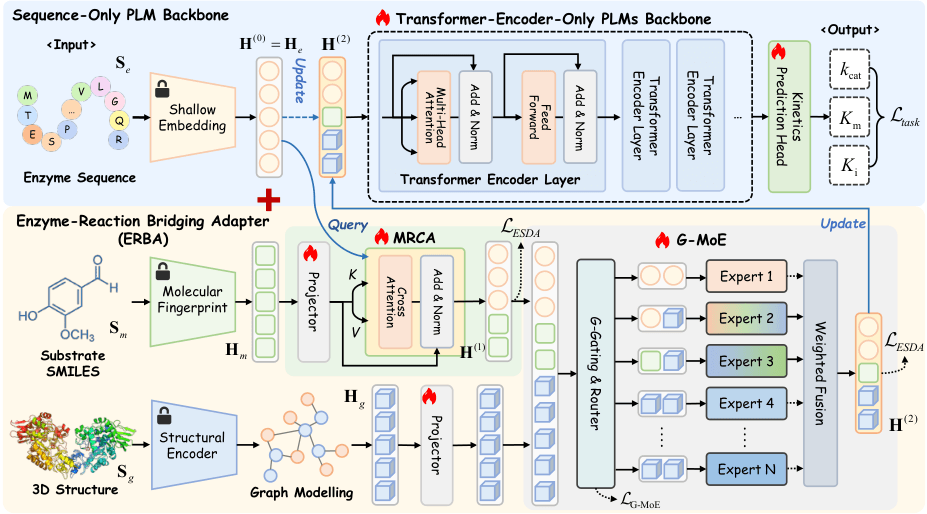
ERBA is an adapter bolted onto a frozen-ish PLM backbone (they test Ankh3, ProtT5, and ESM2 from 8M to 5.7B parameters, fine-tuned with LoRA at rank 8). It works in three tightly coupled pieces:
- Molecular Recognition Cross-Attention (MRCA): a single cross-attention layer where enzyme residue embeddings query substrate token embeddings from an MPNN over the SMILES graph. This produces a substrate-aware enzyme representation before any 3D information is introduced.
- Geometry-aware Mixture-of-Experts (G-MoE): an E-GNN encodes the active-site pocket, and a gating network built from pooled sequence-substrate and pocket features routes each sample to the top-2 of 4 pocket-specialized low-rank experts. Only the pocket residues get modulated, so non-pocket parts of the protein are left alone.
- Enzyme-Substrate Distribution Alignment (ESDA): an RBF-kernel maximum mean discrepancy loss in a reproducing kernel Hilbert space that keeps the sequence-only, sequence-plus-substrate, and sequence-plus-substrate-plus-structure representations distributionally close to the PLM manifold. It is the term that stops geometry from steamrolling the pretrained biochemical prior.
The regression head predicts in log10 space with a heteroscedastic Gaussian negative log-likelihood, which fits the fact that kinetic constants are strictly positive and dominated by multiplicative noise.
The numbers, on standard splits and out-of-distribution
Trained on curated BRENDA and SABIO-RK data (23,151 k_cat, 41,174 K_m, and 11,929 K_i entries with matched sequences, SMILES, and 3D structures), ERBA on ESM2-3B beats every prior specialist on all three endpoints. For k_cat, R² climbs from CatPred's 0.40 to 0.54 and PCC from 0.67 to 0.74. For K_m, R² jumps from 0.49 to 0.61 with RMSE dropping from 0.93 to 0.70. For K_i, PCC hits 0.78 versus CatPred's 0.60.

The more interesting result is out-of-distribution generalization on the EITLEM test sets, which include mutant enzymes with structures predicted by OpenFold or ESMFold. Here ERBA nearly doubles R² for k_cat (0.27 → 0.50) and more than doubles it for K_m (0.23 → 0.55) compared to the previous best. That matters because enzyme engineering workflows almost always involve mutants and predicted structures, not clean wild-type crystal data.
What the ablations actually show
Each component pulls its weight on the K_i endpoint under identical training:
- Swapping vanilla concat plus self-attention for MRCA lifts R² from 0.47 to 0.61 and cuts MAE by 17.3%.
- Replacing standard MoE with the geometry-routed G-MoE moves R² from 0.50 to 0.61.
- Switching plain L2 regression for the ESDA objective raises R² from 0.48 to 0.61 and reduces RMSE by 11.3%.
Fusion order also matters. Recognizing the substrate first and then adapting to geometry beats the reverse order by 37.8% in R², which lines up with the enzymology.
Where it still stumbles
The model does best on lyases (EC-4) and worst on ligases (EC-6), where sample counts are small and K_m and K_i predictions degrade. On the error-percentage-under-one metric, K_m hits 79.5% while k_cat only reaches 67.7%, so absolute turnover numbers remain the noisiest to predict. Interestingly, Ankh3-5.7B performs relatively better on K_m despite lower overall scores, hinting that different PLM pretraining recipes carry different biochemical inductive biases.
The paper does not link a public code release, so anyone wanting to reproduce will need to reimplement the adapter on top of an existing PLM. The CVPR version of the paper gives enough architectural detail to do so, and the recipe is small: LoRA on the top PLM layers, four experts with top-2 routing, and two loss weights set to 0.01 and 0.1. For teams building enzyme-constrained metabolic models, screening designer variants, or planning directed evolution rounds, treating catalysis as a staged conditioning problem rather than a lookup appears to be a genuinely useful reframing.