
EPIC Cuts Seismic AI Latency 8.9x While Actually Beating Centralized Accuracy
EPIC splits seismic AI between edge sensors and a central server, cutting communication energy 33x while actually improving reconstruction quality
 Pro
Takeaways
- EPIC framework splits seismic AI between edge sensors (encoding) and a central server (decoding), cutting 4G latency by 8.9x and communication energy by 33.8x.
- Physics-aware cross-attention in the central decoder learns to weight each sensor's features by spatial relevance, fixing the accuracy loss seen in standard distributed ML approaches.
- Accuracy actually improves: EPIC beats the centralized baseline on 8 of 10 OpenFWI benchmark datasets, not just matching it.
- Fault tolerance built in: with 4 of 5 edge nodes offline, EPIC still reconstructs recognizable subsurface structure; the centralized baseline collapses with just 1 node missing.
- Tested on real hardware: five Raspberry Pi 5 units as edge devices under both Wi-Fi and emulated 4G, not just simulation.
- No public code release has been announced; the paper is available on arXiv.
Running scientific AI in the field is a fundamentally different problem from running it in a data center. When you need to reconstruct what lies beneath the earth's surface in real time -- from sensors scattered across a desert or ocean floor -- you can't afford to pipe gigabytes of raw waveform data back to a server. A new framework called EPIC tackles this head-on, showing that the right split between edge devices and a central node can actually make the model better, not just faster.
The problem with centralized scientific AI
Full-waveform inversion (FWI) is the task at the heart of this work. It is a physics-governed problem where seismic waves are fired into the ground, recorded by an array of receivers, and then a model works backwards to reconstruct a high-resolution map of subsurface rock velocities. FWI is extensively used to identify geophysical properties like velocity and conductivity, and is widely applied in subsurface energy exploration, earthquake early warning systems, and carbon capture and sequestration.
Most existing SciML studies follow a centralized design, assuming that raw measurements collected across distributed sensors are transmitted to a central server for inference. On paper, this is fine. In the field, it is a disaster. The researchers built a real hardware testbed -- five Raspberry Pi 5 units as edge devices plus one central node -- and measured exactly how bad things get. In both Wi-Fi and emulated 4G environments, communication latency occupies a large portion of the latency breakdown: 32.7% for Wi-Fi and 93% for 4G emulation. Under 4G, the system spends almost all of its time just moving data around.

Why the obvious fixes break the physics
The natural response is to distribute the computation. Two well-known paradigms exist for this: Federated Learning-style (FLA) and Split Learning-style (SLA) approaches. FLA runs a full model on each edge device and merges the outputs. SLA runs only the encoder on each device, sends compressed features to the server, and decodes centrally. Both cut communication dramatically -- but both also hurt accuracy in ways that are specific to physics-based tasks.
The root causes are grounded in wave physics:
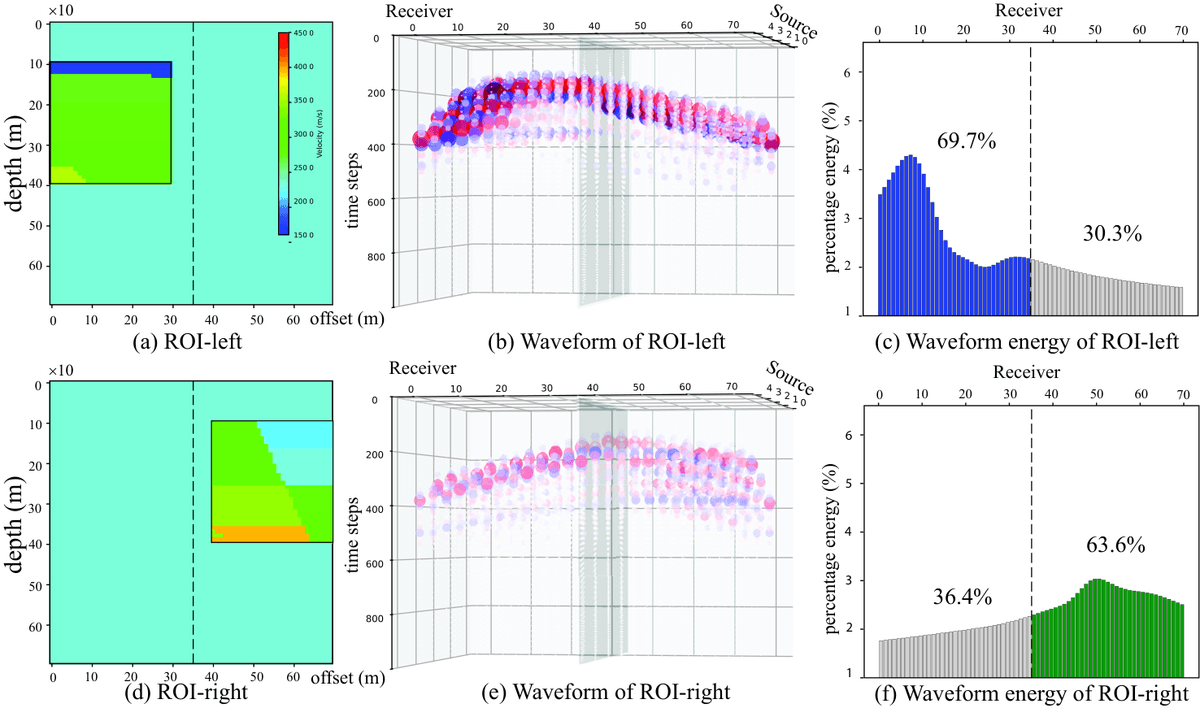
- FLA's problem -- information loss: Acoustic waves from a source propagate throughout the entire medium. When a wave reaches a region, the waveform carrying regional information can be transmitted to receivers outside the region. Each edge device in FLA only sees its own receivers, so it misses signals about the other half of the subsurface. Visible artifacts appear at partition boundaries.
- SLA's problem -- position blindness: The strength of reflected waveforms varies spatially: for a given subsurface region, different receivers capture signals with varying amplitudes depending on their positions. SLA treats all latent features equally when merging them, ignoring that a receiver on the left side of the array is far more informative about the left side of the ground than the right.
The numbers confirm this. Against the centralized baseline (SSIM of 0.85), FLA drops to 0.76 (a 10.6% hit) and SLA to 0.82 (a 3.5% hit). Both reduce communication time from ~5,300ms to ~163ms under 4G, but at a real cost to scientific fidelity.

Two teachers, one framework
EPIC (Edge-compatible and Physics-Informed distributed SciML) is designed around two guiding principles the authors call "teachers": hardware constraints that push computation to the edge, and physics laws that dictate how that computation must be structured. The framework has four interlocking components:
- EPIC-Infra: Formalizes the distributed hardware setup -- number of devices, bandwidth, latency, packet loss rate, and a hard timing deadline T.
- EPIC-Net: The neural network architecture, co-designed with both hardware and physics in mind. This is the core innovation.
- EPIC-Depl: An automated deployment pipeline that configures environments, distributes model weights, and establishes communication channels across all devices.
- EPIC-Mgmt: A runtime manager that monitors transmission status and gracefully handles dropped or delayed edge nodes without stalling the pipeline.
How EPIC-Net actually works
EPIC-Net's architecture is a direct response to the two root causes identified above. It has three stages:
- Distributed Encoding: Each encoder on a given device processes the waveforms from its associated receivers through convolutional blocks with progressive downsampling, producing a compact latent representation of shape 512x1x1. This is what gets transmitted -- a tiny vector instead of a full waveform tensor.
- Self-Attention Fusion: Once all latents arrive at the central node, a self-attention module aggregates them into a single global representation. This directly fixes FLA's information loss problem by forcing the model to consider all receivers together before decoding.
- Position-Aware Cross-Attention Decoder: This is the physics-critical piece. Instead of using only the global latent, EPIC-Net leverages all local latents to implement a position-aware cross-attention mechanism that adaptively weights distributed latents based on spatial location. The decoder learns that when reconstructing the left side of the velocity map, it should attend more heavily to latents from left-side receivers -- exactly what wave physics predicts.
The cross-attention query is formed by concatenating decoder features with learnable position embeddings, then attending over keys and values derived from each encoder's latent. The attention weights are learned end-to-end, but they converge to physically meaningful patterns: left-region reconstruction attends to left-sensor latents, right-region to right-sensor latents.
# Simplified cross-attention in EPIC-Net decoder
# Q: decoder features + position embedding
# K, V: from each distributed encoder latent
Q = Linear(concat(decoder_features, pos_embedding))  # [B, 70*70, d]
K_i = Linear(latent_i)  # [B, 1, d] per device
V_i = Linear(latent_i)
# Attention weight for device i at each spatial position
alpha_i = softmax(Q @ K_i.T / sqrt(d_k))
output = sum(alpha_i * V_i for each device i)
Benchmarks and results
OpenFWI is a collection of large-scale multi-structural benchmark datasets for FWI, consisting of 12 datasets totaling 2.1TB synthesized from multiple sources. It encompasses diverse domains in geophysics (interface, fault, CO2 reservoir), covers different geological subsurface structures (flat, curve), and contains various amounts of data samples ranging from 2K to 67K. The EPIC paper tests on 10 of these datasets across three families: velocity layers, geological faults, and style-transfer-based complex patterns.
Each sample is a seismic waveform tensor of shape [5 sources, 1000 timesteps, 70 receivers] paired with a 70x70 velocity map spanning 1,500 to 4,500 m/s. The evaluation metric is SSIM (Structural Similarity Index -- a perceptual image quality score where 1.0 is perfect).
| Method | Type | Latency (4G) | Avg SSIM | Comm. Energy |
|---|---|---|---|---|
| InversionNet (InV) | Centralized | 5723ms | 0.85 | Baseline |
| FLA | Distributed | 406ms | 0.76 | ~97% reduction |
| SLA | Distributed | 437ms | 0.82 | ~97% reduction |
| EPIC | Distributed | 644ms | 0.87+ | 33.8x reduction |
EPIC reduces end-to-end latency by 8.9x and communication energy by 33.8x compared to centralized approaches, while achieving comparable or better reconstruction fidelity on 8 out of 10 OpenFWI datasets. The remaining two datasets see only a 0.3% SSIM drop. On the hardest datasets (the B-variants with complex geological structures), EPIC's advantage over FLA and SLA is most pronounced.
Robustness is a first-class feature
Field deployments fail. Sensors go offline, networks drop packets, devices overheat. EPIC-Mgmt handles this through a timeout-based mechanism: if an edge device doesn't deliver its latent within the deadline window, the central decoder proceeds with whatever latents it has. The cross-attention mechanism naturally redistributes attention weights across the remaining devices.
When simulating the loss of 0 to 4 out of 5 edge nodes, the centralized baseline's performance degrades dramatically to an SSIM of 0.56 with even just one node missing. In contrast, EPIC's average SSIM decreases from 0.86 to 0.79, 0.72, and 0.65 when 1, 2, and 3 nodes are unavailable. Even with four out of five nodes completely gone, EPIC still recovers recognizable layer and fault structures from the subsurface.

Where it fits and where it falls short
EPIC is purpose-built for scenarios where sensors are distributed across a wide area, wired infrastructure is unavailable, and real-time inference is required. The most direct applications are:
- Seismic monitoring networks in remote environments (deserts, ocean floors, polar regions)
- Earthquake early warning systems where latency is critical
- Subsurface energy exploration and CO2 sequestration monitoring
- Ultrasound computed tomography in distributed medical imaging setups
There are real limitations to be aware of. EPIC's cross-attention decoder adds computation at the central node, which means its end-to-end latency (644ms under 4G) is higher than FLA (406ms) or SLA (437ms) -- the tradeoff is accuracy for speed. The paper notes this gap would close if the central node were a server-grade machine rather than another Raspberry Pi. The framework was also validated on synthetic OpenFWI data; real-world seismic noise and sensor heterogeneity could change the picture. No code or pretrained models have been released publicly at the time of writing.
The real breakthrough
The headline numbers -- 8.9x latency, 33.8x energy -- are impressive, but the deeper result is more surprising: distributing the model actually improved accuracy on most datasets. The hardware-physics co-guidance acts as an implicit regularizer, pushing the network toward physically consistent solutions that a centralized model trained without these constraints doesn't find. This suggests that the constraints imposed by real deployment environments aren't just obstacles to overcome -- they can be a source of inductive bias that makes scientific models more reliable. That's a reframe worth paying attention to as SciML moves from lab benchmarks to field systems.