
EPFL's Latent-DARM Beats Qwen3 on Math Using Just 2% of Its Tokens
Latent-DARM lets a diffusion model plan and an autoregressive model execute, cutting token use by 98% while matching state-of-the-art reasoning accuracy
 Pro
Takeaways
- Latent-DARM pairs a discrete diffusion model (planner) with an autoregressive model (executor) via a learned latent-space projection, bypassing text entirely between agents.
- Accuracy jumps from 27% to 36% on DART-5 and from 0% to 14% on AIME 2024 vs. the text-space baseline, using the same underlying models.
- The system uses less than 2.2% of the token budget of reasoning models like Qwen3 and DeepSeek-R1 while matching or exceeding them on hard math benchmarks.
- The only trainable component is a small Linear-GELU-Linear projector; both the diffusion planner and the ARM executor remain fully frozen.
- The method is the first latent-space communication bridge between architecturally heterogeneous models (bidirectional masked diffusion vs. causal autoregressive).
- Weakness: MMLU performance drops (44% vs. 52.5% text-space) because the latent plan loses fine-grained factual knowledge; no code has been released yet. See the paper.
Every major multi-agent AI system today is built from the same kind of model: an autoregressive language model (ARM) that generates text one token at a time, left to right. That works well for fluent prose, but it has a fundamental weakness: once a token is written, it cannot be revised. The model cannot look ahead, reconsider a plan, or reason globally about a problem. A new paper from researchers at EPFL, MBZUAI, ETH Zürich, and Microsoft Research Asia asks a pointed question: what if you replaced the planner in a multi-agent system with a completely different kind of model?
Two kinds of minds, one pipeline
The paper introduces Latent-DARM, a framework that pairs a Discrete Diffusion Language Model (DDLM) as a planner with a standard ARM as an executor. To understand why this matters, you need to know what makes DDLMs different.
Where an ARM generates tokens sequentially and can never revise earlier decisions, a DDLM generates text by iteratively unmasking a fully masked sequence. It starts with every token hidden, then fills them in over multiple denoising steps, conditioning on global context at every step. This bidirectional, non-sequential process is structurally better suited to planning: the model can reason backward from a goal, weigh multiple paths simultaneously, and revise intermediate steps before committing to an output. On structured tasks like Countdown and Sudoku, diffusion-based approaches achieve 91.5% and 100% accuracy respectively, compared to 45.8% and 20.7% for autoregressive models.
The catch is fluency. Because tokens revealed simultaneously at a given denoising step are predicted independently given only the current unmasked context, this can undermine fluency. When a DDLM tries to communicate its plan to a downstream ARM as plain text, the garbled output degrades the executor's performance. The whole collaboration falls apart at the interface.
The interface problem
The naive fix is to just pass the DDLM's text output to the ARM. The paper calls this the text-space baseline. It does not work well. Under text-space collaboration, most failures fall into cases where the executor is capable of solving the task when provided with a coherent plan, indicating that performance is primarily limited by planning degradation induced by textual decoding.
But there is a deeper problem with going directly to latent space. A key challenge arises in directly passing hidden representations from the DDLM, which is trained bidirectionally through masked denoising, to the ARM, which is trained unidirectionally in an autoregressive manner. These fundamentally different training paradigms result in different embedding spaces. The two models live in entirely different geometric worlds. You cannot just concatenate their hidden states.
Latent-DARM solves this with a small learned projection network: a Linear-GELU-Linear module that maps the DDLM's final hidden state into the ARM's embedding space. Crucially, neither the DDLM nor the ARM is fine-tuned. Only the projector is trained, and it is trained end-to-end on downstream task performance rather than on any geometric alignment objective.
How it works, step by step
- A question is fed to the DDLM planner (LLaDA-8B-Instruct or Dream-v0-7B).
- The DDLM runs its full iterative denoising process and produces a latent plan from its final hidden layer, not decoded text.
- The projector maps this latent vector from the DDLM's 4096-dimensional space into the ARM's hidden dimension.
- The projected embedding is concatenated with the ARM's own encoding of the original question.
- The frozen ARM executor generates the final answer, conditioned on both the original question and the diffusion planner's latent plan.
The projector is trained on 35,000 question-answer pairs drawn from ARC and DART benchmarks, using a standard cross-entropy loss on the ARM's output. No AIME or MMLU data is used during training, making the generalization results especially notable.
The numbers that matter
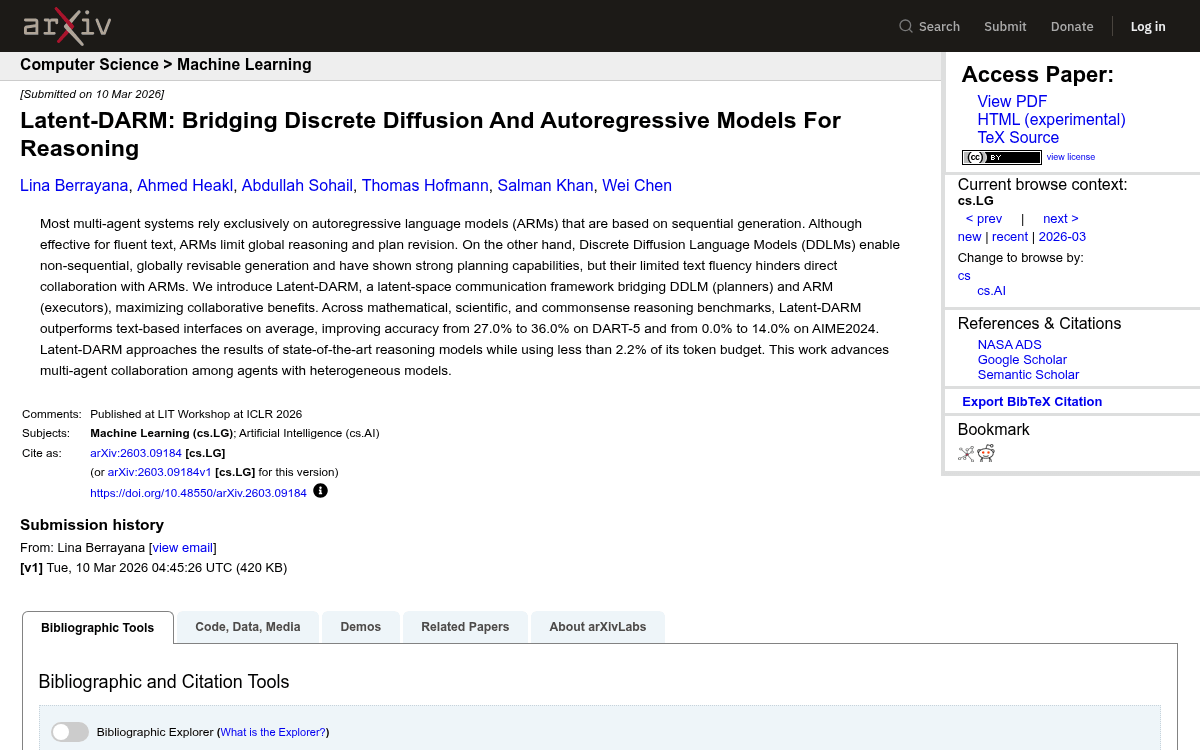
The headline results are striking. Latent-DARM outperforms text-based interfaces on average, improving accuracy from 27.0% to 36.0% on DART-5 and from 0.0% to 14.0% on AIME 2024. DART-5 is the hardest tier of a large-scale mathematical reasoning benchmark, and AIME 2024 is a high-school math olympiad where most small models score near zero.
The efficiency story is even more remarkable. With only 64 planner tokens and an average of 5 executor tokens, Latent-DARM surpasses Qwen3-1.7B on DART-5 while using merely 2.2% of its tokens, and outperforms it on AIME with just 1.9% of the token budget. Reasoning models like DeepSeek-R1 and Qwen3 generate thousands of tokens of chain-of-thought to reach their answers. Latent-DARM skips that entirely.
| Setting | DART-5 | AIME 2024 | Avg. Executor Tokens |
|---|---|---|---|
| Llama-3.2-3B (ARM only) | 36.5% | 3.5% | 41 |
| LLaDA-8B + Llama-3.2-3B (text-space) | 27.0% | 0.0% | 20 |
| Latent-DARM 64-token plan | 54.0% | 12.5% | 6 |
| Latent-DARM 128-token plan | 36.0% | 14.0% | 6 |
| Qwen3-1.7B (ARM only) | 49.0% | 8.5% | 3,106 |
| DeepSeek-R1-Distill-Qwen-7B | 61.5% | 28.5% | 3,068 |
There is one clear weakness: MMLU. The latent approach underperforms on MMLU (44.0% vs. 52.5% text-space), likely because the projector was trained exclusively on reasoning benchmarks where planning provides structural guidance. MMLU emphasizes factual recall across diverse domains, where the planning bottleneck may lose fine-grained knowledge while preserving reasoning patterns. If your task is broad knowledge retrieval rather than structured multi-step reasoning, the latent plan is not helping and may actually hurt.
What actually improved?
The authors ran a careful diagnostic to confirm that the gains come from better plan communication, not some artifact. They split failures into two categories: cases where the DDLM planner was the bottleneck (the ARM could solve the problem when given a good plan from another ARM), and cases where the ARM executor was the bottleneck. Under Latent-DARM, failures shift predominantly to executor failures, demonstrating that latent-space communication substantially improves planning fidelity, with the executor emerging as the dominant bottleneck. In other words, the projector is genuinely transmitting the diffusion model's reasoning structure to the ARM, not just adding noise.
The real breakthrough
The deeper contribution here is architectural: this is the first demonstrated method for latent-space communication between models with fundamentally different architectures. Prior latent-space MAS work like LatentMAS passes hidden states between same-family ARM models. Recent studies have explored leveraging the latent space as an alternative medium for LLM communication, with one line of work studying transferring hidden embeddings for cross-model communication. Latent-DARM extends this to the harder case where the two models were trained under entirely different paradigms, bidirectional masked diffusion versus causal autoregression, and their embedding spaces have different dimensions and geometric properties.
The task-aligned training objective is the key enabler. Rather than minimizing the geometric distance between projected embeddings and some target representation (which is ill-defined), the projector is trained purely to maximize the ARM's downstream accuracy. The geometry of the projection is shaped entirely by what the task requires, not by what the two embedding spaces happen to look like.
When to use it, and when not to
Latent-DARM is most useful when:
- Your task requires multi-step planning or structured reasoning (math competitions, logic puzzles, science problems)
- You have a token budget constraint and cannot afford long chain-of-thought generation
- You want to combine the global reasoning of a diffusion model with the fluency of an autoregressive model
It is less suitable for:
- Broad factual recall tasks like MMLU, where planning structure does not help
- Tasks requiring the full generative fluency of the ARM executor
- Scenarios where you need interpretable intermediate reasoning steps (the latent plan is not human-readable)
No code or model weights have been released alongside the paper. The projector architecture is simple enough to reimplement: three linear layers with two GELU activations, mapping from the DDLM's hidden dimension to the ARM's hidden dimension with a 1024-dimensional bottleneck. Training uses AdamW with LoRA adapters on the ARM's attention and FFN layers for efficiency, while the backbone stays frozen.
The broader implication is one the field has been slow to accept: text does not need to be the sole medium of inter-agent communication. Latent-space interfaces provide a high-bandwidth, task-aligned alternative that enables efficient collaboration between heterogeneous models, opening new directions for scalable and budget-aware reasoning systems. The question now is whether this approach scales to more complex multi-hop pipelines, and whether the projector can generalize across a wider range of task domains without retraining.