
EPFL's Bird-Inspired Drone Folds Its Wings to Slip Through Tight Gaps
EPFL researchers built a 130-gram drone that tucks its wings mid-flight to squeeze through openings narrower than its wingspan.
 Pro
Takeaways
- EPFL built a 130g fixed-wing drone that sweeps its wings back 34% mid-flight to pass through sub-wingspan gaps.
- Wings actuate through the full 80-degree sweep in 100 ms via a lightweight servo bar-linkage mechanism.
- Nonlinear MPC with adaptive constraints runs at 30 Hz using ACADOS and HPIPM solvers.
- New aerodynamic model handles low-Reynolds and post-stall regimes for real-time model-based control.
- Achieved 5 cm mean altitude error at the gap across speeds of 5-7 m/s with collision-free passage.
- Read the full paper on arXiv for the aerodynamic derivations and full trajectory optimization formulation.
Fixed-wing drones have a hard geometric limit: their wingspan. If a doorway or gap is narrower than the wings, the drone either cannot fit or has to roll sideways in a violent maneuver that trades altitude for clearance. A team at EPFL's Laboratory of Intelligent Systems has taken a different approach, borrowing directly from how birds fold their wings when threading through branches. Their new paper describes a 130-gram morphing-wing drone that sweeps its wings inward for a fraction of a second to slip through gaps smaller than its fully extended wingspan, and stays on target with centimeter-level accuracy.
The lift problem, and why birds do it better
The drone has a wingspan of 0.67 meters when extended and 0.45 meters when fully swept, a 34% reduction. That sounds simple until you look at the aerodynamics. Sweeping the wings back throws away lift right when the drone needs it most, at low speeds near stall, and the actuation has to happen at exactly the right moment or the wings will clip the edges of the gap.
Controlled flight through narrow gaps has previously been achieved with foldable rotary-wing drones, but their upward-facing thrusters mean lift and thrust remain unchanged as the shape morphs. Fixed-wing attempts have relied on either a knife-edge maneuver where the drone rolls past 70 degrees, which loses altitude, or passively folding wings that collapse on impact with the gap edges, which can send the aircraft into an unrecoverable tumble if one wing hits first.
A featherweight morphing mechanism

Rather than the overlapping-feather designs common in bird-inspired drones, which add outboard mass and slow down actuation, the team built something mechanically minimal. Each half-wing has a fixed root section with a symmetric S8035 airfoil and an outer flat-plate segment that sweeps backward inside the root. The 4-gram outer segment is driven by a 4.5-gram Bluebird servo through a bar linkage. The outer wing can traverse its full 80-degree sweep range in 0.10 seconds. Because left and right wings sweep independently, asymmetric actuation also gives the drone a roll input, replacing traditional ailerons.
Modeling the messy parts
The control side is where this gets research-frontier. Standard aerodynamic models assume steady flight, small angles, and don't cover the post-stall regime the drone enters during gap passage. The authors built a real-time-computable aerodynamic model parameterized by wing sweep angle, wing geometry, and a minimal set of identifiable airfoil properties, accounting for propeller slipstream and low-Reynolds lift degradation in both pre- and post-stall regimes.
That model feeds a two-stage control stack:
- Trajectory optimization: A four-phase problem (anticipation, gap passage, recovery, steady flight) solved with pseudo-spectral collocation using the MPOPT package.
- Nonlinear MPC: The MPC runs at 30 Hz with adaptive constraints, using the HPIPM solver in the ACADOS toolkit, with a parallel cascaded PID controller at 60 Hz handling lateral alignment via asymmetric wing sweep and the rudder.
- Delay compensation: A measured 65 ms of combined communication, computation, and actuator lag is compensated by propagating dynamics forward using prior input history.
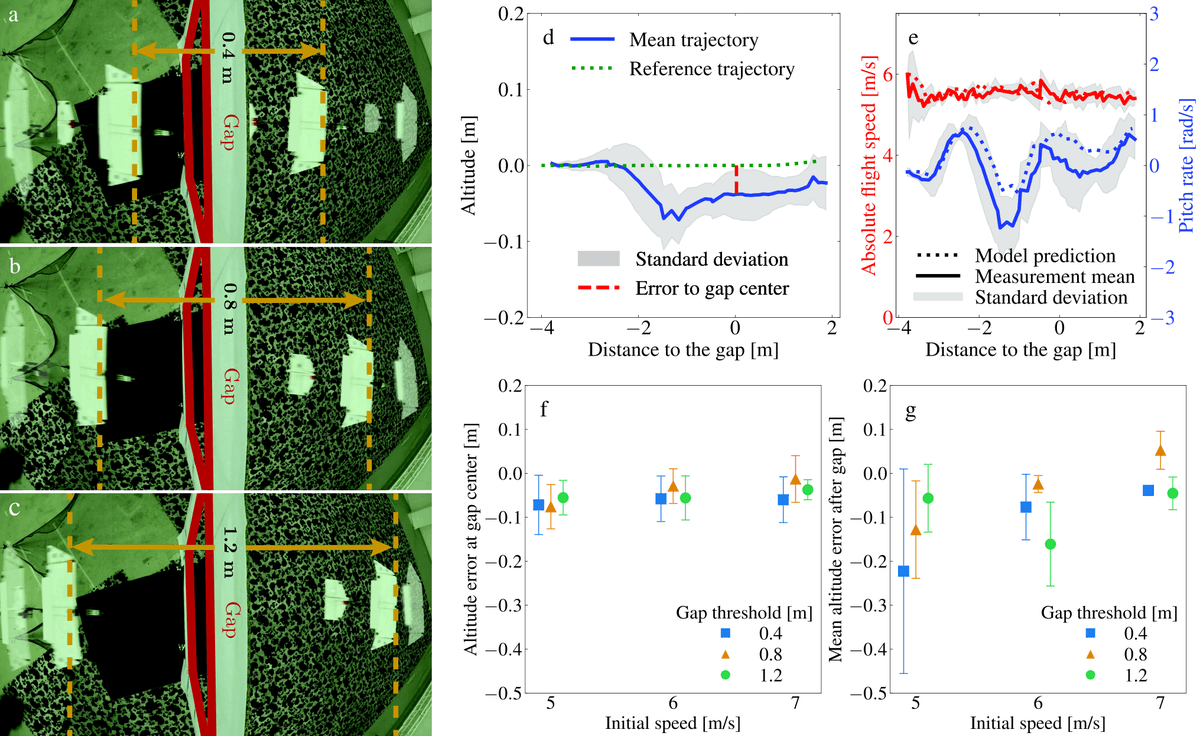
The clever part is that the MPC swaps its cost weights and actuator constraints depending on whether the current prediction step falls inside the gap threshold region. Inside the threshold, wing sweep is forced to fully retracted; outside, the controller is free to choose. This is how the drone learns to "anticipate" the gap without any hand-scripted phase logic at runtime.
What actually happened in the flight arena

Flight tests ran in a 10x10x8 meter arena with motion capture, an automated launcher, and gaps 4 to 6 meters downrange. The team tested three optimization objectives: minimizing altitude change, minimizing forward-speed variation, and minimizing time with wings fully swept.
Across three tested speeds and three gap thresholds, the drone hit a mean altitude error at the gap of -5.1 cm with a standard deviation of 4.4 cm. Accuracy improved with speed: -6.7 cm at 5 m/s, -4.8 cm at 6 m/s, and -3.6 cm at 7 m/s. The wings stayed fully swept for between 55 and 262 ms depending on speed, and lateral error to the gap center averaged 2.8 cm.
An interesting finding compared to biology: budgerigars flying similar gaps at 4-5 m/s show substantially larger altitude variation, likely because the propeller-driven drone can vector thrust upward through the gap while flapping birds cannot and must gain height in advance.
Where it breaks down
A few honest limitations sit in the results:
- Roll-angle variations between flights reduce lift and cause altitude loss beyond what the MPC's level-wing assumption predicts, because asymmetric wing sweep is less effective at low angles of attack.
- The model underestimates pitching dynamics, which the authors attribute to unmodeled dynamic stall and pitch-rate dependencies.
- Below 5 m/s, the required pitch-up to maintain altitude risks a tail strike on the lower edge of the gap.
- The MPC runs offboard on a laptop with motion capture feedback. No onboard vision, no onboard compute, and no code release is mentioned in the paper.
Still, this establishes a useful base for wing-sweep morphing control that generalizes beyond one geometry, one speed, or one gap size. For anyone working on avian-inspired UAVs, indoor inspection, or search-and-rescue platforms that need to negotiate cluttered environments, the modeling framework, particularly the parametric aerodynamic model that handles post-stall and low-Reynolds effects in closed form, is probably the most transferable contribution here.