
EPFL Finds LoRA Cuts Federated Learning Data Leaks by 10x for Free
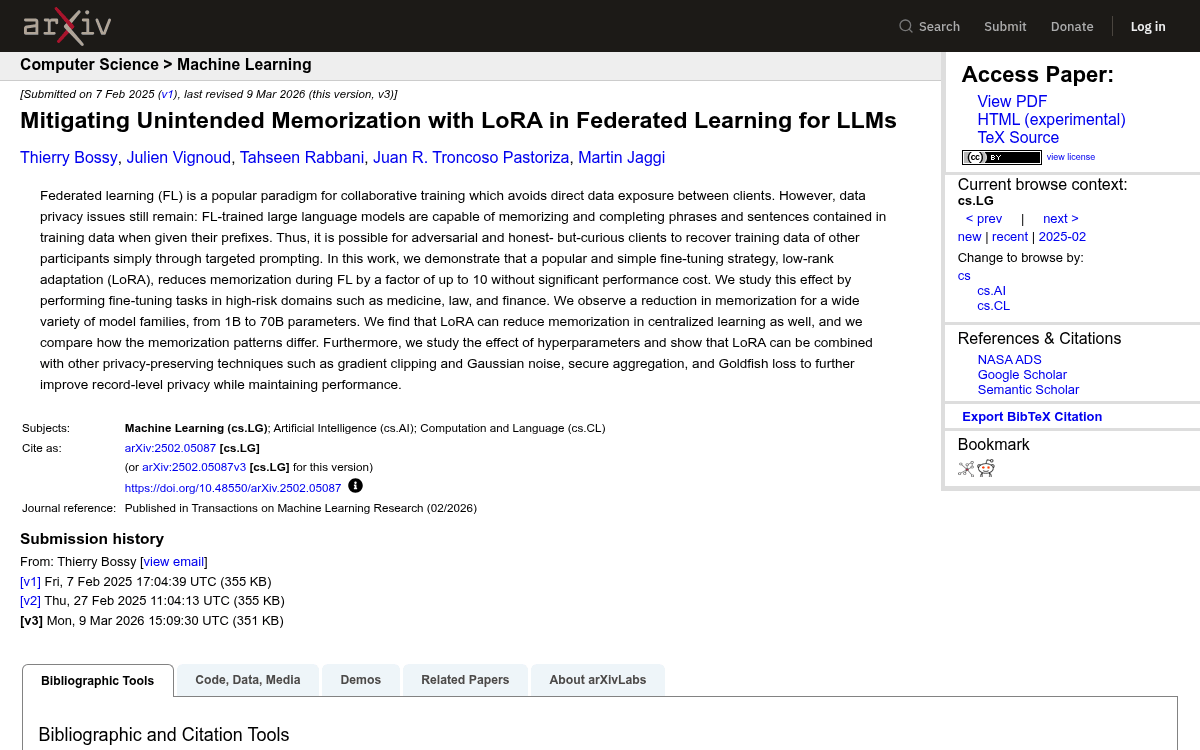
Researchers from EPFL and Tune Insight show LoRA cuts LLM memorization by up to 10x in federated learning, with no meaningful accuracy loss across models up to 70B parameters.
 Pro
Takeaways
- Core finding: LoRA reduces LLM memorization in federated learning by up to 10x with negligible accuracy loss, tested on models from 1B to 70B parameters.
- The threat: FL-trained LLMs can regurgitate sensitive training data (e.g., patient records) when prompted with a prefix, even without any special attack.
- Rank matters most: LoRA rank 16 keeps memorization near zero even with 10x data duplication; rank 64+ starts behaving like full fine-tuning.
- Stacking works: Combining LoRA with Goldfish loss, gradient clipping, or FHE-based secure aggregation further reduces memorization with minimal overhead.
- Why it works: LoRA acts as a regularizer by ignoring minor data components, and mathematically approximates DP-SGD, providing implicit noise-like privacy benefits.
- Code released: Full reproduction code available at github.com/tuneinsight-collab/FederatedLLMs; paper on arXiv.
Federated learning (FL) was supposed to be the privacy-safe way to fine-tune large language models on sensitive data. Multiple organizations pool their knowledge without ever sharing raw records. But there is a catch that has been quietly growing: the resulting model still memorizes training data, and any participant with API access can extract it just by prompting the model with a prefix from someone else's dataset. A new paper from EPFL and Tune Insight shows that a fix may already be in your toolkit.
The leak that FL does not stop
The threat model is straightforward. In federated learning, multiple clients collaboratively train models while keeping their data decentralized. Despite these privacy-preserving mechanisms, LLMs can still memorize and regenerate specific phrases or sentences from the training data, and adversarial users could exploit prompt-based attacks to extract sensitive information from the model. The attack does not require gradient inversion or any exotic technique. An attacker with access to the full prefix of a training sample can query the LLM to regenerate the exact suffix. In a hospital consortium fine-tuning a shared model on patient records, that means one hospital could, in principle, reconstruct another hospital's clinical notes.
The problem is especially sharp in high-stakes domains. There is significant interest in fine-tuning LLMs on specialized domains such as medicine and finance, and these fields handle inherently sensitive user data, necessitating additional mechanisms to prevent data exposure. Previous defenses have leaned on differential privacy (DP), but both prior works evaluated the performance of LoRA in FL combined with DP and found non-trivial performance losses even for high privacy budgets. There is also a deeper conceptual problem: applying DP to natural language is philosophically murky, because it is unclear where one person's "secret" ends and shared context begins.
LoRA as an accidental privacy shield
Low-Rank Adaptation (LoRA) was designed for efficiency, not privacy. The core idea is simple: instead of updating every weight in a model during fine-tuning, LoRA freezes the pre-trained weights and injects trainable, low-rank matrices into the layers of the network. The weight update is represented as a product of two small matrices A and B, where the rank r is much smaller than the original dimensions. During adaptation, the original weights remain frozen and only the low-rank factor matrices are trainable. In practice, the authors achieved a 130-fold reduction in the number of parameters exchanged between FL participants per round.
The paper's central finding is that this efficiency trick has a meaningful privacy side effect. Fine-tuning federated LLMs with LoRA displays lower memorization than full fine-tuning across all metrics and models, and LoRA fine-tuning can reduce memorization up to 10x for a negligible accuracy loss. This holds across model families from 1B to 70B parameters, and across medicine, law, and finance datasets.
How they measured it
The team used a rigorous "canary" methodology, borrowed from the security literature. They injected real patient records from the i2b2/UTHealth 2014 clinical notes corpus (1,304 longitudinal records covering 296 patients) into the fine-tuning data, then measured how often the model could complete those records when given only a prefix. To stress-test the setup, 30% of records were duplicated ten times, since data duplication is known to dramatically amplify memorization.
Two metrics were tracked:
- Exact token match rate: did the model reproduce the suffix verbatim?
- BLEU score (> 0.75 threshold): did the model produce a close paraphrase? This catches subtler memorization that exact matching misses.
The experimental setup was a cross-silo FL scenario with three clients, each holding one of three medical QA datasets (MedMCQA, PubMedQA, Medical Meadow Flashcards), trained for five federated rounds. Models were evaluated on five downstream medical benchmarks to ensure privacy gains were not coming at the cost of performance.
What the numbers show
The results are consistent across the board. With full fine-tuning in FL, even without data duplication, models show alarming memorization rates. LoRA cuts those rates dramatically. The rank hyperparameter is the key lever:
| LoRA Rank | BLEU (no duplication) | BLEU (10x duplication) | Accuracy |
|---|---|---|---|
| 4 | 0.013 | 0.020 | 0.509 |
| 16 | 0.017 | 0.062 | 0.512 |
| 64 | 0.026 | 0.379 | 0.511 |
| 128 | 0.031 | 0.511 | 0.510 |
| 256 | 0.035 | 0.581 | 0.542 |
| 1024 | 0.041 | 0.623 | 0.530 |
A rank of 16 (the common default) keeps BLEU memorization near zero even with heavy duplication, while matching full fine-tuning accuracy. Rank 64 and above starts to behave more like full fine-tuning from a privacy standpoint. Early stopping during LLM training not only improves efficiency, but also helps privacy by reducing the risk of memorization.
FL and LoRA are synergistic, not redundant
One of the more nuanced findings is that federated learning and LoRA reduce memorization through different mechanisms, and they stack. FL's non-IID data distribution means each client trains on a different domain, so the global model never sees any single record enough times to lock it in. LoRA's low-rank constraint acts as a form of regularization, preventing the model from fitting the minor singular components of the data that carry idiosyncratic, memorizable details.
The paper also compares FL versus centralized learning (CL) directly. LoRA fine-tuning consistently follows a more privacy-preserving trend, with lower memorization scores compared to full fine-tuning at similar utility levels. FL adds another layer on top: memorization scores are consistently lower in FL than in CL for the same fine-tuning method, confirming that the two approaches address different parts of the problem.
Interestingly, not all models behave the same. Llama 2 7B shows a dramatic improvement with LoRA, while Mistral v0.3 7B (same parameter count) shows a smaller gap. The authors hypothesize this is due to architectural differences, specifically Mistral's sliding window attention versus Llama's standard multi-head attention, but leave a formal analysis for future work.
Stacking additional defenses
LoRA does not fully eliminate memorization on its own, so the paper also tests combinations with other techniques:
- Goldfish loss: randomly drops tokens from the training objective to prevent verbatim reproduction. Combined with LoRA, it achieves lower memorization than either technique alone.
- Gradient clipping: a clipping value of 0.0001 substantially reduced memorization and improved accuracy, even without adding noise. This is notable because gradient clipping alone provides no formal DP guarantee.
- Secure aggregation: the team implemented a protocol using Fully Homomorphic Encryption (FHE) and Secure Multiparty Computation (SMPC) via the Lattigo library. Encrypting LoRA updates (roughly 24.7M parameters for a 3B model) adds only 11 seconds of overhead per aggregation round, negligible compared to local training time.
- NEFTune (adding noise to embeddings during training): did not improve memorization when combined with LoRA, suggesting LoRA's regularization already covers that ground.
Why does LoRA actually reduce memorization?
The theoretical picture is still incomplete, but the paper offers two compelling hypotheses. First, LoRA acts as a regularizer: by restricting weight updates to a low-rank subspace, it ignores the minor principal components of the data, which are the noisy, idiosyncratic parts most likely to cause overfitting onto specific training examples. Second, recent work shows that LoRA secretly approximates DP-SGD: training with LoRA is mathematically similar to training with noisy batch gradients, where the noise variance decreases as rank increases. This provides an intuitive explanation for why lower ranks mean less memorization.
What this means in practice
The practical implications are significant for anyone building on sensitive data. If you are already using LoRA for efficiency (which most people are), you are getting a meaningful privacy benefit for free. The key recommendations from the paper:
- Use rank 16 or lower for maximum privacy. Rank 4 shows near-zero memorization even with 10x data duplication.
- Apply early stopping. Memorization increases monotonically with training steps, and the model often hits peak accuracy before memorization becomes severe.
- Combine with Goldfish loss if you need an extra margin, especially when data duplication is unavoidable.
- Secure aggregation adds strong guarantees with minimal overhead when using LoRA's compact updates.
The full code and reproduction instructions are available on GitHub. The work was reviewed on OpenReview and the paper is on arXiv. One important caveat: the study is limited to cross-silo settings with three clients. Whether these findings hold at cross-device scale, with millions of participants, remains an open question.