
EPFL Ditches 20-Year-Old Salamander Robot Playbook for Pure Reinforcement Learning
EPFL's Biorobotics Lab trained a single neural policy that directly commands every joint of a salamander robot, replacing decades of central pattern generator control.
 Pro
Takeaways
- EPFL's Biorobotics Lab replaces central pattern generators with a single RL policy that directly commands all salamander joints.
- PPO trained in MuJoCo Playground for 1.5 hours on one RTX 4070, 300M steps.
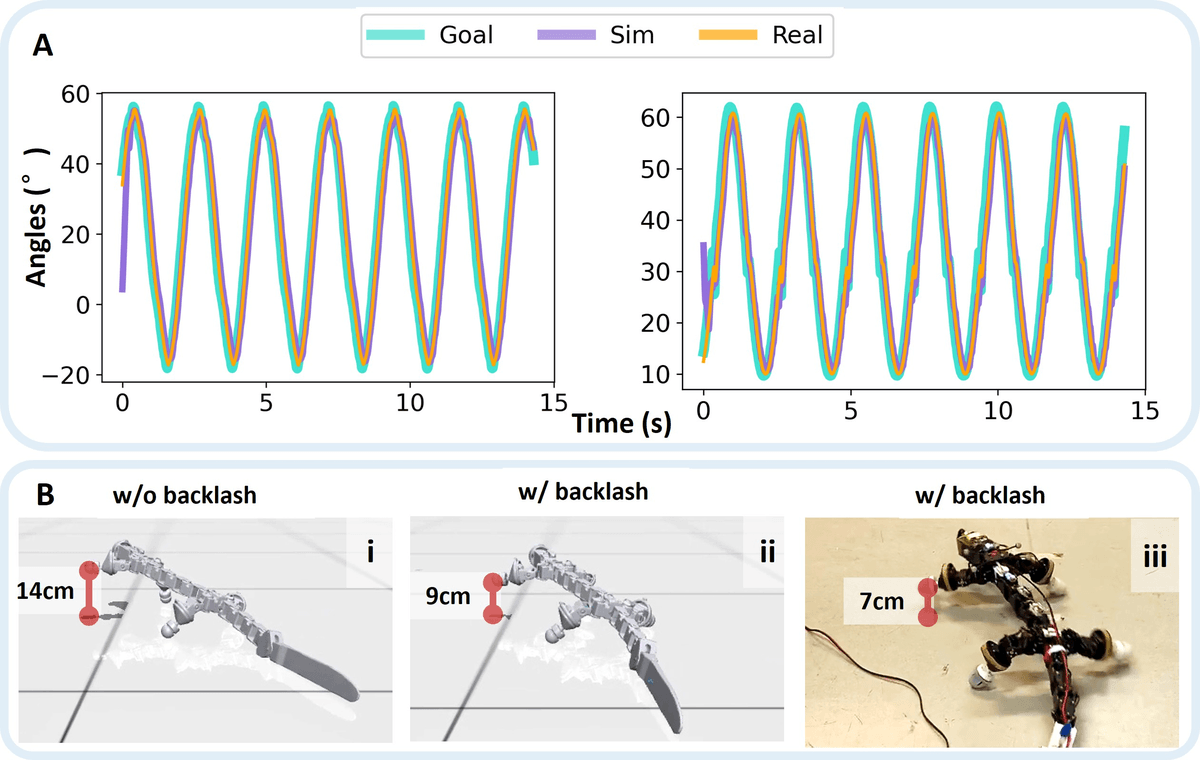
- Sim-to-real works by modeling servo dynamics, injecting real-data noise, and adding passive DoFs to simulate mechanical backlash.
- Real robot walks flat, cobblestone, grass, sand, and 25° slopes at up to 0.23 m/s onboard a Pi Zero 2W.
- A unified policy transitions from walking to swimming in simulation using a binary land/water observation flag.
- Paper does not release code; hardware amphibious transition is future work.
For nearly two decades, salamander robots have been the poster child of biologically inspired locomotion. The classic recipe, pioneered by Auke Ijspeert's group at EPFL, uses central pattern generators (CPGs), networks of coupled oscillators that mimic the spinal circuits animals use to produce rhythmic movement. The same lab has now thrown that playbook out, training a single reinforcement learning policy to command every joint directly, and getting the robot to walk in the real world.
The paper, Learning Whole-Body Control for a Salamander Robot, matters because salamander-like machines have long resisted the end-to-end RL treatment that transformed quadruped control on platforms like ANYmal and Spot. The authors map proprioceptive observations and commanded velocities to joint-level actions, use a system-level real-to-sim matching and sim-to-real transfer strategy, and achieve stable, coordinated walking on both flat and uneven terrain.
Why salamanders break the usual RL recipe
A quadruped has four legs and a mostly rigid trunk. A salamander robot has four legs plus a long articulated spine and a tail, and its body actively contributes to propulsion by undulating. Locomotion emerges from tightly coupled whole-body dynamics where axial bending, limb stepping, and ground contact all interact.
Designing model-based controllers for that becomes intractable as the degree-of-freedom count grows, which is why prior work leaned on CPGs. Those oscillators constrain the policy to modulate a handful of parameters, capping the range of achievable behaviors. Previous learning-based salamander work still kept a trajectory generator or CPG in the loop, with the neural network only tweaking phase parameters rather than issuing raw joint commands.