
ENS-PSL Cracks Why Deep Networks Generalize Without Explicit Regularization
A new theoretical framework identifies when high dimensional gradient flow can be compressed into a lower dimensional Riemannian flow, extending implicit bias analysis to deep ReLU networks and infinitely deep linear networks.
 Pro
Takeaways
- New criterion characterizes when gradient flow admits an intrinsic lower dimensional Riemannian dynamic on a lifted variable.
- Applies to any depth DAG ReLU network under the path-lifting parametrization, for a dense set of initializations.
- Generalizes balanced initialization for linear networks to a broader relaxed balanced class parameterized by λ·Id.
- Provides first closed-form intrinsic dynamics for a 3-layer ReLU MLP with scalar input and output.
- Derives explicit metric for infinitely deep linear networks (linear neural ODEs) under relaxed balanced initialization.
- Numerical illustrations and code available on GitHub.
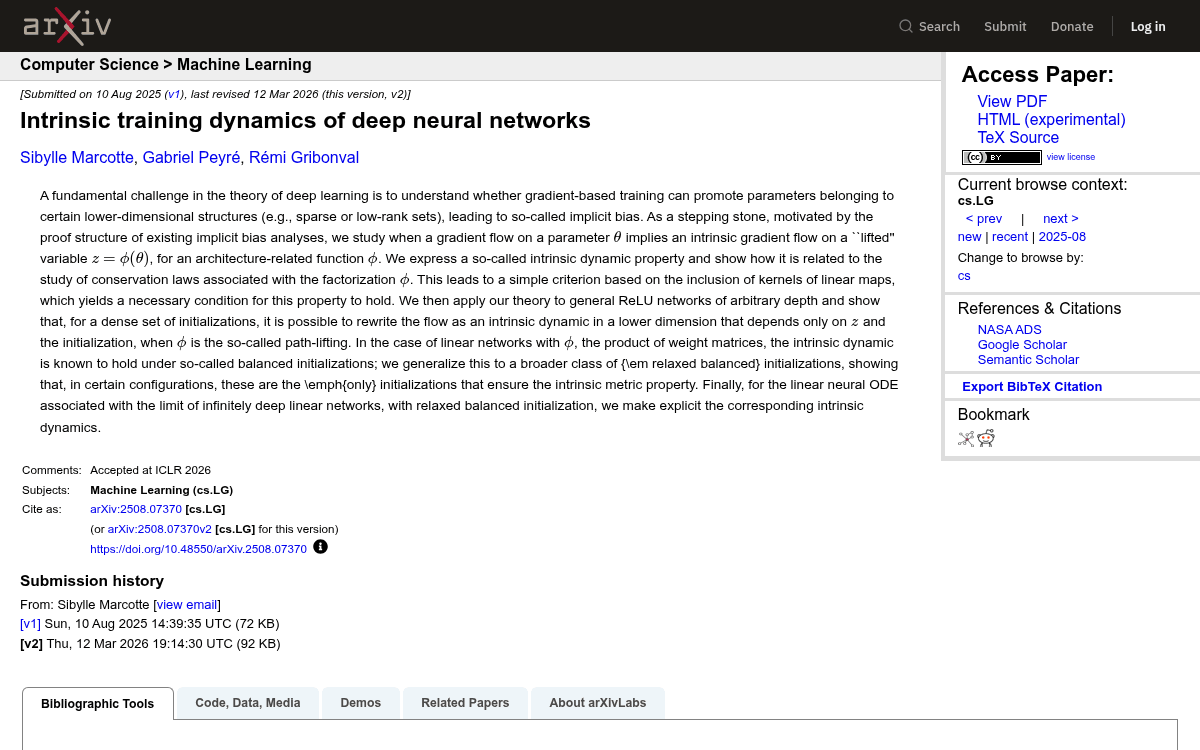
One of the persistent mysteries of deep learning is why gradient descent, applied to wildly overparameterized networks, still produces models that generalize. The favorite explanation is implicit bias: the training dynamics themselves prefer low complexity solutions like sparse or low rank ones. Proving that rigorously is hard, and a new paper from ENS-PSL and Inria tightens the mathematical machinery needed to do it.
The paper by Sibylle Marcotte, Gabriel Peyré, and Rémi Gribonval asks a precise question: when can a gradient flow on the raw parameters be rewritten as a gradient flow on a smaller, more meaningful variable that captures the network's structure? The answer determines whether existing implicit bias tooling applies to a given architecture.
The missing rung on the implicit bias ladder
Most implicit bias proofs follow a two step recipe. First, show that the dynamics of some lifted variable z = φ(θ), where φ encodes the architecture, can be written as an intrinsic Riemannian gradient flow whose metric depends only on z and the initialization. Second, show that this flow is a mirror flow, unlocking convex analysis tools that yield explicit characterizations of what the training converges to.
A 2022 result by Li, Wang, Lee, and Arora gave sufficient conditions for both steps, but required the reparametrization φ to be commuting, a condition that essentially never holds outside of diagonal networks. Prior work by the same authors (Abide by the Law and Follow the Flow) introduced conservation laws: quantities preserved along any gradient flow trajectory regardless of the loss or dataset, which pin the trajectory to a lower dimensional manifold determined by the initialization.
Kernels, Lie brackets, and a cleaner criterion
The new work fills in the first rung of the ladder under much weaker assumptions. It defines three nested properties: intrinsic recoverability (the parameters can be fully reconstructed from z and the initialization), intrinsic metric (the metric matrix M(θ) = ∂φ(θ)∂φ(θ)ᵀ can be written as a function of z alone), and intrinsic dynamic (the flow on z is autonomous).
The central technical contribution is a simple, checkable criterion. Intrinsic recoverability holds if and only if
ker ∂φ(θ) ∩ ker ∂h(θ) = {0}where h collects the conservation laws. The authors show this is nearly equivalent to the Frobenius property, a condition from geometric control theory that is strictly weaker than the involutivity condition used in earlier work, and much weaker than commuting.
What this unlocks for ReLU and linear networks
The payoff comes from applying the criterion to concrete architectures. Under the path-lifting parametrization from Gonon et al., the intrinsic recoverability property holds for any DAG ReLU network of arbitrary depth, including skip connections and mixes of ReLU, linear, and max-pooling activations, and for a dense set of initializations. That's a significant generalization of the previous two-layer result.
- For deep ReLU networks, the paper proves the m canonical conservation laws (one per hidden neuron) are exhaustive on a dense open set of parameters.
- For a 3-layer ReLU MLP with scalar input and output, they derive the first closed-form intrinsic dynamics, involving a coupled fixed-point system that admits a unique positive solution via a Banach contraction argument.
- For deep linear networks, the balanced initialization condition (U_{i+1}ᵀU_{i+1} = U_i U_iᵀ) is generalized to relaxed balanced: U_{i+1}ᵀU_{i+1} − U_i U_iᵀ = λ_i·Id. This broader class still yields an intrinsic dynamic.
- For two-layer linear networks, relaxed balanced initializations are shown to be the only ones satisfying the intrinsic metric property when the rank is at most max(n, m), making the condition tight.
- For the infinite depth limit (linear neural ODEs), the authors derive an explicit closed-form for the intrinsic metric, which the finite depth case lacks beyond two layers.
The concrete formulas
Under the relaxed balanced condition with parameter λ, a two layer linear network of shape (n, r) × (m, r) evolves as
Ż = -Π_Z [λ/2·Id + (1/2)√(λ²·Id + 4ZZᵀ)] ∇f(Z)
     - ∇f(Z) Π_{ZᵀZ} [-λ/2·Id + (1/2)√(λ²·Id + 4ZᵀZ)]
which recovers the classical balanced formula of Arora, Cohen, and Hazan when λ = 0. For the infinite depth linear residual network with relaxed balanced initialization λ(s), the paper gives an integral formula for Ż₁ involving fractional powers of ZZᵀ and ZᵀZ weighted by an explicit kernel exp(γ(s)).
What this is and isn't useful for
This is a theory paper. It does not propose a new optimizer, architecture, or training trick. What it does is extend the mathematical foundation on which implicit bias proofs are built, closing the gap between two-layer results and the deep DAG networks people actually train. Researchers working on implicit regularization, low rank matrix factorization, or the geometry of transformer optimization now have a criterion to check whether their setup admits an intrinsic dynamic, and if so, what its metric looks like.
Practical limits are worth naming. The results apply to gradient flow, not discrete SGD with noise, momentum, or weight decay. The linear network analysis leaves open the case r > max(n, m). And the mirror flow step, which is what actually yields sparsity or margin conclusions, is not addressed here; the paper explicitly frames itself as a stepping stone toward warped mirror flow analyses of real architectures.
Code and numerical illustrations of the different intrinsic metric regimes are available in the authors' GitHub repository, and the paper is also mirrored on Inria HAL.