
Emory Used Reddit to Reveal Why Patients Prefer Ketamine Over SSRIs
A DeBERTa-v3 classifier fine-tuned on SMM4H data plus LLM augmentation maps how 3,480 Reddit users talk about depression medications
 Pro
Takeaways
- Emory team analyzed 5,059 Reddit posts referencing treatment-resistant depression across 28 subreddits from 2010 to 2025
- Fine-tuned DeBERTa-v3 on SMM4H 2023 therapy sentiment data, hitting 0.800 micro-F1 versus 0.778 shared-task top
- LLaMA3-70B generated 4,445 synthetic minority-class tweets to fix class imbalance in training data
- Overall Reddit sentiment: 72.1% neutral, 14.8% negative, 13.1% positive across 23,399 medication mentions
- SSRIs and SNRIs skewed negative; ketamine and esketamine skewed favorable and dominated mention volume
- No code released, but the pipeline is reproducible from public SMM4H data, DeBERTa-v3, and LLaMA3
Randomized trials tell you whether a drug works. They rarely tell you what it feels like to take one for years. A new study from Emory University tries to close that gap by pointing an aspect-based sentiment classifier at more than a decade of Reddit posts written by people with treatment-resistant depression, quantifying how patients actually talk about the medications prescribed to them.
The authors curated 5,059 Reddit posts explicitly referencing TRD, extracted 23,399 medication mentions across 81 generic drugs, and scored each mention as positive, neutral, or negative. The headline finding: conventional SSRIs and SNRIs skew negative in patient chatter, while ketamine and esketamine skew favorable, mirroring the clinical excitement around rapid-acting NMDA-pathway drugs.
Why patient chatter matters for TRD
Treatment-resistant depression is the label given when someone with major depressive disorder fails to reach remission after two or more adequate antidepressant trials. Roughly one third of MDD patients fall into this category, which pushed the field toward glutamatergic options like ketamine after abnormalities in glutamate transmission were tied to antidepressant response. Clinical trials establish efficacy, but they are short, small, and often miss the tolerability signals that drive real-world adherence. Reddit, with its long, unfiltered first-person threads, is one of the few places where that signal accumulates at scale.
Building the pipeline
The corpus was scraped from 28 mental health-related subreddits between 2010 and 2025, filtered to posts that explicitly mention TRD. From there, 3,839 posts contained at least one medication, producing 23,399 mentions of 81 generic drugs after a lexicon-based normalization pass that folded brand names, misspellings, and colloquialisms into canonical forms.

Building that normalization lexicon is where the LLM earns its keep. Rather than hand-curating every way a Redditor might mangle "venlafaxine" or refer to Spravato instead of esketamine, the authors used a language model to generate candidate spelling variants and colloquial aliases for each generic drug, then filtered them into a lookup table.
The classifier and the augmentation trick
For sentiment, the team fine-tuned DeBERTa-v3-base on the SMM4H 2023 Task 2 corpus, a shared task that asks systems to classify tweets as expressing positive, negative, or neutral sentiment toward a specific therapy. The dataset is heavily skewed: of the labeled tweets, 998 (18.6%) are positive, 619 (11.5%) are negative, and 3,747 (69.9%) are neutral, which makes the minority classes hard to learn.
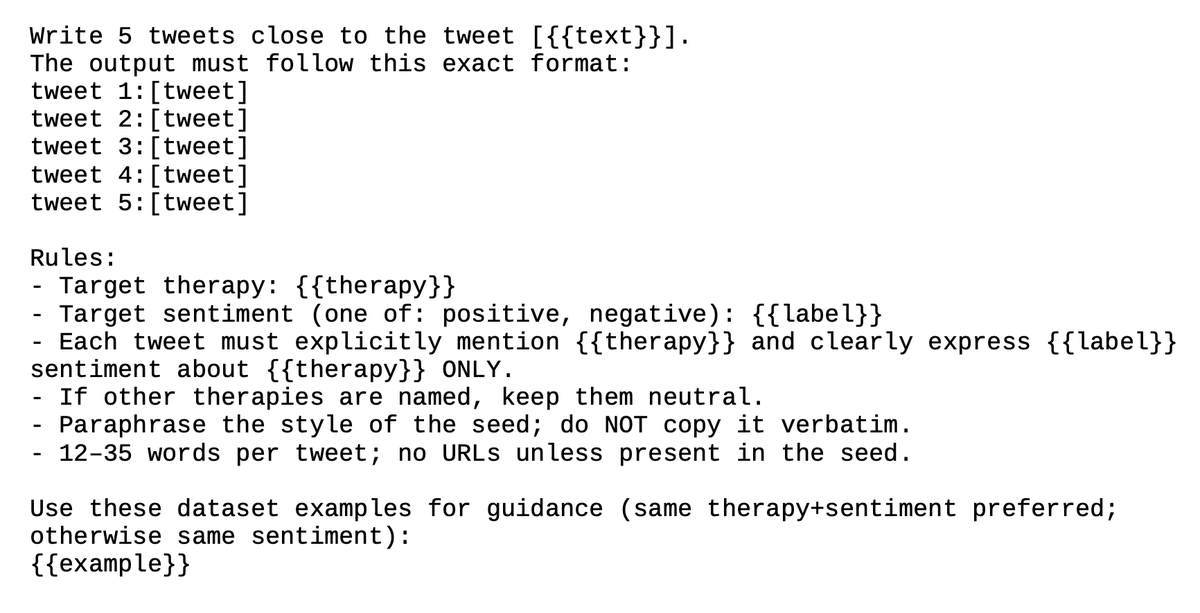
To fix the imbalance, they generated synthetic minority examples with LLaMA3-70B-Instruct. For each positive or negative training post, the model was prompted few-shot to produce five synthetic posts that preserved the same target therapy and the same sentiment toward it while keeping other therapies neutral, yielding 4,445 synthetic tweets (2,850 positive, 1,595 negative) and an augmented training set of 7,454 tweets. The test set was untouched.
The payoff was measurable. The augmented DeBERTa-v3-base hit a micro-F1 of 0.800 (95% CI 0.780 to 0.820), beating the top system reported in the shared task overview (0.778), with class-specific F1 of 0.467 negative, 0.874 neutral, and 0.636 positive. That is a modest but real gain over the shared-task leader, and the balance across classes matters more than the headline number when the goal is to characterize minority sentiment.
What the Reddit data actually says
Applying the classifier to the full corpus gave a picture that clinicians will find both familiar and uncomfortable. Overall, 72.1% of medication mentions were neutral, 14.8% negative, and 13.1% positive; conventional SSRIs and SNRIs showed consistently higher negative than positive proportions, whereas ketamine and esketamine exhibited comparatively more favorable sentiment profiles with positive mentions approximating or slightly exceeding negative mentions.
Drilling into specific drugs, the negatively skewed medications were concentrated in first-line antidepressant classes, particularly SSRIs (citalopram, fluvoxamine), an SNRI (venlafaxine), and the atypical antidepressant vilazodone. Ketamine and esketamine were also the most frequently discussed drugs overall: rapid-acting glutamatergic NMDA-receptor antagonists dominated both mention counts and unique-subscriber reach, suggesting they occupy a central place in contemporary TRD peer discussions.
What it is good for, and where it breaks
The obvious use case is pharmacovigilance and market research that goes beyond spontaneous adverse-event reports. A pipeline like this can:
- Surface tolerability complaints for specific drugs before they show up in registries
- Track sentiment shifts around new approvals or label changes over time
- Compare patient-perceived experience across drug classes without running a survey
- Feed patient-reported outcome signals into comparative-effectiveness research
The limitations are equally clear. Reddit users are not a representative sample of TRD patients, and self-selection into peer-support forums tilts toward people who are struggling, which likely inflates negative sentiment for first-line drugs that people abandon before finding what works. Intranasal esketamine is FDA-approved not only for TRD but also for depressive symptoms in adults with MDD with acute suicidal ideation or behavior, so a subset of esketamine-related discussion may reflect indication overlap rather than TRD specifically. And the negative-class F1 of 0.467 means roughly half of negative mentions are still being misclassified, so drug-level ratios should be read as directional rather than precise.
The paper does not release code or a model checkpoint, but the recipe is reproducible from public parts: SMM4H 2023 data, DeBERTa-v3, LLaMA3-70B for augmentation, and a lexicon built with prompted LLM calls. For anyone working on health-related social media mining, the interesting takeaway is less the sentiment scores and more the demonstration that LLM-generated minority-class examples can push a fine-tuned encoder past a shared-task leaderboard without any new human labels.