
Emory's BabyReasoningBench Tests Tiny AI Models Like Toddlers, Not Adults
A new benchmark borrows 19 tasks from developmental psychology to test what reasoning actually emerges in tiny models trained on child-directed speech.
 Pro
Takeaways
- New benchmark BabyReasoningBench tests small LMs using 19 classic developmental psychology paradigms.
- Tasks span theory of mind, analogies, causal inference, transitive inference, and conservation.
- Questions were generated by GPT-5.2 from templates, with 11 variants each, then hand-validated.
- Two GPT-2 BabyLM baselines score 52% and 54% on average, with wide task-level swings.
- Scaling helps physical and causal tasks but hurts causal structure learning and pretend-syllogisms.
- Code available at github.com/kaustubhdhole/baby-reasoning-bench.
Most reasoning benchmarks assume the model on the other end has read the internet. That's a bad fit for so-called baby language models, which are pretrained on the kind of input a toddler might actually hear: caregiver speech, simple stories, and picture-book narratives. BabyReasoningBench proposes a different yardstick, borrowing 19 classic experimental paradigms from developmental psychology to ask which reasoning abilities can plausibly emerge from a child-sized diet of text.
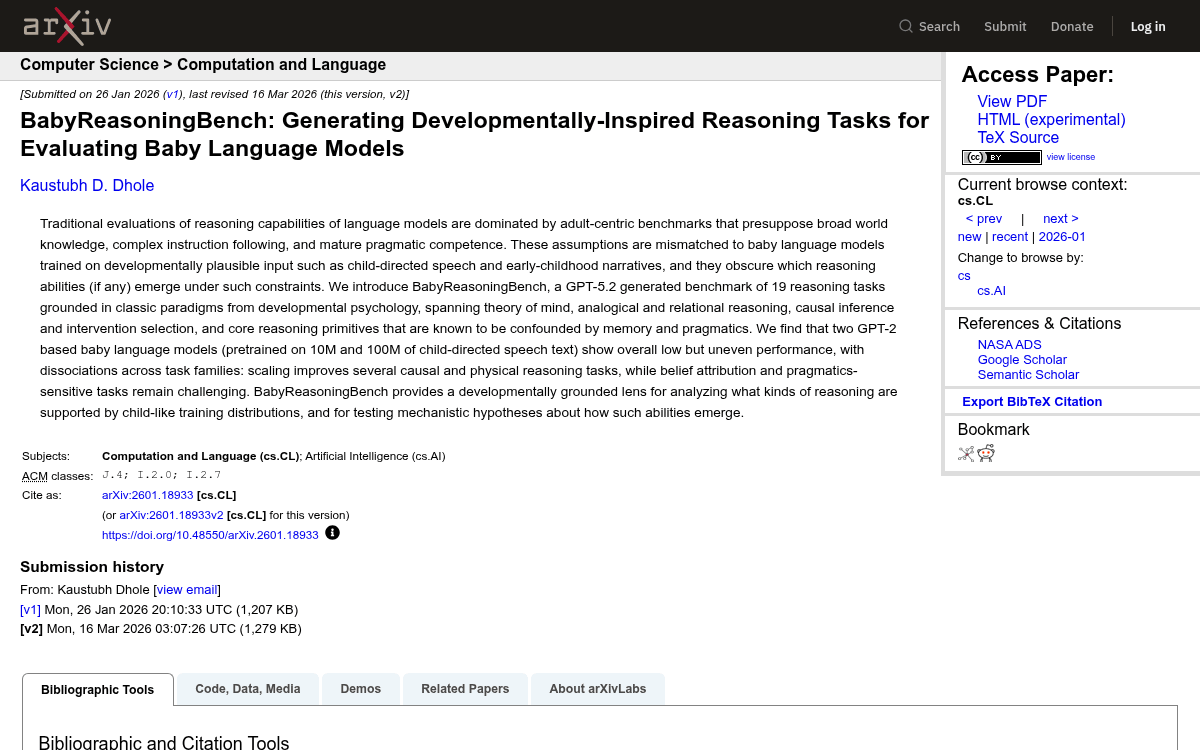
The paper, from Kaustubh D. Dhole at Emory, argues that traditional evaluations of language models are dominated by adult-centric benchmarks that presuppose broad world knowledge, complex instruction following, and mature pragmatic competence, assumptions mismatched to baby language models trained on developmentally plausible input such as child-directed speech. That mismatch obscures what small, developmentally trained models can actually do.
Why adult benchmarks miss the point
The BabyLM program has pushed the field toward sample-efficient pretraining on corpora sized like a child's cumulative language exposure (roughly 10M or 100M words, often drawn from resources like CHILDES). But once you have such a model, testing it on MMLU or GSM8K is close to meaningless. What you want is something closer to what psychologists use with three-year-olds: false-belief tasks, blicket detectors, transitive inference, and conservation problems.
These paradigms have a useful property: many of them are specifically designed to disentangle reasoning from confounds like working memory, pragmatic misinterpretation, or inhibitory control. A model that fails on a class-inclusion question ("are there more dogs or more animals?") may not lack the underlying concept, it may be tripping on the wording, the same way young children do.
Nineteen tasks, generated then hand-checked
The benchmark spans four families:
- Theory of mind and belief attribution: Sally-Anne, unexpected transfer, vignette batteries, and violation-of-expectation variants that infants pass nonverbally.
- Analogical and relational reasoning: causal analogies like melting chocolate versus melting snowmen, story-analogy relational shifts, and problem-solving transfer.
- Causal inference and intervention: blicket-detector inference, Bayes-net-style structure learning, and exploratory play under confounded evidence.
- Core primitives: transitive inference, counterfactual reasoning, category-based induction, class-inclusion wording, control of variables, and conservation under accidental versus intentional transformations.
Construction is deliberately mechanical. The author first provides GPT-5.2 with a template containing the 19 tasks including a brief description, and instructs it to generate one multiple-choice question per task. After manually validating these seed questions, GPT-5.2 is prompted to produce 10 additional variants for each seed, yielding 11 questions per task. Every item is then reviewed and edited by hand. The variants exist to blunt the effect of any single phrasing, which matters because small models are famously sensitive to surface form.
Scoring uses the standard likelihood trick: for each choice, concatenate it with the question, sum the log-probabilities of the answer tokens under the model, and pick the highest. There is a light effort to keep option lengths comparable so the perplexity comparison is not just a token-count race.
What the baby models actually do
Two BabyLM baselines based on GPT-2, pretrained on 10M and 100M tokens of child-directed text respectively, were run through the benchmark. Averages land at 52.15% for the 10M model and 53.59% for the 100M model, essentially flat, but the task-level picture is far more interesting.

Scaling from 10M to 100M produces sharp gains on some tasks and outright regressions on others:
- Physical cause-effect jumps from 63.64% to a perfect 100%.
- Simple counterfactual causal reasoning climbs from 18.18% to 63.64%.
- Analogical problem solving moves off the floor, 0% to 36.36%.
- Causal structure learning collapses the other way, from 81.82% down to 18.18%.
- Counterfactual syllogism in pretend contexts drops from 63.64% to 9.09%.
Belief attribution sits in an interesting middle zone. Both models are clearly above chance on explicit false-belief items (Sally-Anne holds at 63.64% for both, the vignette battery reaches 81.82% at 100M), but performance swings widely across formats. The author's summary is that these models can exhibit some belief-sensitive and pragmatics-sensitive behavior, but that such competence is unstable across formats rather than robustly generalized.
The real signal: dissociations, not averages
The headline finding is less "baby models can reason" and more that a bigger training set is not a monotonic win at this scale. Reasoning competence, when it appears, is patchy and format-dependent. That is a familiar story in developmental psychology, where a child who fails a class-inclusion question with one phrasing will pass it with another, and it suggests that similar diagnostic care is warranted for tiny LMs.
For anyone working on data-efficient pretraining, curriculum design, or mechanistic interpretability of small models, the benchmark offers something that BLiMP and GLUE-style probes do not: a way to isolate belief attribution from memory load, or causal-graph induction from surface pragmatics. It is also cheap to run, since everything is multiple choice and scoreable via log-likelihood.
Where it falls short
The author is candid about the limits. Several paradigms lose something in translation to text. Some tasks, like evaluating for analogies and counterfactuals, maintain their essence in textual form, but others, like the Sally-Anne task and the blicket task, may arguably be better assessed with multimodal input, like their behavioral counterparts. The blicket task in particular is reduced to a subset of its original causal-inference space, with no disjunctive or conjunctive variants yet. Nineteen tasks with 11 items each is also a small evaluation set by modern standards, so noise at the task level is real.
Code and the full task list are on GitHub, and the benchmark is positioned as a diagnostic instrument rather than a leaderboard. If you are training small models on developmentally plausible data, or trying to figure out which reasoning abilities actually emerge from constrained input distributions, it is a more honest test than throwing a toddler-sized model at an adult exam.