
Emory Builds LLM-MINE to Unlock Hidden Alzheimer's Signals in Doctor Notes
A prompting-based pipeline pulls Alzheimer's phenotypes out of messy clinical notes, beating dictionary and biomedical NER baselines on unsupervised patient staging.
 Pro
Takeaways
- LLM-MINE uses Gemma-3-12B to extract Alzheimer's phenotypes from unstructured clinical notes without fine-tuning.
- Constrained classification-style prompting maps notes to binary phenotype vectors for downstream clustering and stats.
- Best config hits ARI=0.290 and NMI=0.232, versus 0.011 for QuickUMLS and biomedical NER baselines.
- Few-shot prompting boosted ARI by 46% and NMI by 88% over zero-shot on Phenotype List 2.
- Evaluated on MIMIC-IV with 8.4K CN, 841 MCI, and 8.3K ADRD patients.
- Main weakness: over-broad extraction on family history and neuroimaging categories, dropping kappa to ~0.65.
Most of what clinicians actually observe about a dementia patient never makes it into a neat database column. Memory lapses, word-finding trouble, changes in judgment, driving concerns , these live inside free-text discharge notes, not in ICD codes or lab tables. A new paper from Emory and Northwestern proposes LLM-MINE, a training-free pipeline that uses a general-purpose open-source LLM to pull Alzheimer's-related phenotypes out of those notes and turn them into structured feature vectors usable for clustering and statistical analysis.
Why structured EHR data isn't enough
Alzheimer's Disease and Related Dementias (ADRD) affects more than 6 million people in the U.S. and over 55 million worldwide, and staging patients along the continuum from cognitively normal (CN) to mild cognitive impairment (MCI) to overt dementia depends on subtle behavioral signals. The problem: cognitive assessments and clinician impressions are often documented in free-text notes or ad hoc tools such as handwritten MMSE or MoCA scores rather than stored in consistent structured tabular formats. Prior extraction work leaned on regex rules, UMLS dictionaries, or fine-tuned biomedical transformers like BioBERT , approaches that break when clinical language drifts from the templates they were built on.
How LLM-MINE works
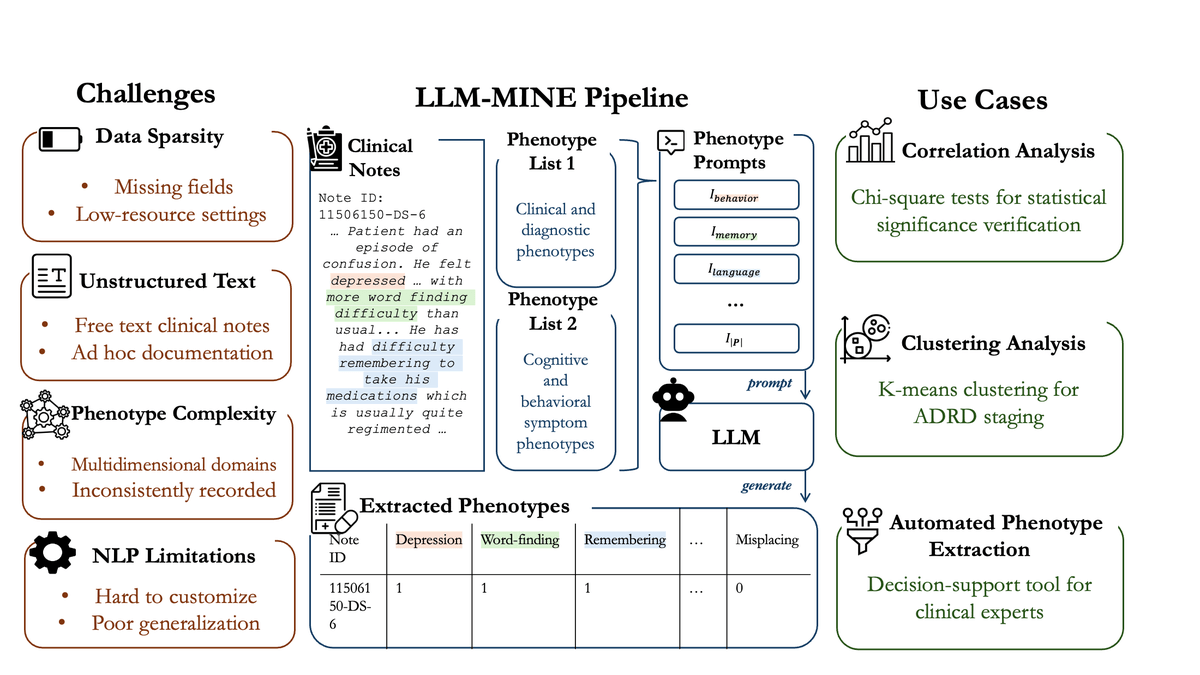
The framework is deliberately simple. It uses gemma-3-12b-it, an instruction-tuned open model, and never fine-tunes it. LLM-MINE directly takes in raw clinical notes without any domain-specific preprocessing, tokenization, or concept normalization. Two expert-built phenotype lists drive extraction:
- Phenotype List 1 , 10 items across memory indicators, comorbidities, family history, neurobehavioral tests, neuroimaging findings, and biomarker results.
- Phenotype List 2 , 27 cognitive-domain items covering memory, executive function, language, visuospatial skills, and behavior.
Because notes routinely blow past the context window, each note is split at sentence boundaries, the model is prompted on each chunk, and the union of results forms the patient's phenotype profile. Crucially, the authors frame extraction as constrained classification rather than open generation: for each phenotype category, the model is instructed to select only from a user-customizable candidate phenotypes defined in the phenotype lists, outputting a comma-separated list of present phenotypes or 'none' if none are mentioned. That kills free-form reasoning, cuts hallucination risk, and makes outputs directly mappable to binary feature vectors. Both zero-shot and three-example few-shot prompts are tested.
The evaluation setup
The cohort comes from MIMIC-IV, a large open source healthcare database that contains information for patients admitted to either emergency department or critical care units. Group labels are derived from ICD-9/10 codes, yielding roughly 8,372 CN, 841 MCI, and 8,327 ADRD patients. Since there are no ground-truth phenotype annotations, the authors evaluate indirectly: chi-square tests for cohort-level significance, K-means clustering (K=2 and K=3) on the extracted binary vectors, and a small human review of 20 notes by three annotators.
What the numbers say
Combining both phenotype lists with few-shot prompting produced the best clustering results, hitting ARI=0.290 and NMI=0.232 at K=2. The gap over baselines is large: under the same K=2 setting, the best method improves ARI from 0.011 to 0.290, NMI from 0.011 to 0.232 versus QuickUMLS and the biomedical-ner-all transformer. Few-shot examples helped consistently , for Phenotype List 2, few-shot prompting improves ARI by 46% and NMI by 88% under K=2.

Some clinical findings pop out of the analysis:
- Memory is the strongest signal. "Recent Events" memory problems appear in 926 of 992 MCI and 973 of 1,000 ADRD patients, compared with only 648 of 1,000 CNs.
- Executive and language features detect impairment but don't stage it. Judgment problems jump from 609 CNs to 943 MCI, then barely move to 967 in ADRD.
- Counterintuitive patterns are clinically real. Driving problems go down as dementia worsens , because those patients stop driving entirely.
- MCI vs. ADRD is genuinely hard. Across most categories, that pairwise comparison is borderline or non-significant, which is why K=2 clustering outperforms K=3.
Where it breaks
Human review exposed the model's main failure mode: over-broad interpretation. For family history, the LLM sometimes extracts family history of any disease, even though the prompt defines this category as ADRD-related family history only, and it similarly flags atrophy or infarct in non-brain organs. Fleiss' kappa dropped to 0.64 and 0.66 on those two categories, versus 1.0 on memory and comorbidities. The authors also flag the ICD-code proxy for cognitive status as noisy, and note prompt sensitivity as an open concern.
Why this matters practically
There's no released code or model weights mentioned in the paper , LLM-MINE is presented as a methodology built on off-the-shelf Gemma 3 rather than a packaged tool. But the recipe is straightforward to reproduce: define a candidate list, wrap it in the constrained classification prompt, chunk long notes, union the results. That makes it a useful template for anyone doing retrospective cohort work on unstructured EHRs, particularly for early-stage detection screening or feature engineering upstream of a risk model. The authors point at Google's MedGemma as the natural next step , a clinically pretrained backbone could tighten up exactly the false-positive categories where a general model currently overreaches.