
Ekimetrics' f-CBM Fixes AI's Hidden Leakage Problem Without Losing Accuracy
A new research paper proposes f-CBM, tackling the long-standing problem of concept leakage in interpretable models by combining a differentiable leakage loss with a Kolmogorov-Arnold Network head.
 Pro
Takeaways
- Researchers from Ekimetrics, Sorbonne, and Télécom Paris introduce f-CBM, a faithful multimodal Concept Bottleneck Model.
- Combines a differentiable KDE-based leakage loss with a Kolmogorov-Arnold Network prediction head on a CLIP backbone.
- Achieves best Pareto trade-off across four datasets (N24News, CUB-200, AGNews, DBpedia) and two CLIP sizes.
- Cuts task leakage by up to 97% versus baselines while keeping accuracy within about 0.5% of a black-box CLIP.
- Only method whose accuracy reliably improves when experts correct concept predictions at inference time.
- Components can be dropped into existing CBM pipelines like CT-CBM and Independent-CBM for large leakage reductions.
A team of researchers from Ekimetrics, Sorbonne Université, and Télécom Paris has published a paper proposing f-CBM, a framework for building Concept Bottleneck Models that work across images and text without sacrificing accuracy for interpretability. It targets one of the most stubborn failure modes in interpretable ML: concept representations that quietly smuggle in information they were never supposed to carry.
The trust problem inside interpretable models
Concept Bottleneck Models (CBMs) are a class of interpretable-by-design networks. Instead of mapping inputs directly to a label, they first predict a set of human-readable attributes (for a bird: wing_color, beak_shape), and then a small classifier uses those attributes to produce the final answer. In principle you can inspect the concepts and understand the reasoning.
In practice, two things go wrong. Concepts must be properly detected, and concept representations must encode only their intended semantics, without smuggling extraneous task-relevant or inter-concept information into final predictions, a phenomenon known as leakage. When leakage happens, the concept layer becomes a covert side channel: the model looks interpretable but is actually reading between the lines. Existing approaches treat concept detection and leakage mitigation as separate problems, and typically improve one at the expense of predictive accuracy.
There is also a coverage gap. CBMs are well-studied in vision and, more recently, in text, but multimodal setups where a model consumes an image and a caption together have been mostly untouched.
What f-CBM actually does
The paper introduces f-CBM, a faithful multimodal CBM framework built on a vision-language backbone that jointly targets both aspects through two complementary strategies: a differentiable leakage loss to mitigate leakage, and a Kolmogorov-Arnold Network prediction head that provides sufficient expressiveness to improve concept detection.

The architecture uses a CLIP backbone. Image and text embeddings are concatenated and fed into a Concept Bottleneck Layer that predicts numerical activations for a set of concepts. Those activations then pass through a Kolmogorov-Arnold Network (KAN) layer that produces the final class prediction.
Two ideas do the heavy lifting:
- A differentiable leakage loss. The team formalizes leakage using mutual information between predicted concepts and task labels. Because standard mutual information estimators use discrete bins that kill gradients, they estimate it with Kernel Density Estimation (essentially fitting smooth Gaussian bumps around each sample), which makes the whole thing trainable end-to-end.
- A KAN prediction head instead of a linear layer. KANs place learnable univariate functions on the edges of the network (rather than fixed activations on nodes), so a single KAN layer can represent non-linear, saturating relationships between a concept and a class. That extra expressiveness relieves the concept layer of the pressure to encode extra signal just so a linear head can classify well.
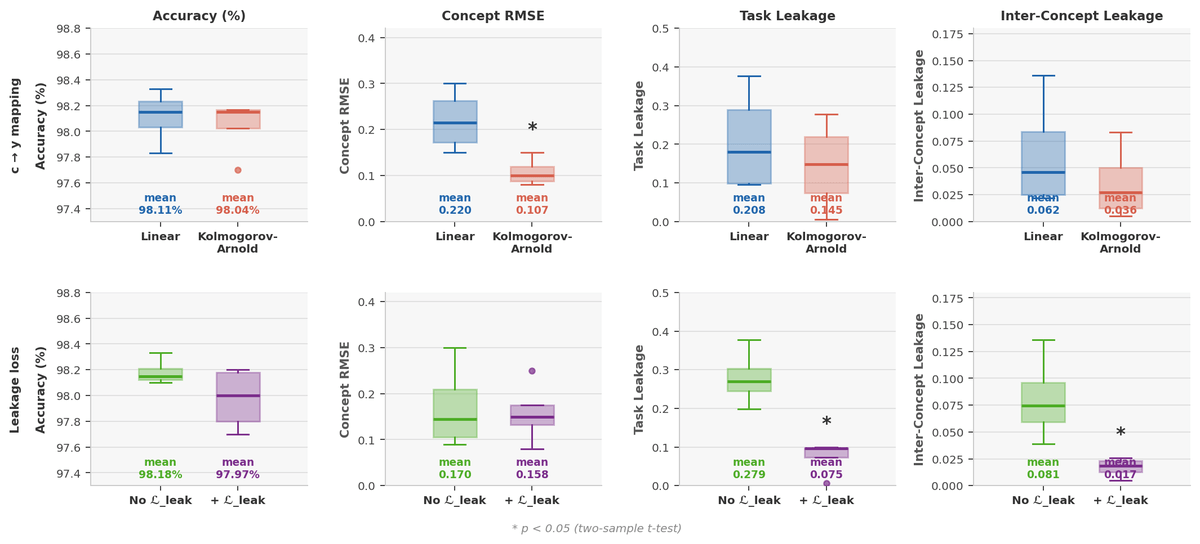
A useful side effect emerges from the preliminary analysis: task leakage and inter-concept leakage tend to co-occur, so explicitly penalizing task leakage reduces the inter-concept variety as well, even though it is never directly targeted in the loss.
How it stacks up on benchmarks
The team evaluated f-CBM on four datasets covering both multimodal and text-only regimes: N24News (news articles with images), CUB-200-2011 (bird classification, with synthetically generated text descriptions), and the text-only AGNews and DBpedia. They compared against three baselines extended to the multimodal setting: Independent-CBM, Label-free CBM, and CT-CBM. Two CLIP sizes were tested, base (110M params) and large (395M).

The headline results:
- f-CBM approximately matches the fine-tuned black-box CLIP accuracy while producing interpretable concept activations. On N24News with CLIP-base, the baseline mCBM hits 98.1% versus 98.5% for the black-box.
- On leakage, f-CBM outperforms every competitor by a large margin. On AGNews with CLIP-large, its concept-task leakage score is 0.004 versus 0.922 for Independent-CBM and 0.207 for Label-free.
- Overall average rank across the four metrics (accuracy, concept RMSE, task leakage, inter-concept leakage) comes in at 1.69 for CLIP-base and 1.88 for CLIP-large, first place across all backbones.
- The KAN head alone drops concept RMSE by about 51% versus a linear layer with almost no change in task accuracy. Adding the leakage loss cuts task leakage by 73% at roughly 0.2% accuracy cost.
The intervention test
The most telling result is the intervention experiment. A faithful CBM should get better when you manually correct wrong concept predictions with ground-truth values before the classifier sees them. If accuracy drops instead, that means the classifier was relying on leaked signal that gets destroyed by the correction.
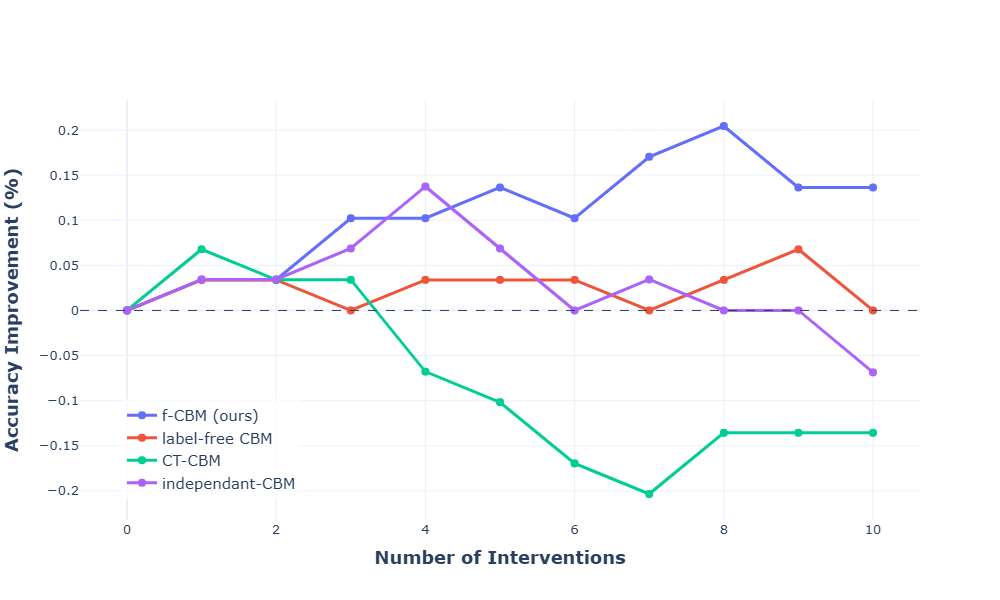
f-CBM is the only method whose accuracy consistently improves as more concepts are intervened on. CT-CBM actually degrades under intervention, exposing the leakage in its bottleneck. Label-free stays flat because its concept detection is too noisy. Independent-CBM plateaus and slightly degrades after a few interventions. That is the practical proof that low leakage scores translate into a model that behaves the way its explanations claim it does.
Where it fits and where it does not
f-CBM is aimed at settings where you need to justify predictions to a human, and where the cost of a plausible-looking but dishonest explanation is high. Multimodal news classification, medical imaging paired with clinical notes, and moderation pipelines all fit that profile. Because the components (leakage loss, KAN head) are drop-ins, the paper also shows they can be bolted onto existing CBM pipelines like CT-CBM and Independent-CBM with substantial leakage reductions.
The limits are worth noting. On CUB-200 with CLIP-base, f-CBM hits 79.3% versus 91.3% for a fine-tuned black-box, so on fine-grained visual tasks with many classes there is still a real accuracy gap. Training also requires concept-annotated data, which the authors bootstrap using Claude and CLIP-based similarity, adding a preprocessing step that generic classifiers do not need. And the KAN response curves, while interpretable, add basis-function machinery that is heavier to tune than a linear head.
The paper does not link to a code release, so anyone wanting to reproduce or extend the approach will be working from the equations in the paper for now.