
Eindhoven Researchers Expose How Cute Robots Deceive Dementia Patients
A scoping review of 26 studies on social robots in dementia care maps which design cues can create false beliefs and proposes a framework to tell deception from harmless anthropomorphism.
 Pro
Takeaways
- Scoping review of 26 studies on social robots for people with dementia, covering 558 participants and 21 robots.
- Identifies three design cue categories that can trigger false beliefs: physiological signs, social intentions, familiar-being mimicry.
- Machine-like cues (plastic, mechanical motion) may serve as useful ethical constraints, not design failures.
- Six recurring user responses: biological attribution, social categorization, mental capacity, roles, empathy, ontological fluctuation.
- Proposes a dual-process definition distinguishing conscious suspension of disbelief from unconscious false belief.
- Flags baby-schema cuteness in robots like Paro and LOVOT as a potential dark pattern for vulnerable users.
When a resident with dementia strokes a robotic seal, calls it hungry, and asks a caregiver to help it sit up, is that a warm moment of engagement, or is the robot deceiving her? A new scoping review from researchers at Eindhoven University of Technology and Northwestern Polytechnical University tries to answer that question rigorously by analyzing every design cue and user response reported across the field.
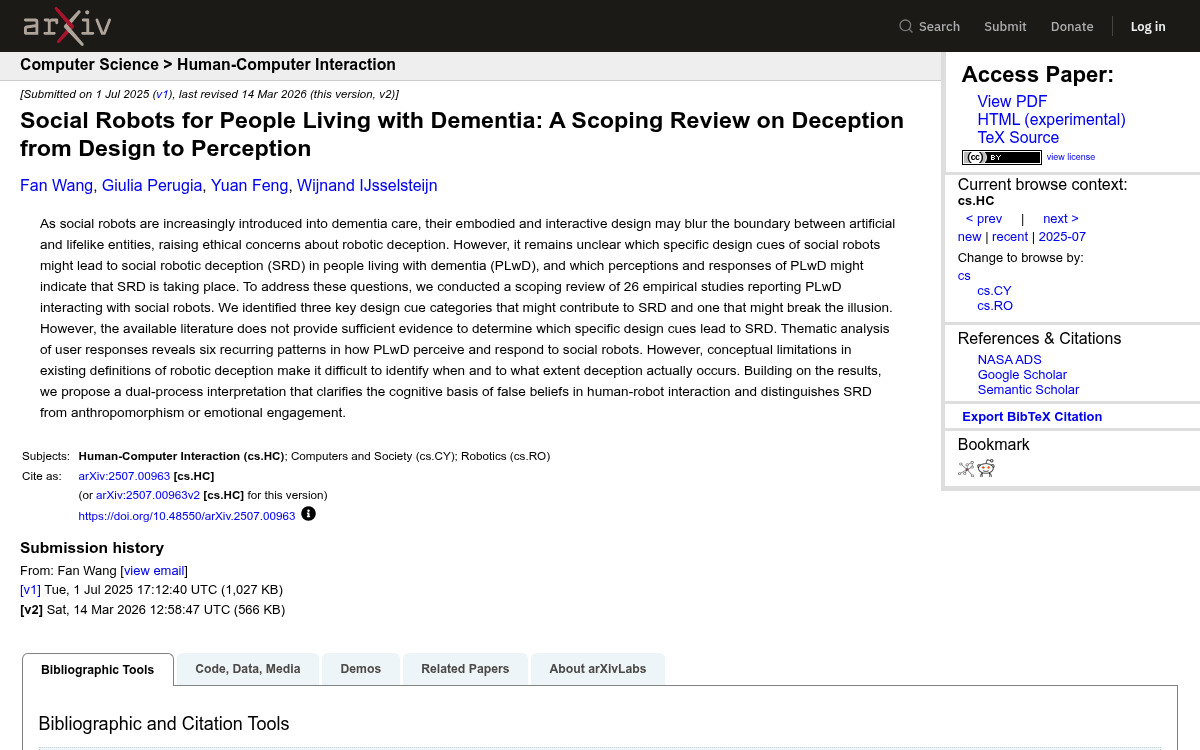
The paper, Social Robots for People Living with Dementia, systematically examines 26 empirical studies covering 558 people living with dementia interacting with 21 different social robots, from Paro and Nao to LOVOT, Telenoid, and JustoCat. The authors then propose a dual-process framework to separate genuine deception from ordinary anthropomorphic engagement.
When lifelike design crosses into misleading users
Social robots are increasingly deployed in dementia care because they demonstrably help. Prior work has shown they can reduce agitation, anxiety, and depression while promoting social engagement. The same features that make them therapeutic, including lifelike movement, cute vocalizations, and responsive gaze, may also create false beliefs in cognitively vulnerable users.
The authors adopt John Danaher's definition of social robotic deception (SRD): a robot creating a misleading impression through its representations or signals. Existing definitions tend to be philosophical and disconnected from what actually happens in interactions, so the team went looking for empirical patterns.
Four categories of design cues that shape belief

After thematic analysis of every robot description in the corpus, the authors grouped design cues into four buckets. Three of them nudge users toward believing the robot is alive:
- Physiological signs. Nao was programmed to slightly undulate when not talking, giving the impression of breathing. Simulated heartbeat and blinking appear in several other robots.
- Social intentions. The JfA Cat and Dog performed playful movements such as rolling on their back to invite interaction, like a real dog or cat.
- Familiar beings. Cat-like purring, seal-like flipper wagging, childlike gestures, female voices. Fourteen of the 26 studies deployed robots making semantic-free speech such as meowing, barking, cooing, or baby crying.
The fourth category does the opposite: mechanical movements, plush toy-like textures, and hard plastic surfaces that quietly remind users the thing is artificial. The authors treat these as potentially valuable ethical design constraints rather than failed realism.
Six ways people with dementia actually respond
Thematic analysis of user responses across studies produced six recurring patterns. People with dementia attribute biological traits (interpreting a switched-off robot as sick or dead), assign social categories like gender and age, attribute mental capacities such as intention and emotion, assign social roles (pet, child, student, companion), and show empathy and caretaking behavior (asking to feed the robot, checking a crying robot's diaper). The sixth pattern, oscillation, matters most for design: one participant's perception of JustoCat shifted from day to day, recognizing it as robotic at times and as a real cat at others, influenced by its behaviors, especially purring and breathing.
A dual-process definition of deception
Here the paper moves beyond a literature summary. The authors argue that anthropomorphism alone does not count as deception. Even neurotypical adults happily talk to Roombas. What matters is whether the false belief is voluntarily entertained or unconsciously held.
They borrow dual-process theory from cognitive psychology. Type 1 processing is fast, intuitive, and heuristic. Type 2 is slow, analytical, and reflective. In people with dementia, Type 2 processing is often impaired or fluctuates. When intuitive interpretations of a robot's behavior go uncorrected by reflective reasoning, false beliefs can solidify without any conscious agreement to pretend.
That distinction lets the authors draw a sharper line: SRD becomes problematic when the false belief is unconscious rather than a willing suspension of disbelief. Playing along with a robot cat is fine. Genuinely believing your child has returned in seal form is not.
Implications for anyone building these systems
The paper flags cuteness engineering as a potential dark pattern. Robots such as NAO, QT, Eva, Hiro, Paro, Pleo, JustoCat, Cuddler, Lovot, Miro, Furby, and Sanne share design characteristics including large eyes, rounded faces, oversized heads, simplified body proportions, soft textures, and baby- or pet-like vocalizations. Because cuteness responses are biologically hardwired, these cues can override rational understanding of what the robot actually is.
The authors suggest three concrete mitigations grounded in the reviewed evidence:
- Assess the baseline cognitive state of the person on the day of interaction, since dementia fluctuates.
- Introduce the robot with a hybrid neutral-mechanical framing, hinting at its functionality ("it has sensors in its whiskers") without technical jargon.
- Follow along with deceptive perceptions if they arise, but do not proactively feed them, a pattern seen in some studies where caregivers actively reinforced the illusion.
No code, dataset, or model accompanies the paper, which offers a conceptual and methodological contribution rather than a system release. For anyone designing embodied agents for vulnerable users, or building the multimodal interaction stacks that power them, the taxonomy of cues and the dual-process test give a much sharper lens than the vague ethics-of-AI discussions this space usually gets. The full HTML version is worth reading for the tables mapping each robot to its embodiment, morphology, surface material, and reported therapeutic outcomes.