
Eindhoven Researchers Build a Smarter Safety Net for AI-Controlled Systems
A new scenario optimization framework learns reachable sets from trajectory data with tunable guarantees that survive adversarial noise and distribution shifts.
Takeaways
- New scenario-optimization framework learns reachable sets from trajectory data with tunable size-versus-coverage trade-off
- Slack variables and a penalty parameter
ρlet users dial conservatism without losing probabilistic guarantees - Adversarial extension handles bounded trajectory perturbations, yielding a posteriori bounds on future violation probability
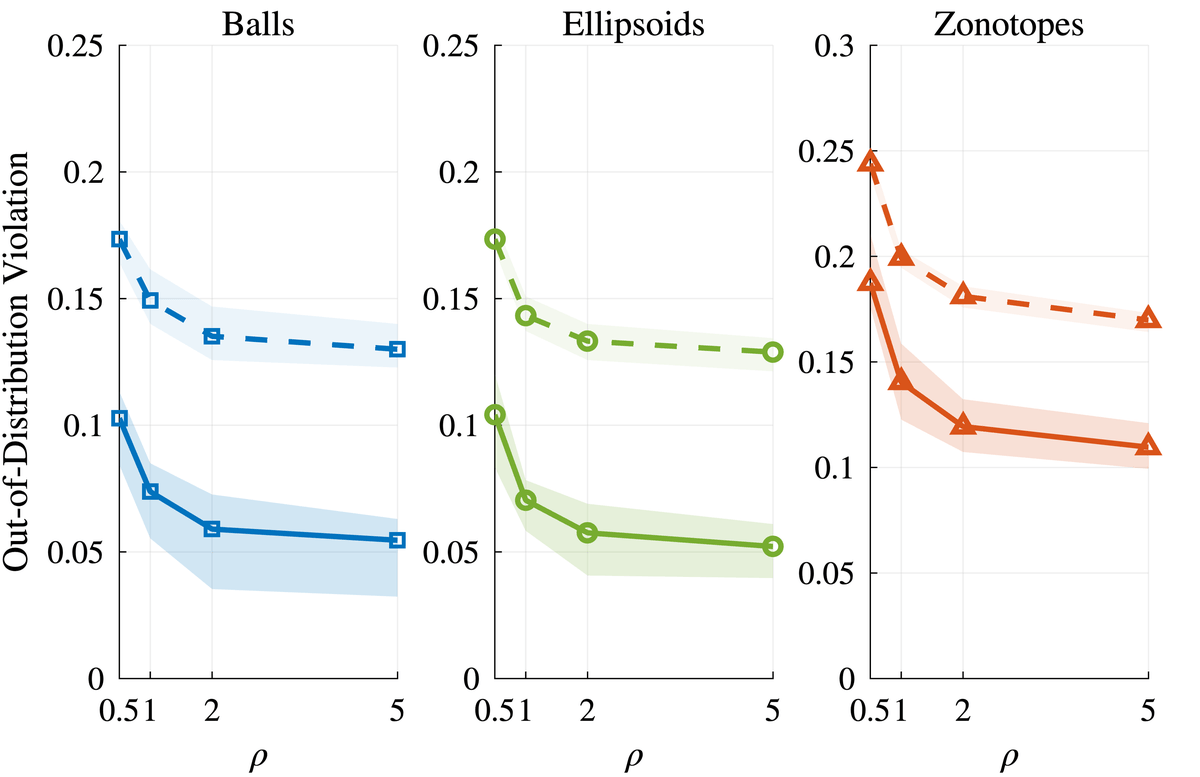
- Wasserstein distribution shifts degrade the guarantee by
μ/R, giving explicit out-of-distribution certificates - Convex reformulations provided for p-norm balls, ellipsoids, and zonotopes, all solvable with standard tools
- Simulations on a 2D stochastic nonlinear system confirm empirical violation stays below theoretical bounds across geometries
Predicting where a dynamical system might go next is a foundational problem in control, safety verification, and robotics. When the dynamics are known, classical set-propagation methods work well. When they are not, you have to learn reachable sets directly from sampled trajectories, and that is where probabilistic guarantees get messy. A new paper from researchers at Eindhoven University of Technology proposes a scenario-optimization framework that lets you dial in the trade-off between how tight your reachable set is and how likely future trajectories are to stay inside it, while adding robustness to adversarial perturbations and distribution shifts.
Why hard-constraint scenario methods break
Reachable sets describe the potential states a dynamical system can attain over a finite horizon under admissible uncertainty, initial conditions, and inputs. They form the foundation for verification, safety analysis, and constrained control. The trouble is that for many modern systems, the governing equations are only partially known. Engineers instead have piles of trajectory data from simulations or experiments and want to infer reachable sets that extrapolate beyond what they have already seen.
The scenario approach is a randomized optimization technique that produces solutions with probabilistic guarantees for unseen samples. Prior work such as Devonport and Arcak's 2020 paper applied it to reachability with hard constraints: every observed trajectory must sit inside the learned set. That makes the estimator brittle to outliers and offers no knob to trade tightness against reliability. The authors identify three gaps that existing methods rarely address together: a tunable trade-off between set size and coverage, robustness to perturbed trajectory data, and guarantees that degrade gracefully under distribution shifts measured by Wasserstein distance.