
EditorClean Quietly Breaks Every Major AI Image Protection Tool
Researchers show that popular tools like Glaze, PhotoGuard, and Mist can be stripped away by attackers using mismatched diffusion pipelines, exposing images to unrestricted editing.
 Pro
Takeaways
- New paper shows adversarial image protections like Glaze, PhotoGuard, and Mist can be stripped by mismatched pipelines.
- Two purifiers proposed: VAE-Trans and EditorClean, both fully black-box.
- EditorClean uses a Diffusion Transformer to exploit architectural heterogeneity against U-Net-based defenses.
- Evaluated on 2,100 editing tasks across six protection methods: AdvDM, AdvPaint, Diffusion-Guard, Mist, PhotoGuard, SDS.
- Results: 3 to 6 dB PSNR gain and 50 to 70 percent FID reduction versus protected inputs on downstream edits.
- Reveals a purify-once, edit-freely failure mode, urging protections to be tested under model mismatch.
Artists and photographers have been leaning on a small arsenal of tools to fight back against unauthorized AI training and edits. Systems like Glaze, PhotoGuard, and Mist add tiny, invisible perturbations to an image so that if someone tries to fine-tune a diffusion model on it or edit it with img2img, the output falls apart. A new paper argues that this defensive posture is far more fragile than the field assumes, and demonstrates a purification pipeline that can quietly restore full editability across six major protection methods.
The core finding is what the authors call a purify-once, edit-freely failure mode: once purification succeeds, the protective signal is largely removed, enabling unrestricted editing. In other words, the shield is not just weakened, it is effectively gone.
Why the shield leaks
Proactive protection tools work by solving an adversarial optimization problem against a specific surrogate diffusion model. AdvDM and SDS generate perturbations targeting the entire latent diffusion model through end-to-end optimization, while Glaze focuses on perturbations against the latent encoder, and Mist combines latent and denoising losses. That surrogate assumption is the crack in the wall. Once an image is posted online, the content owner has no idea which pipeline a downstream attacker will use, and the paper shows that architectural mismatch between the surrogate and the attacker's actual editor is enough to make the perturbation lose its bite.
Prior work already hinted at this. IMPRESS generates an image that is visually similar to the protected image and remains consistent when reconstructed by a latent diffusion model, and DiffPure runs the image through a diffusion denoiser. Both tend to trade image quality for protection removal, and neither systematically examines what happens when the attacker's model architecture differs from the one the defense was tuned against.
Two purifiers, one uncomfortable result
The authors propose two black-box purifiers that assume no access to the protection algorithm's internals or the original clean image:
- VAE-Trans projects the protected image through a variational autoencoder's latent space, correcting perturbations that live in encoder-sensitive directions.
- EditorClean performs instruction-guided reconstruction with a Diffusion Transformer (DiT). Because DiTs use a fundamentally different backbone than the U-Net-based Stable Diffusion models most protections target, the perturbations transfer poorly, and the reconstruction ends up close to the clean image.
The clever bit is exploiting architectural heterogeneity as an attack surface. Protections are optimized against one family of models; running the image through a structurally different one strips the signal almost as a side effect of reconstruction.

The numbers
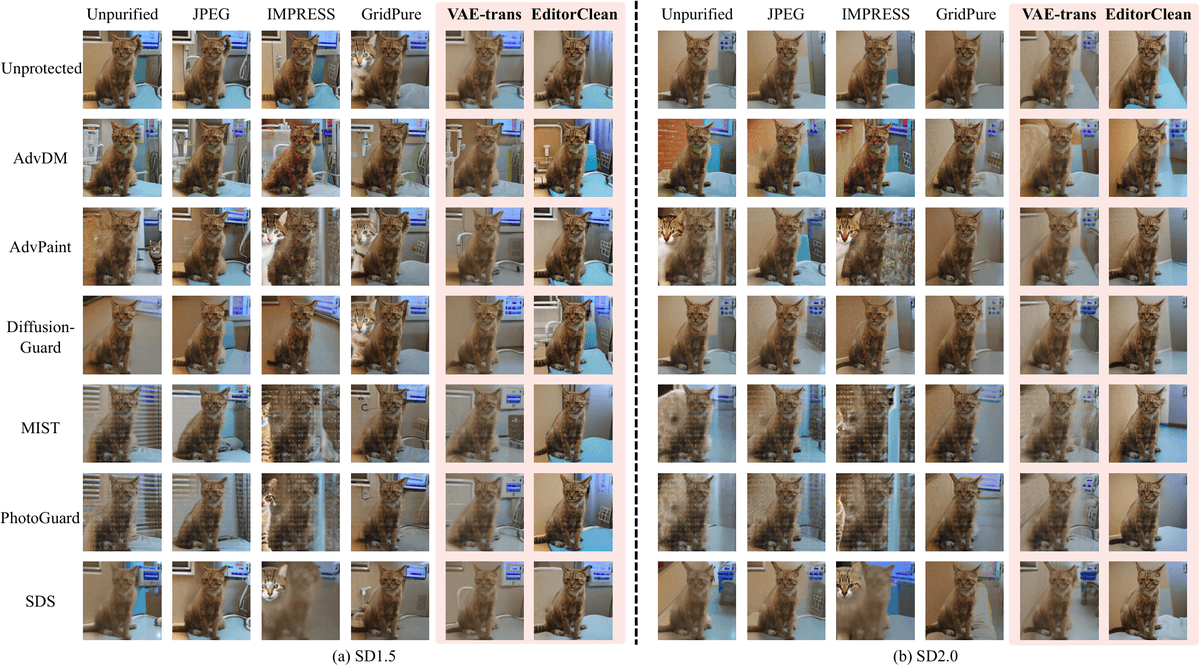
Evaluation covers 2,100 editing tasks across six protection methods, including AdvDM, AdvPaint, Diffusion-Guard, Mist, PhotoGuard, and SDS. Compared to feeding the protected image straight into a downstream editor, EditorClean improves PSNR by 3 to 6 dB and cuts FID on the resulting edits by 50 to 70 percent. Against prior purification baselines like JPEG compression, IMPRESS, and GridPure, it still wins by roughly 2 dB PSNR and 30 percent lower FID.

Qualitatively, the pattern is stark. Protected cat images that produce distorted, artifact-riddled edits under AdvDM or PhotoGuard come out clean after EditorClean, and downstream editors including Seedream, Qwen-Image, Step1X-Edit, Gemini, and ChatGPT all recover normal editing behavior.
What it is good and bad at
EditorClean is a purification method, not a general adversarial defense. It is useful for stress-testing whether a protection actually holds up when the attacker does not use the exact surrogate the defense was built against. It is also a fairly direct blueprint for anyone wanting to remove Glaze-style perturbations at scale, which is the uncomfortable part.
The weaknesses are inherent to the approach. Reconstruction-based purification will introduce some semantic drift, so protected images with very fine detail may lose fidelity in the cleaned version. And because EditorClean relies on a large DiT-based editor, it is not cheap to run per image.
What this means for defenses
The broader takeaway lands on the defense side. Protections evaluated only against their own surrogate model are giving a misleading picture of real-world robustness. Recent interpretability work also suggests that Glaze and Nightshade redistribute energy along dominant image-aligned frequency axes rather than introducing diffuse noise, which likely explains why a structurally different reconstructor can bypass them so cleanly.
The paper does not yet appear to have an accompanying open-source release on arXiv, though the framework is described in enough detail to reproduce. For anyone building or relying on image protection tools, the practical lesson is straightforward: test against heterogeneous attacker pipelines, or assume the shield is thinner than it looks.