
Easy-IIL Cuts Robot Training Workload Five-Fold With Just One Human Demo
A new interactive imitation learning framework replaces most human teleoperation with a one-shot model-based expert, cutting operator burden four to five times.
 Pro
Takeaways
- Easy-IIL replaces most human teleoperation in interactive imitation learning with a one-shot model-based assistant expert.
- The human provides one demo to bootstrap the assistant, then only intervenes near failure states.
- Reports a 4-5x drop in human intervention rate while matching HG-DAgger, IWR, and Sirius on success rate.
- Assistant expert combines Grounded-SAM, SuperPoint, LightGlue, and ICP for one-shot trajectory transfer.
- Uses action-chunk switching, exploration noise, and a bottleneck-prohibition rule to keep online data clean.
- NASA-TLX user study shows statistically significant subjective workload reduction (p < 0.01) on two tasks.
Teaching a robot arm through demonstration usually means a human spends hours behind a teleoperation rig, first recording clean examples and then constantly monitoring the policy while it practices, ready to grab the controls whenever it wanders toward failure. A team from Southern University of Science and Technology and KTH proposes a way to keep the accuracy of that approach while sharply reducing how much the human actually has to drive the robot. Their framework, called Easy-IIL, hands most of the joystick work to a second robot policy built from a single human demo.
The teleoperation tax on imitation learning
Interactive Imitation Learning (IIL) sits between plain behavior cloning and reinforcement learning. Standard IIL trains a novice from an expert-collected offline dataset and then iterates online rollout, expert intervention at near-failure states, data aggregation, and retraining. That loop works, but it burns operator time on two fronts: recording every offline trajectory and shadowing the robot during every online rollout. This places a heavy burden on the human expert, limiting scalability as dataset size and task complexity grow and potentially inducing fatigue that degrades the quality of collected data.
Most previous work chipped at the passive-monitoring side of the problem, using anomaly detectors like SafeDAgger, EnsembleDAgger, HG-DAgger, and ThriftyDAgger to decide when a human should be pulled in. Easy-IIL instead attacks the active side: the actual teleoperation.

Bootstrapping an assistant from one demo
The key observation is that recent model-based imitation methods can perform robotic manipulation tasks from one or a few human demonstrations by leveraging generalizable priors from pre-trained models, although they are typically surpassed by end-to-end IL policies at larger dataset scales. Easy-IIL turns that limitation into a feature: use a model-based, one-shot method as a stand-in expert during data collection, then train a stronger end-to-end policy on top of the collected data.
The assistant expert is stitched together from off-the-shelf vision components. From a single human demo containing an RGB-D image plus 6D end-effector pose per waypoint, the system uses Grounded-SAM to segment target objects, SuperPoint and LightGlue for image matching, and then computes a 6D pose transformation via ICP and RANSAC. Trajectories from the demo are warped into the new scene using linear interpolation for position and spherical linear interpolation (Slerp) for orientation. When the arm drifts too far from the transformed path, a replanning routine kicks in as a recovery behavior.
Who drives when
The workflow splits into an offline and an online phase, both governed by a small set of switching rules:
- Offline: the human records exactly one demonstration to bootstrap the assistant, then the assistant collects the remaining demos while the human watches and only intervenes near failure.
- Online: the novice policy rolls out, but with a gating function that randomly hands control to the assistant expert in chunks. The probability of switching decays across rounds, so the novice gradually earns more airtime.
- Bottleneck prohibition: the workspace is split into a free region and a bottleneck region near the target object. In the bottleneck, novice actions are disabled entirely because precision matters most there.
- Exploration noise: zero-mean Gaussian noise is added to the novice's normalized actions to widen coverage.
- Chunked switching: switches happen at the granularity of action chunks (size H = 8), which suits sequence models like diffusion policy and ACT better than swapping one action at a time.

Training uses a diffusion policy with a DDPM noise scheduler. A per-action weight matrix zeroes out any action produced by the novice itself, so only human and assistant expert samples contribute to the loss. That prevents the model from reinforcing its own mistakes when online rollouts get folded back into the dataset.
What the numbers show
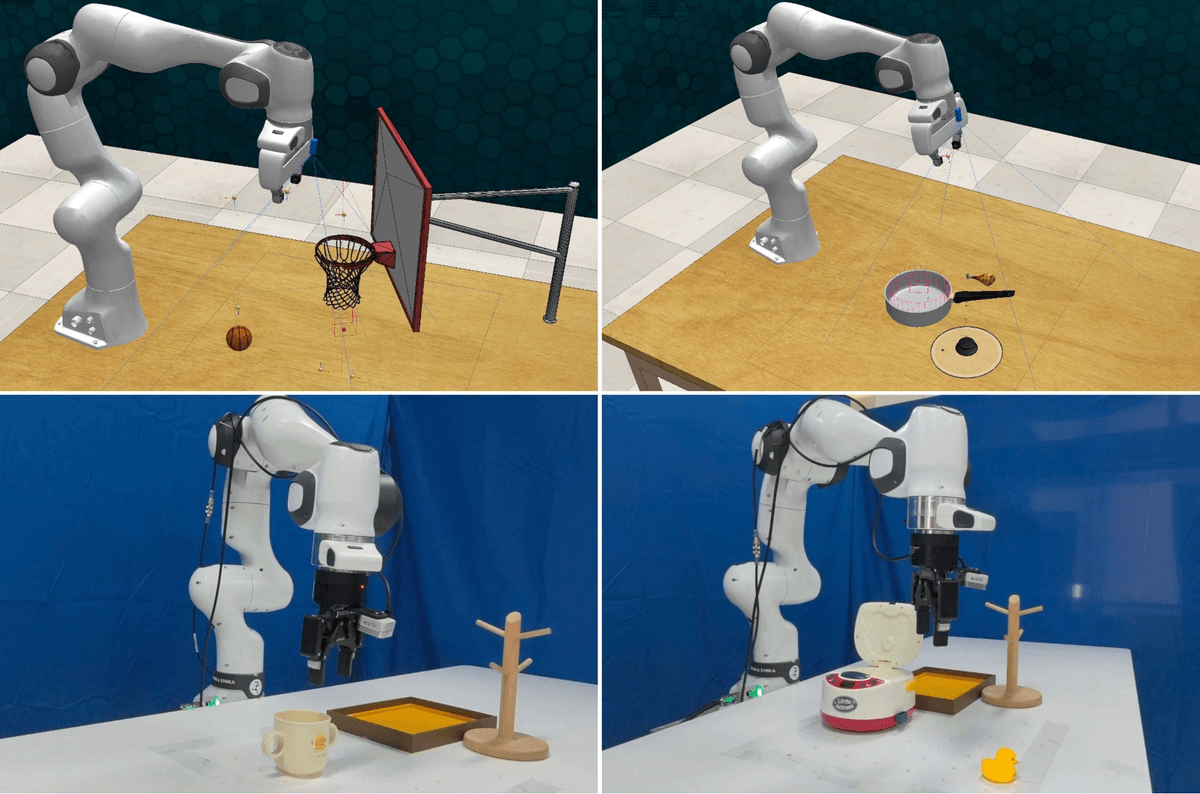
The team evaluates on two simulated RLBench tasks (Basketball in Hoop, Take Chicken in Saucepan) and two real-world Franka Research 3 tasks (Hang the Cup, Put Duck in Cooker), against HG-DAgger, IWR, and Sirius. Easy-IIL consistently achieves performance comparable to all IIL baselines, with success rate differences within a 3-4% margin, while significantly reducing the human intervention rate across all tasks, achieving a substantial four- to five-fold reduction.
The ablation makes the offline savings stark. Across the two simulated tasks, the offline success rate of Easy-IIL is comparable to that of the baselines while the offline intervention rate is substantially lower than that of baselines. In practice that means an offline intervention rate around 3-5% for Easy-IIL versus 100% for the standard IIL baselines, which require full teleoperation of every demo.

An additional experiment addresses the obvious question of whether the end-to-end policy actually beats the model-based helper it was trained with. At 80 demonstrations the diffusion policy hits 95% on Basketball and 91.7% on Chicken, edging past the assistant expert's 91.7% and 88.9% respectively, confirming that the end-to-end policy retains its scaling advantage.
Subjective workload was measured with a NASA-TLX-derived Burden score on a 7-point scale. Easy-IIL achieves a statistically significant reduction in subjective operational workload across the two simulation tasks when compared to IIL baselines, with Burden dropping from around 4.0-5.0 to 1.7-2.3 (p < 0.01).
Where it fits and where it breaks
Easy-IIL is a good match when three conditions hold: the manipulation task can be decomposed into stages with clear target objects that vision foundation models can segment, a single clean demo is enough to define the trajectory shape, and you want to end up with a strong end-to-end policy rather than being stuck with the model-based one. The chunked switching also matters. In additional experiments, chunk switching helped BC-RNN and diffusion policy but did nothing for a simple CNN-GMM baseline, suggesting the technique is aimed at sequence-based architectures.
The limitations flow from the assistant expert itself. It relies on matching the current scene to the single demo via ICP-based pose estimation, so tasks with heavy occlusion, deformable objects, or objects Grounded-SAM cannot cleanly segment will strain the pipeline. The bottleneck region also has to be defined manually, and the approach still needs human monitoring during rollouts, just not human teleoperation. Code is not currently released publicly; the authors point readers to a project page for videos and additional materials.