
East China Normal University's VoT Teaches AI to Forecast Shocks Using News
A new multimodal forecasting method uses LLMs to reason over news and events alongside numerical patterns, beating baselines across 10 domains.
 Pro
Takeaways
- VoT combines LLM reasoning over news/events with a numerical branch for time series forecasting.
- Historical In-Context Learning stores corrected reasoning traces and retrieves them at inference, avoiding LLM fine-tuning.
- Adaptive Frequency Fusion learns which branch to trust across low, mid, and high frequency bands.
- Beats 11 baselines on 19/20 metrics across 10 real-world multimodal datasets.
- Removing HIC hurts more than removing the entire event branch, showing grounded reasoning is critical.
- Open source at github.com/decisionintelligence/VoT; inference costs ~5.9s per prediction due to LLM calls.
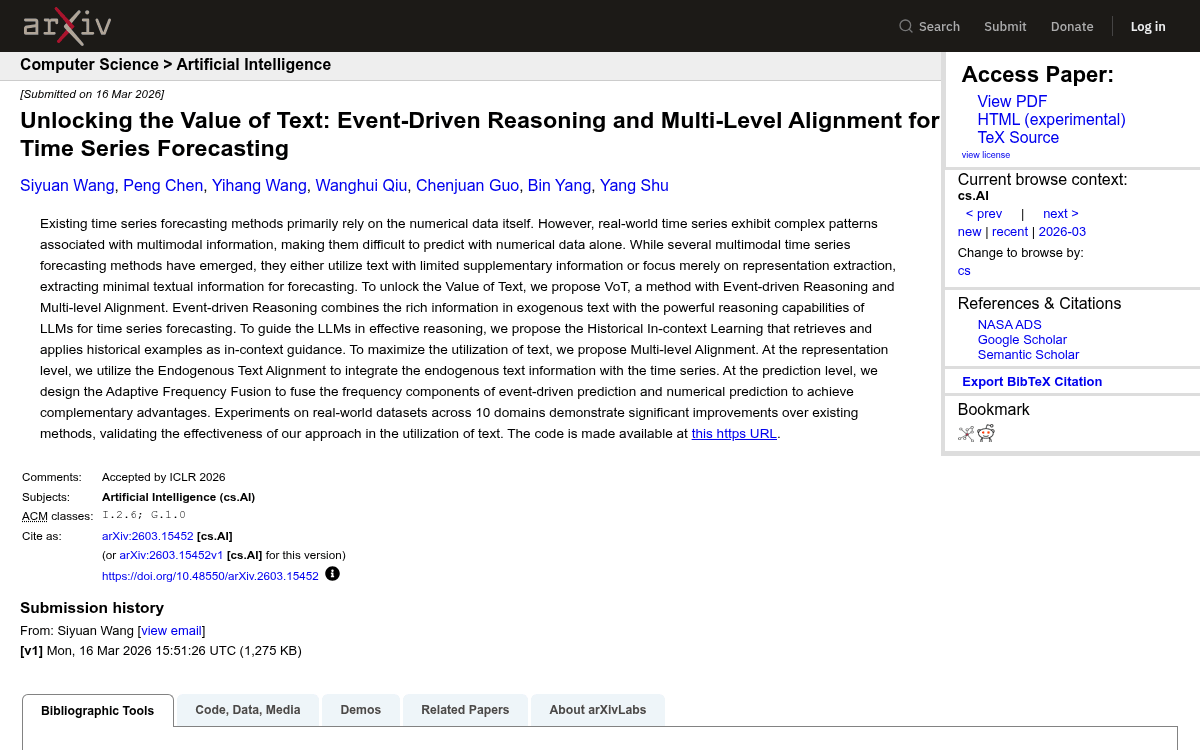
Numerical time series models are great at capturing trends and seasonality, but they routinely miss the shocks that actually matter: financial crashes, pandemics, policy changes. A team from East China Normal University has released VoT (Value of Text), a multimodal forecasting method that pairs an LLM reasoning branch with a conventional numerical branch to squeeze predictive signal out of news articles, policy documents, and other exogenous text. Code is available on GitHub.
Why numbers alone keep getting blindsided
Existing time series forecasting methods primarily rely on the numerical data itself, but real-world time series exhibit complex patterns associated with multimodal information, making them difficult to predict with numerical data alone. The classic example is the unemployment rate: smooth for years, then a violent spike when something like the 2008 crash or COVID hits. A model looking only at past numbers has no way to anticipate that shift.

Recent work has tried to bolt LLMs onto forecasters, but the authors argue existing approaches fall into two camps that both fall short. Some methods only feed the LLM endogenous text, meaning statistical summaries generated from the series itself, which adds little new information. Others process exogenous text like news, but treat the LLM as a feature extractor rather than a reasoner, so the semantic content stays largely untapped.
A dual-branch architecture
VoT runs two prediction branches in parallel and fuses them at the end:
- Event-driven branch: An LLM reads exogenous text (news, reports) and reasons its way to a numerical forecast.
- Numerical branch: A PatchTST backbone processes the raw series, aligned against auto-generated endogenous text describing statistical properties.

The event-driven branch uses a three-step generative pipeline. First, an LLM generates a dataset-specific template based on the dataset description and text-series samples, which serves as a structured dictionary containing key-value mappings that guide the extraction of predictive information. Second, this template is used to generate summaries from raw exogenous text and time series, filtering redundant information while preserving the information influential to time series forecasting. Then a reasoning model (DeepSeek-R1 by default) produces both the numerical prediction and an explanation of why.
Historical In-Context Learning: teaching the LLM from its own mistakes
The most interesting contribution is Historical In-Context Learning (HIC), which sidesteps expensive fine-tuning. During training, the LLM makes an initial prediction on a historical window, then gets shown the ground truth and asked to explain what it got wrong. That corrected reasoning gets stored, keyed by an embedding of the summary.
At inference time, the system embeds the current summary, retrieves the nearest-neighbor historical example from the knowledge base, and injects the corrected reasoning as an in-context example. The error-informed learning helps the model understand how exogenous text impacts time series, thereby improving predictions when similar event-driven fluctuations occur, and achieves this without requiring expensive fine-tuning, making it efficient and scalable across different forecasting domains.
The ablation numbers here are telling. Removing HIC drops performance to worse than removing the entire event-driven branch, suggesting that unguided LLM reasoning can be more detrimental than no reasoning at all. In other words, if you're going to let an LLM hallucinate numbers, you'd better ground it in retrieved examples.
Aligning the two branches
Two more components stitch things together:
- Endogenous Text Alignment (ETA): The numerical branch decomposes the series into trend and seasonal components, converts statistical descriptors to text, encodes them with GPT-2, and uses contrastive learning to pull matching trend/seasonal representations closer in embedding space.
- Adaptive Frequency Fusion (AFF): Both branch predictions get FFT'd, split into low/mid/high frequency bands, and combined with six learnable weights. The intuition is that event-driven predictions win at low frequencies (trend shifts from shocks) while numerical predictions capture the high-frequency wiggles.
The frequency analysis in the paper backs this up empirically: the event-driven branch tracks ground truth better on low-pass filtered signals, while the pure numerical branch wins on high-pass. Adaptive weighting across bands lets each modality contribute where it's strongest.
Results across 10 domains
VoT was evaluated on 9 datasets from the MM-TSFLib benchmark plus a new Weather dataset, covering agriculture, climate, economy, energy, health, environment, traffic, security, social good, and weather. VoT ranks first in all 20 metrics against time series-only and text-enhanced baselines, and 19 out of 20 metrics against multimodal methods. Gains are largest on event-sensitive domains like Energy and Social Good, which lines up with the theory.
Baselines beaten include iTransformer, PatchTST, RAFT, GPT4TS, GPT4MTS, TaTS, TimeVLM, and CALF. On the Health dataset, MSE drops from 1.34 (GPT4TS) to 1.21. On Social Good, it drops from 0.87 (Time-VLM) to 0.80.
The catch: latency
Running an LLM per prediction is not free. The paper reports total inference latency around 5.9 seconds, almost entirely from the event-driven branch, versus 2ms for the numerical branch alone. The authors' pragmatic take: multimodal domains typically sample at low frequency anyway (weekly gasoline prices, monthly unemployment), so second-level latency is fine. If you need real-time predictions, just use the numerical branch.
The method is also sensitive to text quality. Robustness tests with 10-20% masking or noise show modest degradation, but in extreme cases with no valid text, the event-driven branch becomes a liability rather than an asset. Reasoner choice matters less than expected: DeepSeek-R1, GLM-4.5, and Qwen3-8B all produced competitive results, suggesting the framework generalizes across reasoning-capable LLMs rather than depending on a specific model.