
East China Normal University's ASTGI Beats Top Models on Messy Real-World Time Series
A new graph-based framework for irregular multivariate time series drops MSE by roughly 6% across healthcare, biomechanics, and climate benchmarks by ditching interpolation and static interaction rules.
 Pro
Takeaways
- ASTGI treats each irregular observation as a point in a learned spatio-temporal embedding space, avoiding interpolation or alignment.
- An adaptive kNN search plus causal mask builds a per-point interaction graph, replacing fixed rules used by ODE and static-graph baselines.
- Message passing conditions both weights and messages on the relative spatio-temporal displacement between points.
- Beats 12 baselines on MIMIC, PhysioNet, Human Activity and USHCN, with roughly 6% lower MSE than Hi-Patch.
- Ablations confirm learnable coordinates, adaptive graphs and relation-aware propagation each contribute meaningful gains.
- Code and datasets released at github.com/decisionintelligence/ASTGI.
Forecasting from irregular multivariate time series is one of those problems that looks easy on paper and then quietly wrecks every model you throw at it. Vital signs in an ICU, gauge readings on a piece of industrial equipment, weather station logs going back a century: the observations arrive at unequal intervals, different variables get sampled on different clocks, and the gaps themselves carry information. A team from East China Normal University has proposed ASTGI (Adaptive Spatio-Temporal Graph Interaction), a framework that treats every raw observation as a point in a learned embedding space and lets the model dynamically decide which other points it should talk to.
Why the usual tricks distort the data
The core difficulty with irregular multivariate time series (IMTS) is that most deep learning stacks expect tidy, evenly spaced tensors. To force IMTS into that shape, existing methods pick one of three compromises, and each one leaks information.

- Interpolation-based methods transform an irregular series into an equally spaced series through numerical interpolation, but this generates artificial data points that were not actually observed, introducing bias and distorting the sampling distribution.
- Time-aligned methods map all variables to a unified timeline and fill missing values, which loses precise information about the time intervals between the original observations.
- Patch-aligned methods divide the series into patches, but rigid division can disrupt continuity and intra-patch aggregation smooths out critical fine-grained dynamics.
The second problem is how observations talk to each other. ODE-based interaction strictly follows the temporal order, meaning an observation can only influence its immediate subsequent state on the timeline and cannot establish a direct connection with more distant historical observations. Graph-based approaches usually hardcode edges by variable or timestamp, which cannot adapt as the system state evolves.
Points in space, not rows in a tensor
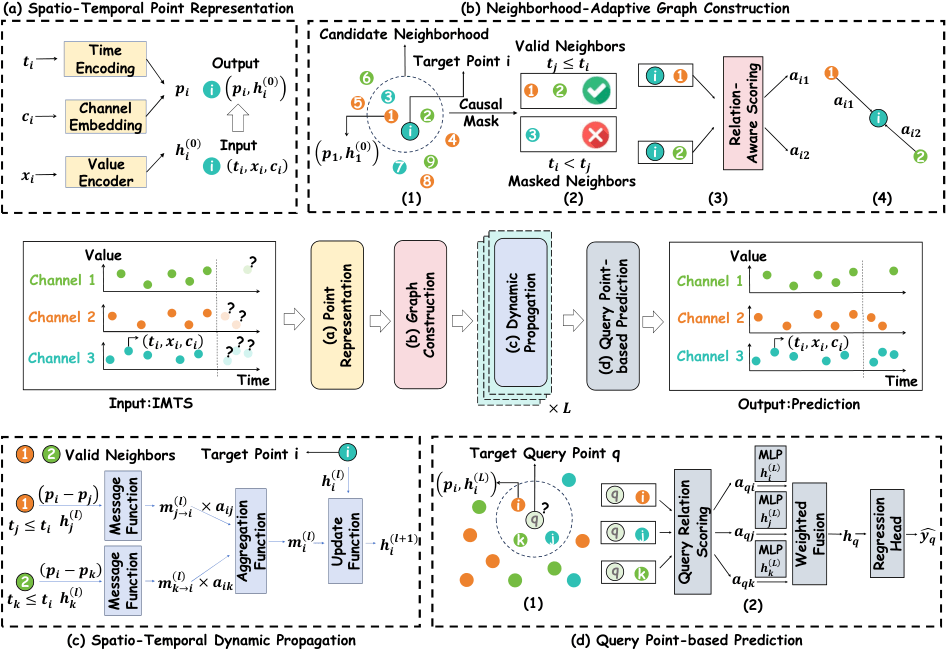
ASTGI reframes the whole problem. Instead of aligning observations, it encodes each tuple of (timestamp, value, variable index) as a point in a learnable spatio-temporal embedding space. A channel embedding handles the variable identity, an MLP encodes the timestamp, and a separate MLP maps the observed value into an initial feature vector that later gets refined by propagation. The concatenation of channel and time embeddings becomes a fixed positional anchor for that observation, while only the feature vector evolves.
Crucially, the "spatial" axis here is not physical geography. It is an abstract dimension learned from the data, designed to capture the intrinsic relationships between different variables. Two clinical variables that tend to move together end up near each other in that space, regardless of when they were sampled.
How the adaptive graph is built
Once every observation is a point, ASTGI builds a directed causal graph on the fly. For each point i, it finds the K nearest neighbors in the learned coordinate space using Euclidean distance, then applies a causal mask that removes any neighbor with a timestamp later than i. This guarantees information only flows from past to future without needing a predefined topology.
Message passing then runs for L layers. The trick is that both the messages and the attention weights are conditioned on the relative spatio-temporal position between points, not just their features. Concretely, each layer:
- Builds a relation vector combining the coordinate difference
p_i - p_jwith the current features of both endpoints. - Feeds it through a small MLP to produce a raw score, then softmaxes over the causal neighborhood to get interaction weights.
- Generates a message from neighbor
jtoiusing another MLP that also takes the displacement vector as input. - Aggregates messages with a weighted sum and updates the node feature through a residual MLP with LayerNorm.
Forecasting is treated as the same problem in reverse. A query (t_q, c_q) is embedded into the same coordinate space, its K nearest historical neighbors are retrieved, and a dedicated scoring and value network aggregates their final representations into a prediction. The ablations show this matters: replacing the interaction-weighted fusion in the prediction stage with simple neighborhood average pooling leads to a substantial drop in performance.
The numbers
The authors evaluate on four public benchmarks that span very different irregularity regimes: MIMIC (96 clinical variables from ICU stays), PhysioNet (36 variables from a mortality prediction challenge), Human Activity (12 motion sensor channels) and USHCN (5 climate variables over decades). Twelve baselines are included, from mTAN and GRU-D to more recent graph models like GraFITi, tPatchGNN and Hi-Patch.
Compared to the second-best performing model, Hi-Patch, ASTGI achieves reductions of approximately 6.04% in MSE. The gains are largest on MIMIC, where MSE drops from around 0.428 (Hi-Patch) to 0.391, and MAE from 0.403 to 0.385. The framework wins on both metrics across every dataset.
The ablations also isolate why. Replacing the learnable time and channel embeddings with fixed, non-parametric encodings leads to a significant drop in performance, indicating that an adaptively learned metric space is crucial for capturing non-linear patterns and inter-variable correlations. Degrading the basis for neighborhood search from the learned spatio-temporal coordinates to the original timestamps results in a notable performance decline. In other words, both the learned coordinates and the kNN-in-embedding-space step are doing real work.
What it is actually good for
The paper includes a nice qualitative look at the learned graphs on a MIMIC sample. The model spontaneously discovers three useful patterns: synchronous cross-variable correlations (Bilirubin Direct and pH at the same hour), direct long-range self-dependencies (a Troponin I reading at t=4 connecting to the same variable at t=7 without going through intermediate steps), and cross-variable lagged effects. That is the kind of behavior clinicians and control engineers care about because it maps to intuitions about the underlying process.
Practically, this makes ASTGI a reasonable default when your data looks like ICU records, lab panels, weather station archives, industrial sensor streams with dropouts, or any setting where you cannot afford to invent observations that were never taken. It is less obviously useful when your data is already regular, since the whole architecture is designed around the assumption that alignment itself is destructive.
The main caveat is compute. Every observation becomes a node, and every node runs a kNN search plus L layers of message passing. The parameter sensitivity study shows performance saturates at modest values of K and L, so this is manageable, but it is still heavier than a straightforward patch-based transformer. Sensitivity analysis also flags that too many layers can introduce the risk of over-smoothing on complex datasets, leading to a slight decrease in performance.
The datasets and code are available in the authors' decisionintelligence/ASTGI repository, and the full paper including appendix visualizations of the learned embedding space is on arXiv.