
East China Normal University Mines GitHub to Build 10,000-Skill AI Agents
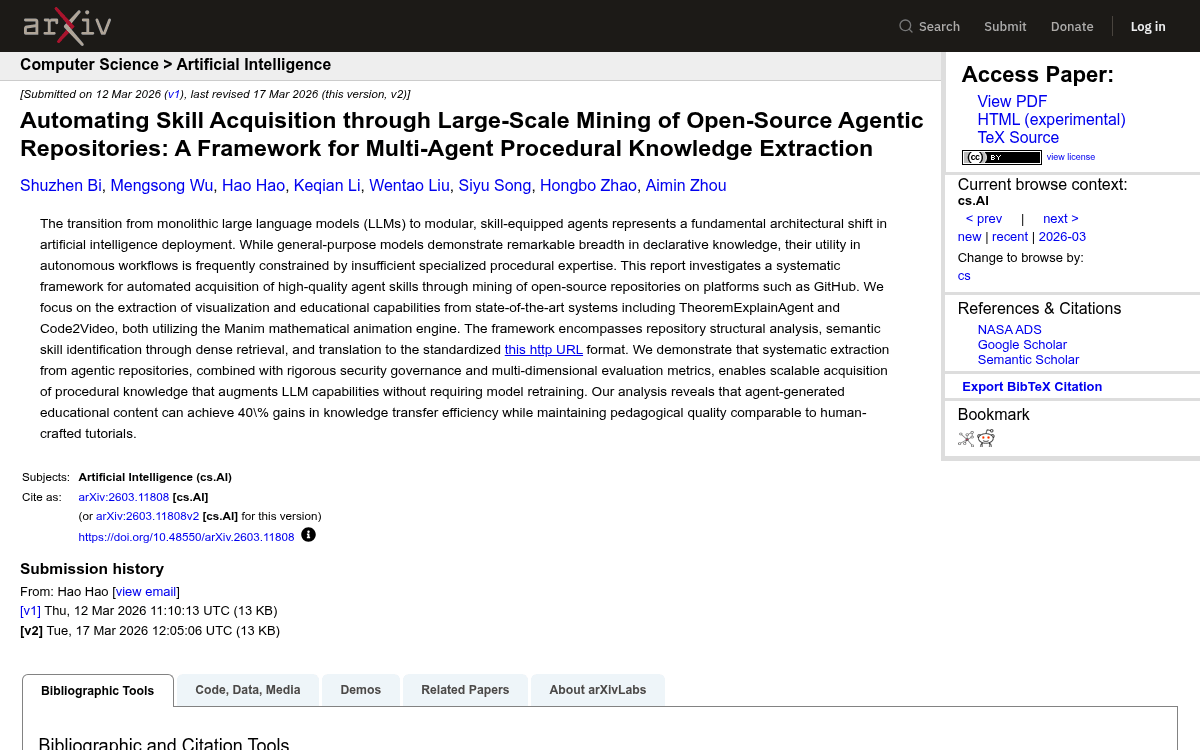
Researchers propose a pipeline that mines GitHub agent repositories, extracts reusable procedural skills, and packages them into the SKILL.md format without retraining.
 Pro
Takeaways
- Framework mines GitHub agentic repos and converts reusable code patterns into standardized SKILL.md artifacts.
- Three-stage pipeline: structural analysis via repo2AI, dense retrieval plus cross-encoder ranking, then automated SKILL.md synthesis.
- Case studies extract skills from TheoremExplainAgent and Code2Video, both Manim-based educational systems.
- Reported 40% gains in knowledge transfer efficiency on the TeachQuiz metric versus baseline code generation models.
- Four-stage security pipeline (G1-G4) addresses the 26.1% vulnerability rate found in community skills.
- Progressive disclosure lets agents index 10,000+ skills using only 30-100 tokens each at startup.
A new framework from East China Normal University and the Shanghai Innovation Institute argues that the next wave of capable AI agents will not come from bigger models, but from harvesting procedural know-how already sitting in open-source repositories. The team lays out an end-to-end pipeline for scraping GitHub, isolating reusable behaviors, and repackaging them as standardized SKILL.md artifacts that any sufficiently capable LLM can load on demand.
The motivation is straightforward. Contemporary LLMs possess extensive declarative knowledge spanning diverse domains, but their effectiveness in autonomous task execution remains limited by insufficient specialized procedural expertise required for real-world applications. Knowing what a Fourier transform is doesn't help an agent actually animate one. And the traditional fix, having domain experts hand-write skills, hits a wall the moment you want thousands of them.
Why skills, not weights
The paper leans on the emerging skills paradigm, where procedural knowledge lives on the filesystem rather than in model parameters. Procedural knowledge is encapsulated into discrete, filesystem-based units that agents can dynamically discover, load, and execute on demand. That decoupling matters because it lets teams patch or extend agent behavior without touching a checkpoint.
Formally, a skill is defined as a four-tuple containing applicability conditions, a policy, termination criteria, and a callable interface. The concrete implementation is Anthropic's SKILL.md specification, which uses a three-tier progressive disclosure structure:
- Level 1 (30 to 100 tokens): YAML metadata pre-loaded at startup so the agent knows a skill exists.
- Level 2 (200 to 5,000 tokens): Procedural instructions injected into context only when the skill is triggered.
- Level 3 (unbounded): Scripts, templates, and reference docs loaded on demand by the Level 2 instructions.
Level 1 metadata serves as an efficient table of contents, enabling agents to maintain awareness of thousands of available skills without context window degradation. That is how the authors claim libraries can plausibly scale into the 10,000+ range without blowing the context budget.
The extraction pipeline
The mining framework runs in three stages. First, tools like repo2AI flatten a repository into a Markdown map of directories, orchestration scripts, and configs so an extractor LLM can reason about it. Second, a two-stage retrieval system identifies latent skills: a bi-encoder produces dense embeddings for candidate modules and task descriptions, then a cross-encoder does fine-grained relevance scoring on the top-K matches.
Candidates only survive if they satisfy four filters: recurrence across contexts, verification that the code actually runs, non-obviousness (it took real expertise to write), and generalizability. The third stage synthesizes the SKILL.md, generating YAML frontmatter, writing Level 2 instructions as LLM-facing procedural guidance rather than user docs, and bundling assets into scripts/, references/, and templates/ subdirectories with hardcoded paths and API keys stripped out.
Two case studies in visual reasoning
To make the framework concrete, the authors mine two well-known Manim-based systems. TheoremExplainAgent uses a Planner and Coding Agent pair to produce long-form STEM explainers. The Coding Agent translates storyboards into executable Manim Python scripts, and TEA implements a multi-attempt error-correction loop enabling the agent to analyze Python stack traces and iteratively debug animation code. A RAG layer grounds it in current Manim documentation to prevent API hallucinations.
Code2Video pushes further with a tri-agent Planner-Coder-Critic design. The interesting piece is the Critic's Visual Anchor Prompting: the process overlays a 10 by 10 grid on rendered frames, enabling precise identification of element positions and potential occlusions, and when spatial overlap exceeds defined thresholds, the Critic generates refactoring suggestions for Python positioning code.
From these two systems the extractor produces skills like visual-theorem-walkthrough and visual-layout-critic. The layout critic's Level 2 procedure is essentially: overlay the grid, locate elements, compute pairwise overlap, and if it exceeds a threshold, emit positioning fixes such as:
# Template: Shift overlapping label
original:   label.next_to(object, UP)
refactored: label.next_to(object, RIGHT)
The numbers
The headline result comes from Code2Video's TeachQuiz metric, which trains a VLM to unlearn a domain, feeds it the generated video, then quizzes it on fact recovery. Empirical results demonstrate that agent-generated videos achieve 40% gains in knowledge transfer efficiency compared to baseline code generation models, with certain categories surpassing human-crafted tutorials. On the TEA side, the o3-mini agent implementation demonstrated an overall score of 0.77 on TheoremExplainBench.
The paper also cites SkillNet-style consolidation gains once libraries are organized into an ontology of relations like is-a-subset-of and requires-output-from: roughly 30% fewer execution steps through composition and 40% higher average task rewards across different backbones.
The security problem nobody talks about
Automated mining of random GitHub code is a security nightmare. A comprehensive survey of community-distributed skills identified vulnerabilities in 26.1% of analyzed artifacts, including data exfiltration attempts and privilege escalation vectors. The framework responds with a four-tier verification pipeline:
- G1 Static analysis: Scan for
eval(),exec(), unauthorized network calls, destructive filesystem ops, and obfuscated segments. - G2 Semantic classification: LLM-based check for hidden prompt injections and metadata-implementation mismatches.
- G3 Behavioral sandboxing: Run scripts in isolated containers with network isolation and resource monitoring.
- G4 Permission validation: Enforce allowed-tools manifests so skills touch only declared resources.
Skills graduate through trust tiers based on audited runtime behavior, which is closer to how package registries treat untrusted contributions than how most agent frameworks currently handle plugins.
Where this actually fits
The framework sits alongside, not against, protocols like MCP. Skills answer what to do; MCP answers how to connect. A presentation skill would define slide rhythm and visual best practices while calling a PowerPoint MCP server to actually manipulate the file. That orthogonality is probably the paper's most useful contribution beyond the extraction pipeline itself.
The framework is useful when you need to bootstrap agent capabilities in a specialized domain without a training budget, when procedural expertise already exists as running open-source code, and when you want capability updates to happen at deployment time rather than fine-tuning time. It is less useful for skills that require novel reasoning not already demonstrated in some repo, and it inherits whatever brittleness the source projects have around API drift. The paper is a review and methodology proposal rather than a released tool, so the pipeline itself is not currently packaged as code you can pip install, though the source systems it mines (TheoremExplainAgent, Code2Video, repo2AI) are all publicly available on GitHub.