
Earth2Ocean Segments Underwater Life Across 255 Species Without Any Training
New research introduces the largest fine-grained underwater segmentation dataset and a training-free framework that adapts land-based vision models to the ocean.
 Pro
Takeaways
- New paper introduces Earth2Ocean, a training-free open-vocabulary segmentation framework for underwater scenes.
- AquaOV255 dataset ships 255 fine-grained categories across 20,723 underwater images, largest of its kind.
- UOVSBench benchmark unifies six underwater datasets for consistent open-vocabulary evaluation.
- GMG module refines CLIP features using DINO-based geometric self-similarity priors.
- CSA module fuses GPT-4o attribute reasoning with underwater prompt templates for better text alignment.
- Code and dataset released at github.com/LiBingyu01/Earth2Ocean, achieves 17.5 FPS on RTX 4090.
Segmenting fish, corals, and marine debris in underwater imagery has always been a strange orphan of computer vision. Most datasets and models target terrestrial scenes, and the few underwater benchmarks that exist tend to lump everything from clownfish to dolphins into a single "fish" label. A new arXiv paper, Exploring the Underwater World Segmentation without Extra Training, tries to fix both the data problem and the model problem in one go.
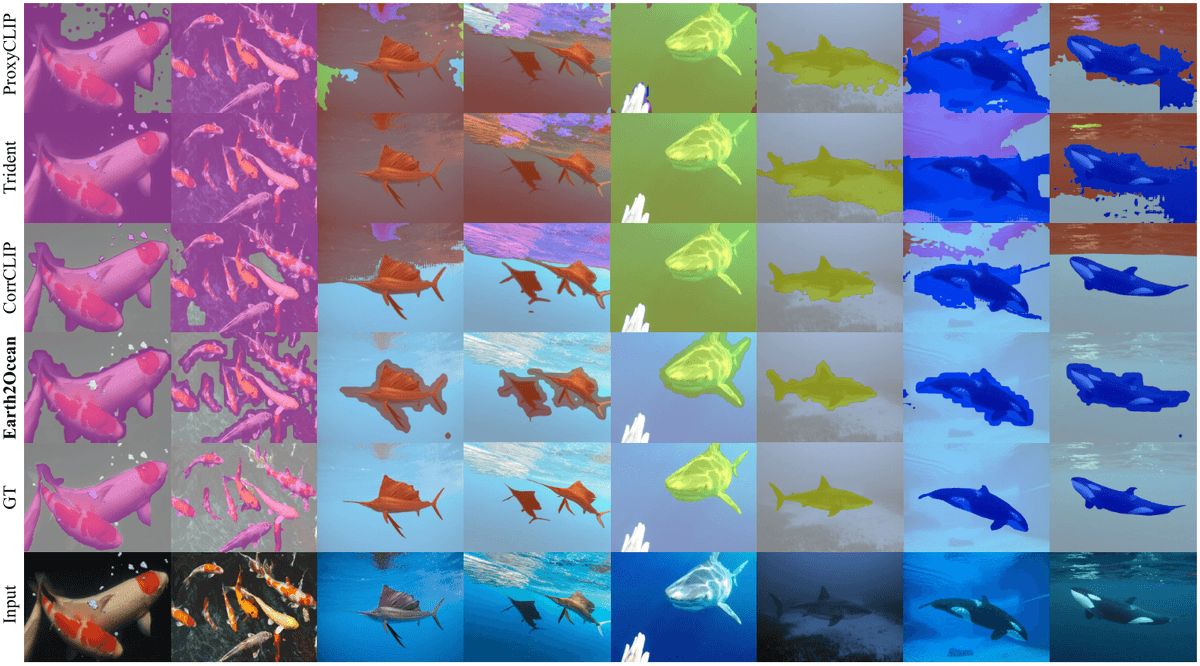
The authors, led by Bingyu Li, release three things together: AquaOV255, a fine-grained underwater segmentation dataset; UOVSBench, a benchmark that unifies six underwater datasets for open-vocabulary evaluation; and Earth2Ocean, a training-free framework that ports terrestrial CLIP-style models to underwater scenes without any additional training on aquatic imagery.
Why the ocean breaks your segmenter
Underwater imagery violates a lot of the assumptions baked into models trained on internet photos. Color attenuation, light scattering, low visibility, and blurred textures make it hard to extract reliable visual features, and conventional segmentation methods struggle at large-scale biological monitoring. Most existing underwater work is also stuck in closed-set recognition, meaning a model trained to detect ten species has no idea what a zebrafish or a leafy sea dragon is.
Open-vocabulary segmentation (OVS), where a model can segment any category described in natural language, is the obvious fix. CLIP and its cousins, however, were trained on terrestrial data, so their concept of "fish" is thin and biased toward aquarium photos.