
EAGC Fixes the Hidden Gradient War Holding Back Open-World AI Discovery
A new plug-and-play module fixes a subtle optimization conflict in Generalized Category Discovery, delivering up to 9.6 percent accuracy gains.
 Pro
Takeaways
- New CVPR 2026 paper identifies gradient entanglement as the hidden bottleneck in Generalized Category Discovery methods
- EAGC is a plug-and-play module with two parts: Anchor-based Gradient Alignment and Energy-aware Elastic Projection
- Boosts every tested baseline: average +3.2% All ACC and +4.3% New ACC across five datasets
- SelEx + EAGC on CUB jumps from 73.6% to 83.2% All ACC, with novel classes gaining 15.1 points
- Training-only module: zero inference cost, roughly 14% extra training time and modest memory overhead
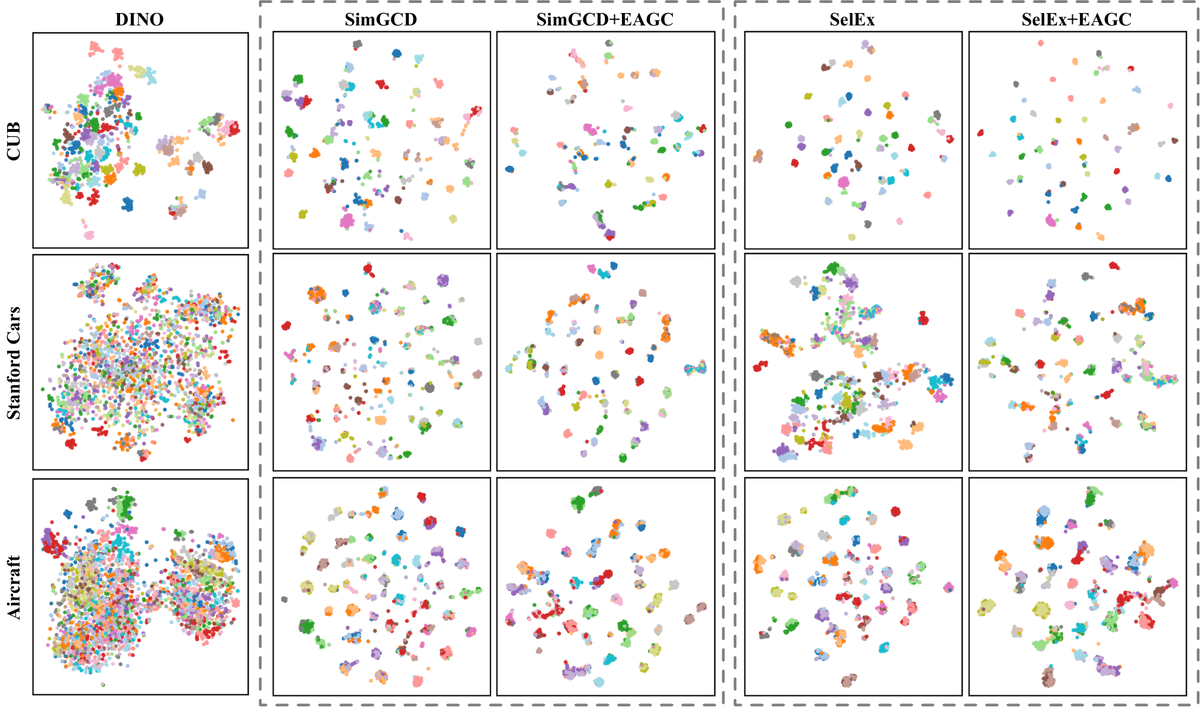
- Paper and project page include theoretical analysis and t-SNE visualizations
A team from the University of Trento and Hefei University of Technology has put a name to a subtle failure mode that has quietly held back Generalized Category Discovery (GCD) for years. They call it gradient entanglement, and their fix, the Energy-Aware Gradient Coordinator (EAGC), is a plug-and-play training module that lifts every major GCD baseline it touches, sometimes by nearly ten points of accuracy. The paper is slated for CVPR 2026, and the code is on GitHub.
The open-world problem GCD is trying to solve
GCD sits between supervised classification and pure clustering. The unlabeled data may contain both known and novel categories, and the objective is to correctly recognize samples from familiar classes while simultaneously discovering unseen ones. Picture a wildlife camera trap where you have labels for 100 bird species but the feed also contains dozens of species nobody has ever annotated. GCD asks a model to classify the known ones and cluster the rest into coherent new groups at the same time.
The dominant recipe, popularized by SimGCD, jointly optimizes a supervised loss on the labeled data and an unsupervised loss (usually self-distillation with pseudo-labels) on everything else. SimGCD is a robust baseline that replaces clustering with a classifier trained using a pseudolabeling strategy borrowed from semi-supervised learning. It works, but the two objectives fight each other during training in ways nobody had precisely characterized.
Diagnosing the tug-of-war inside the gradients
The authors set out to quantify that fight. They define two diagnostic metrics: the Gradient Deviation Coefficient (GDC), which measures how much the unsupervised loss twists the direction of the supervised gradient, and the