
Dyn-Bench Exposes How Frontier AI Models Fail at Tracking Moving Objects
A new CVPR 2026 benchmark reveals that top vision language models like GPT-5 and Gemini 2.5 Pro fumble basic reasoning about moving objects in video.
 Pro
Takeaways
- Dyn-Bench evaluates MLLMs on dynamic 4D video with 1k clips, 7k VQA pairs, 3k grounding masks.
- Qwen3-VL-235B tops the leaderboard at 65.3%, beating GPT-5 (59.5%) and Gemini 2.5 Pro (59.8%).
- Three test axes: inter-object perception, object-scene tracking, and camera-object reasoning.
- Chain-of-thought prompting barely helps; structured spatial-temporal text maps and mask overlays do.
- ST-TCM lifts Qwen3-VL-32B accuracy from 62.8 to 68.3 when all components are enabled.
- Code, dataset, and paper available at dyn-bench.github.io.
Multimodal models have gotten remarkably good at describing what is in a picture. Ask them what happens across a series of frames, though, and things get shaky. A new benchmark called Dyn-Bench, accepted to CVPR 2026, puts numbers behind that intuition and shows that even frontier systems struggle to consistently perceive, track, and reason about moving objects in the physical 4D world.
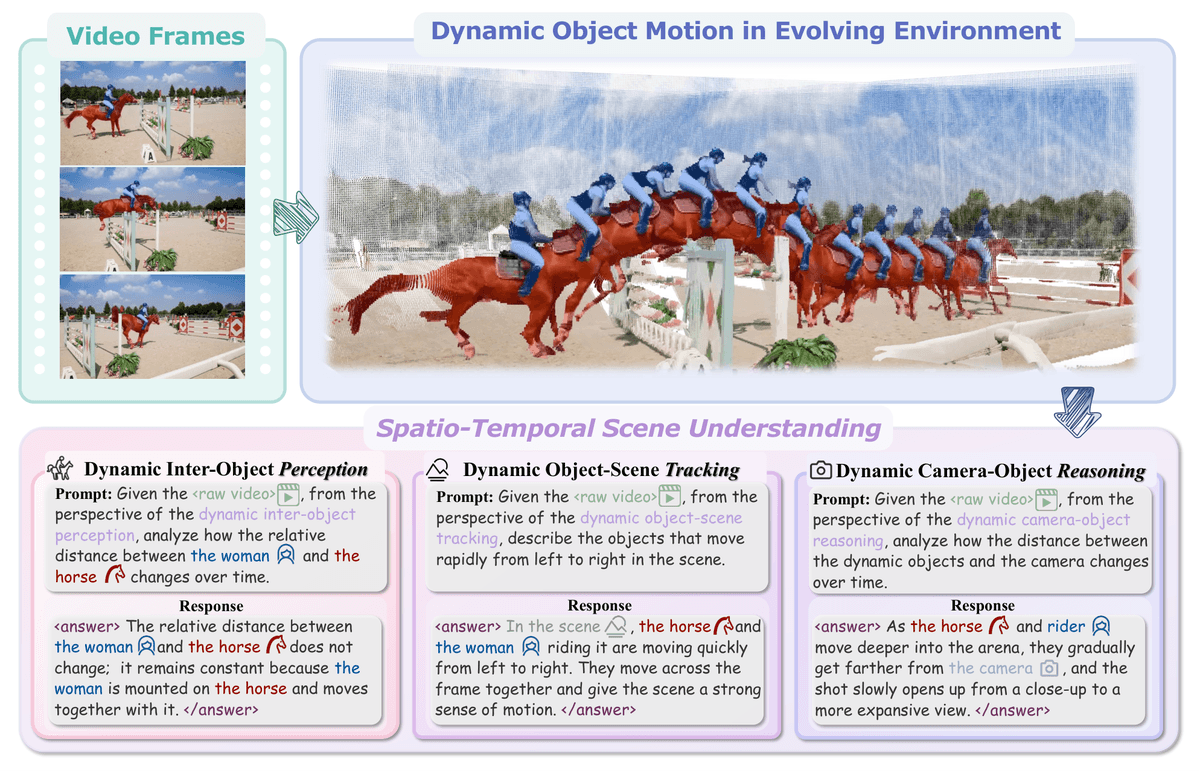
The team behind it, a collaboration across Xiamen University, Tsinghua, CUHK, and others, argues that existing video benchmarks lean too heavily on scene-level captions and skip the object-centric dynamics that matter for interaction. Dyn-Bench comprises 1k dynamic video scenes with 7k visual question answering pairs and 3k grounding annotations, collected from four 2D video segmentation and four 4D dynamic scene datasets spanning diverse environments, motion patterns, and camera trajectories.
Why static intelligence breaks in motion
The paper frames the problem as a gap between spatial and spatio-temporal cognition. While these models demonstrate strong semantic and spatial reasoning capabilities on static images, their success does not readily generalize to dynamic video understanding. When scenes evolve, models lose track of who moved where, misjudge distances under camera motion, and confuse the order of events.
The authors dissect this failure by looking at GPT-4o's own chain-of-thought traces. Errors cluster into three types: temporal reasoning errors, where the model fails to maintain event order or motion continuity, interpreting sequences as discrete frames rather than continuous processes; spatial grounding errors, arising from limited geometric understanding and resulting in inaccurate distance or position estimation; and relational reasoning errors, reflecting persistent difficulty in capturing causal or interactional dependencies between objects.

Three levels of dynamic understanding
Dyn-Bench structures its tasks around three complementary axes, each pairing multiple-choice VQA with a matching segmentation-mask grounding task:
- Dynamic Inter-Object Perception captures spatial relations and interactions among moving objects, like approach, occlusion, or overtaking.
- Dynamic Object-Scene Tracking models how individual objects enter, leave, or transform within evolving scenes.
- Dynamic Camera-Object Reasoning tests how camera motion changes perceived geometry, depth, and event order.
The source videos come from eight datasets: DAVIS, SA-V, DynPose-100K, YouTube-VIS, DynamicReplica, PointOdyssey, Spring, and Total-Recon. A multi-stage filter then trims roughly 38,500 raw candidates down to 1,000 human-verified clips, scoring each on motion features, geometric stability, and semantic coherence via a random forest that predicts a video dynamism score between 0 and 5.
The scoreboard is uncomfortable
The team evaluated three families of models: general MLLMs, spatial reasoning variants, and region-level models that natively output masks. On spatio-temporal reasoning, Qwen3-VL-235B achieving comparable or even superior overall results to closed frontier models, topping the leaderboard at 65.3% average accuracy. Gemini 2.5 Pro (59.8%) narrowly edged GPT-5 (59.5%), while GPT-4o trailed at 50.1%. Random guessing sits at 25%.
Some categories are downright painful. GPT-4o scores just 38.7% on movement and temporal dynamics questions, and 42% on camera-object interaction. Even the best-performing region-level model, UniPixel-7B, averages only 58.1% on reasoning while achieving a much stronger 65.2 J&F on grounding, illustrating a core finding: existing models cannot simultaneously maintain strong performance in both spatio-temporal reasoning and dynamic object grounding, often producing inconsistent interpretations of motion and interaction.

Prompting doesn't save you, structure does
Perhaps the most useful takeaway for practitioners is what does and does not fix the gap. Conventional prompting strategies, such as chain-of-thought or caption-based cues, yield limited gains, whereas structured integration methods, including Mask-Guided Fusion and the proposed ST-TCM, enable more coherent modeling of motion and significantly improve spatio-temporal reasoning on Dyn-Bench.
ST-TCM, short for Spatio-Temporal Textual Cognitive Map, is the paper's main methodological contribution. Rather than asking a model to infer geometry from pixels, it reconstructs 3D object trajectories from RGB-D and mask inputs, then translates that structure into text the model can actually consume. The pipeline works like this:
- Sample RGB-D frames at 6 FPS with instance masks, then use VIPE to estimate per-frame depth and camera poses at metric scale.
- Project instance centroids into world coordinates to build 3D trajectories, computing velocity and acceleration with exponential smoothing.
- Derive inter-object distances, relative motion rates, and object-camera azimuth/elevation to categorize behaviors as approaching, receding, or parallel.
- Convert every geometric and kinematic attribute into natural-language descriptions with a rule-based template, forming a per-frame textual narrative.
- Feed the resulting cognitive map into Qwen3-VL-235B alongside the video for object-centered VQA and grounding.
An ablation over the three ST-TCM components (temporal semantics T, motion dynamics M, spatial geometry S) shows all three help, but not equally. On Qwen3-VL-32B, average accuracy climbs from 62.8 without the map to 68.3 with all three components enabled. For UniPixel-3B, motion cues alone deliver the biggest bump on grounding. The visual counterpart, Mask-Guided Fusion, overlays segmentation masks on raw frames and pushes Qwen3-VL-8B from 53.8 to 57.1 average, with the largest gains in inter-object and camera-object reasoning.

What this is good for
If you are building a robotics stack, an AR agent, or any system that consumes video and needs to reason about object motion, Dyn-Bench gives you a specific diagnostic for the object-centric failure modes your model will hit in production. The three-axis structure lets you identify whether the weakness is inter-object relations, scene evolution, or camera-motion coupling, and the paired grounding masks make it possible to verify not just that the model answered correctly but that it looked at the right pixels.
The benchmark isn't a training set and won't fix your model on its own. The takeaway is architectural: for now, feeding structured geometry and mask overlays as auxiliary inputs beats hoping a bigger model or a longer chain-of-thought will figure motion out on its own.
Everything is public. The code lives on GitHub, the dataset is on Hugging Face, and the full paper includes prompt templates for every task category if you want to reproduce or extend the QA generation pipeline.