
Duke's UnfoldLDM Fixes Blurry AI Image Restoration Across 8 Tasks at Once
UnfoldLDM merges deep unfolding networks with latent diffusion priors to restore images from unknown degradations, topping benchmarks across eight tasks
 Pro
Takeaways
- UnfoldLDM integrates deep unfolding networks with a latent diffusion model to tackle blind image restoration across unknown degradation types.
- It fixes two core DUN failures: degradation-specific dependency and over-smoothing bias that destroys fine textures.
- The MGDA module estimates degradation as both a holistic matrix and decomposed factors simultaneously, with no assumption about degradation type.
- A compact 64-dim diffusion prior (DR-LDM, 3 timesteps) guides an OCFormer to explicitly recover high-frequency textures suppressed by gradient descent.
- Achieves SOTA on 8 BIR benchmarks including denoising (40.23 dB on SIDD), underwater (+3.24% over Reti-Diff), and deraining at 87 GFLOPs vs. 2335 GFLOPs for DGUNet.
- DR-LDM works as a plug-and-play module for existing DUN architectures, delivering consistent gains across 6 different models and tasks.
Image restoration has long been split between two camps: model-based methods that are interpretable but brittle, and deep learning methods that are powerful but opaque. Deep unfolding networks (DUNs) were supposed to be the best of both worlds, translating classical iterative optimization algorithms into trainable neural network stages. In practice, they hit a wall the moment the degradation type is unknown.
A team from Duke University, Shanghai Jiao Tong University, Peking University, and Tsinghua University now proposes UnfoldLDM, a framework that surgically fixes the two core failure modes of DUNs by embedding a compact latent diffusion model inside the unfolding loop. The result is a single architecture that handles eight different blind image restoration (BIR) tasks -- from denoising and deblurring to underwater enhancement and blind super-resolution -- and sets new state-of-the-art results across all of them.
The two problems DUNs have always had
To understand why UnfoldLDM matters, you need to know how DUNs work. A DUN takes a classical optimization algorithm (like proximal gradient descent) and "unrolls" it: each iteration of the algorithm becomes one stage of a neural network. Each stage alternates between a gradient descent step (which enforces that the output looks like the degraded input) and a proximal step (which enforces that the output looks like a natural image, using a learned prior).
Existing proximal-gradient DUNs face two challenges. First, degradation-specific dependency: most are designed for a particular degradation type and rely on known physical priors, making them unsuitable for complex or mixed degradations. You train a DUN for deblurring, and it breaks on rain. You train it for low-light, and it fails on noise.
Second, over-smoothing bias: the gradient descent step derives updates dominated by low-frequency content, creating an information bottleneck that starves the proximal operator of the high-frequency cues needed for texture recovery. This bias accumulates across stages, producing over-smoothed results with diminished structural fidelity.

Three modules, one coherent fix
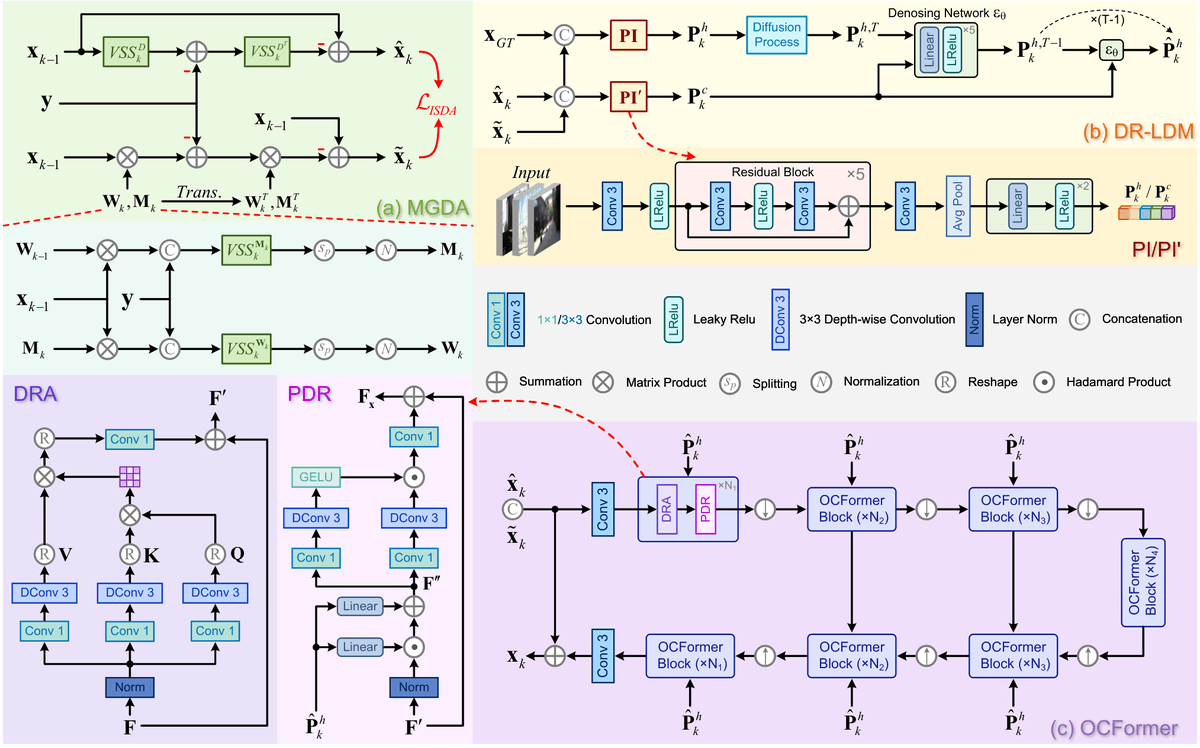
UnfoldLDM integrates DUNs with a latent diffusion model for BIR. In each stage, it employs a multi-granularity degradation-aware (MGDA) module as the gradient descent step, which models BIR as an unknown degradation estimation problem and estimates both the holistic degradation matrix and its decomposed forms, enabling robust degradation removal.
The key insight in MGDA is a structured matrix decomposition. Instead of trying to learn a single giant degradation matrix D (whose size grows quadratically with image resolution), the team decomposes it into two smaller matrices W and M that capture spatial and spectral distortions separately. Both forms are estimated simultaneously, and a custom Intra-Stage Degradation-Aware (ISDA) loss keeps them consistent with each other. Visual State Space (VSS) blocks -- a Mamba-based architecture well-suited for global spatial reasoning -- are used to simulate the degradation operators in a data-driven way, with no assumption about what the degradation actually is.
For the proximal step, the team introduces two new components:
- DR-LDM (Degradation-Resistant Latent Diffusion Model): A compact diffusion model that operates in a low-dimensional latent space (a 64-dimensional vector by default). It takes the MGDA outputs and distills them into a degradation-invariant prior -- a compact representation of what the clean image should look like, stripped of artifacts. Critically, it runs in only 3 diffusion timesteps, keeping inference fast.
- OCFormer (Over-smoothing Correction Transformer): A U-shaped transformer that takes the MGDA estimates and the DR-LDM prior, then explicitly recovers the high-frequency textures that gradient descent suppressed. It uses a Prior-guided Detail Recovery (PDR) module that reweights latent features using the diffusion prior as a conditional signal.

The training is split into two phases. Phase I pretrains the backbone using ground-truth images to teach the network what kind of prior information helps fine-detail recovery. Phase II then trains DR-LDM to reproduce those high-quality priors from degraded inputs alone. This unique combination ensures the final result is degradation-free and visually rich.
What the numbers say
UnfoldLDM was evaluated on eight BIR tasks across a wide range of benchmarks. The results are consistently strong:
- Denoising (SIDD/DND): 40.23 dB PSNR on SIDD, surpassing MambaIR (39.89 dB) and DeepSN-Net (39.79 dB)
- Deblurring (GoPro/HIDE): Leads qualitatively and quantitatively against UFPNet, FFTformer, and DeepSN-Net
- Underwater enhancement (UIEB): 24.70 dB PSNR, surpassing the previous best (Reti-Diff) by 3.24%
- Backlit enhancement (BAID): 24.97 dB PSNR, surpassing Reti-Diff by 5.78%
- Low-light enhancement (LOL-v2-syn): 27.92 dB PSNR, beating Reti-Diff by 2.36% and CIDNet by 3.32%
- Blind super-resolution (RealSR/DRealSR): Best fidelity-perception tradeoff, running 2x faster than existing SOTAs
- Deraining (5 datasets): SOTA across all metrics with only 87.33 GFLOPs -- far below DGUNet's 2335 GFLOPs
Beyond raw image quality, the team tested whether better restoration translates to better downstream performance. UnfoldLDM benefits downstream tasks -- specifically, applying it as a preprocessing step for low-light object detection on the ExDark benchmark pushed mean AP from 75.8 (Reti-Diff) to 81.1.

The plug-and-play angle
One of the most practical contributions is that DR-LDM can be dropped into existing DUN-based pipelines without retraining them from scratch. The team tested this across six different architectures and tasks:
- URetinex-Net (low-light): +1.49 dB PSNR on LOL-v1
- IVF-Net (image fusion): +0.50 EN on TNO dataset
- DeepSN-Net (deblurring): +0.93 dB PSNR on GoPro
- DGUNet (deraining): +0.62 dB PSNR on Rain100L
- RUN (salient object detection): improved F-beta on both DUT and HKU datasets
- CORUN (dehazing): lower FADE and BRISQUE scores on RTTS
The gains are consistent across both low-level restoration tasks and high-level vision tasks, suggesting the DR-LDM prior captures genuinely universal structural information.
Efficiency and limitations
The base UnfoldLDM model has 26.91M parameters and runs at 11.32ms per image on an RTX 5090, training 40% faster than Reti-Diff (18.59h vs. 30.89h). For resource-constrained settings, the team also released UnfoldLDM-l, a lightweight variant with just 1.06M parameters and 2.12 GFLOPs that still beats CIDNet by 0.65 dB with 44% fewer parameters.
The framework does have real constraints. It assumes same-resolution input and output in its gradient steps, so super-resolution tasks require an external upsampling module. The multi-stage design also faces memory pressure at very high resolutions despite parameter sharing across stages. The authors flag two future directions: faster prior extraction via consistency distillation or flow-based models, and extending the framework to video restoration by exploiting temporal coherence across unfolding stages.
Code has not yet been released at the time of writing, though the paper states it will be made available. Given the plug-and-play nature of DR-LDM, the release will be worth watching for anyone working on image restoration pipelines built on existing DUN architectures.