
Dublin City University Finds Stronger AI Circuits Don't Always Improve Performance
New research shows synthetic pretraining data can boost induction-head signatures without making them causally necessary, complicating a popular data intervention playbook.
 Pro
Takeaways
- Bi-Induct injects short duplicate-span snippets into pretraining to explicitly excite induction and anti-induction circuits.
- Across 0.13B, 0.5B, and 1B models under matched compute, the intervention reliably increases induction-head activity in telemetry.
- Standard few-shot benchmarks are largely performance-neutral, and the 1B natural-only baseline wins on function-style probes.
- Ablating the top 2% induction heads hurts the natural-only baseline most, indicating more centralized, load-bearing circuitry.
- Even explicit backward-copy training fails to produce meaningful anti-induction heads, exposing a strong forward/backward asymmetry.
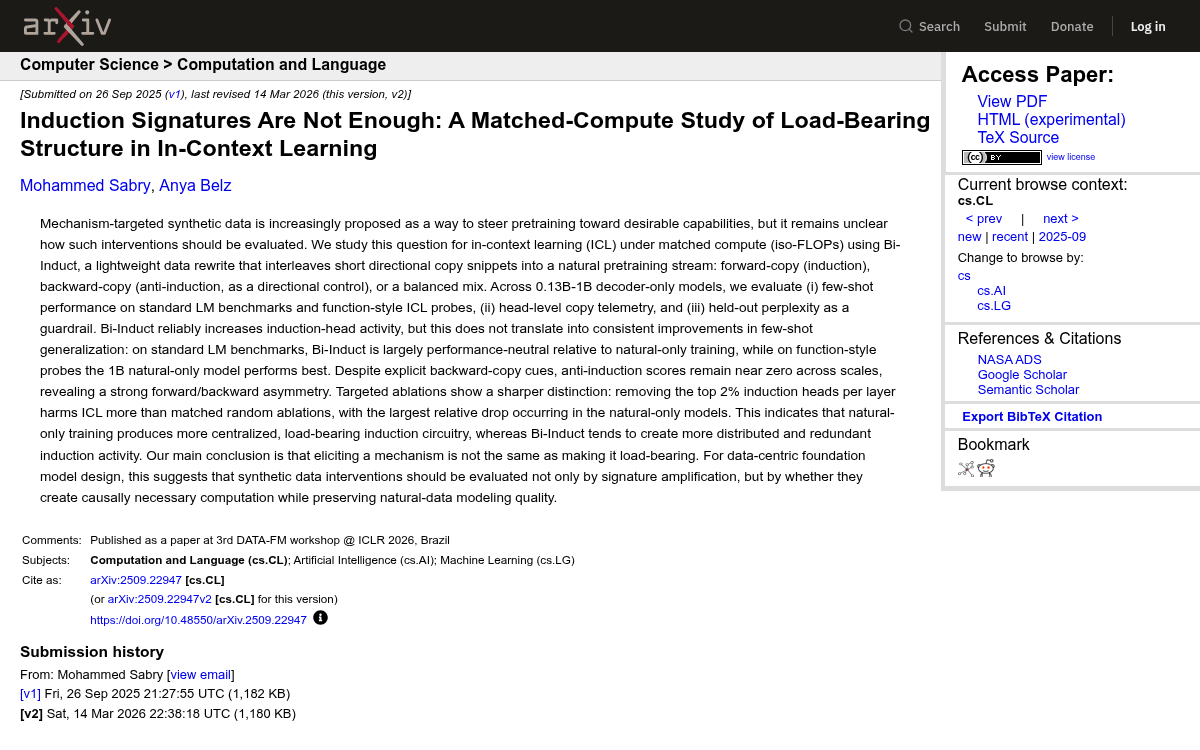
- Full paper and methodology available at arxiv.org/abs/2509.22947.
A common assumption in data-centric pretraining is that if you can nudge a model into forming a specific internal circuit, you'll also boost the behaviors that circuit supports. A new paper from researchers at Dublin City University's ADAPT Centre pushes back on this idea with a controlled experiment across 0.13B, 0.5B, and 1B decoder-only models. Their conclusion: making a mechanism visible is not the same as making it useful.
The team focused on induction heads, the two-attention-head motif famously linked to in-context learning (ICL) by Anthropic's interpretability team. When a token A reappears in context, the model increases the probability of the token that followed the previous A, and this simple copy pattern is widely credited with the emergence of few-shot behavior. The problem is that this motif typically emerges only after many billions of tokens, well after the first training-loss plateau. If you could trigger it earlier through data alone, ICL should improve at the same compute budget. That's the hypothesis the paper tests, and mostly falsifies.
Copying as a curriculum
The intervention is deliberately minimal. The authors introduce Bi-Induct, a lightweight curriculum that interleaves short duplicate-span snippets with natural text during early training. Each snippet is a short random token span followed by a separator and then either the same span again (forward induction) or its reverse (anti-induction, used as a directional control). A third variant flips a coin per injection to mix directions.
Under the chosen operating point (span length 20, 50% initial mix ratio linearly annealed to zero over the full training budget), the recipe replaces a small fraction of natural tokens with these synthetic copy exercises. Training uses The Pile with iso-FLOPs across all conditions, meaning any variant gets exactly the same compute as the natural-only baseline. Here is a rough sketch of what a forward snippet looks like in practice:
span = sample_tokens(L=20)
sep = tokenize(" ")
forward_snippet = span + sep + span            # induction
backward_snippet = span + sep + span[::-1]     # anti-induction
Signatures light up, performance doesn't
The evaluation runs along three axes: few-shot benchmarks (MMLU, ARC-C, BoolQ, LAMBADA, PIQA and more), function-style probes from Todd et al.'s function vectors suite (capitalize, next_item, alphabetically_first, etc.), and head-level copy telemetry.
On standard LM benchmarks, Bi-Induct is essentially a wash. At 0.13B, Anti is closest (22.5 vs. 22.7); at 0.5B, Induction leads (23.9 vs. 23.6); at 1B, Balanced is on par or marginally higher (24.3 vs. 24.2). The story shifts on the function-style probes, which are more sensitive to explicit copy behavior. There the natural-only 1B model is clearly ahead of all Bi-Induct variants.

Held-out perplexity tells a consistent third story. The perplexity gap between copy-snippet curricula and the baseline shrinks with scale, suggesting that larger models can absorb a small synthetic perturbation of the training stream without lasting calibration cost. These observations show that a light, annealed Bi-Induct schedule keeps the perplexity penalty bounded and shrinking with scale, but the natural-only baseline remains consistently better on held-out perplexity at every scale.
Emergence vs load-bearing
The most interesting result comes from targeted ablations. The authors define a per-head copy score, then zero out the value-stream contribution of the top 2% highest-scoring induction heads per layer at inference. They compare that drop to ablating the same number of random heads.
If Bi-Induct genuinely built stronger circuitry, the copy-snippet models should be hurt most by removing their supposedly stronger induction heads. The data shows the opposite pattern on the function-probe suite:
| Model | Baseline Δ induct | Induction Δ induct | Balanced Δ induct |
|---|---|---|---|
| 0.13B | -22.6% | -4.9% | -19.2% |
| 0.5B | -14.6% | -10.3% | -12.5% |
| 1B | -19.5% | -14.5% | -8.7% |
The natural-only Baseline degrades the most when its top induction heads are removed. The authors interpret this as evidence that natural-only training produces more centralized, load-bearing induction circuitry, whereas Bi-Induct tends to create more distributed and redundant induction activity. A plausible driver is front-loaded recruitment: because Bi-Induct concentrates copy cues early and then anneals them away, it may recruit multiple induction-capable heads that persist as redundant backup pathways rather than becoming a single load-bearing bottleneck.

A stubborn forward/backward asymmetry
The anti-induction results are their own kind of finding. Even explicitly training on backward-copy snippets fails to produce meaningful anti-induction heads. The largest peak we observe is ≈0.04 at 0.5B (Induction curriculum), followed by ≈0.02 at 1B (Baseline). That matches earlier reports of a pretrained transformer asymmetry favoring forward copy, and it suggests token-level data rewrites can't easily flip that bias.
Why this matters for data-centric design
The methodological takeaway is stricter than a Bi-Induct verdict. Synthetic pretraining rewrites like WRAP and math/code rephrasing recipes are increasingly popular because they're cheap to deploy at scale. This paper argues the evaluation bar should include:
- Does the intervention amplify the target internal signature? (Bi-Induct: yes)
- Does downstream few-shot behavior improve or at least hold? (Bi-Induct: neutral to worse at 1B)
- Does head-level ablation confirm the target circuit is causally necessary, not just visible? (Bi-Induct: no, natural training wins)
- Does natural-language modeling quality stay intact? (Bi-Induct: small but persistent perplexity penalty)
The authors are careful to frame Bi-Induct as a case study, not a failed recipe. The wider claim is that circuit emergence and circuit reliance can move independently, and that only the second one predicts task behavior. For anyone building synthetic pretraining pipelines, that's a load-bearing distinction.