
DualTSR Sharpens Blurry Text 27% Better Without an External OCR Model
A single multimodal transformer trained with two diffusion objectives restores blurred scene text without any external OCR module.
 Pro
Takeaways
- DualTSR unifies scene text super-resolution and text recognition in a single multimodal transformer, no external OCR needed.
- Combines Conditional Flow Matching for images with absorbing-state discrete diffusion for characters in one backbone.
- Uses MM-DiT joint attention from SD3 so image and text tokens interact at every layer, not just at fusion points.
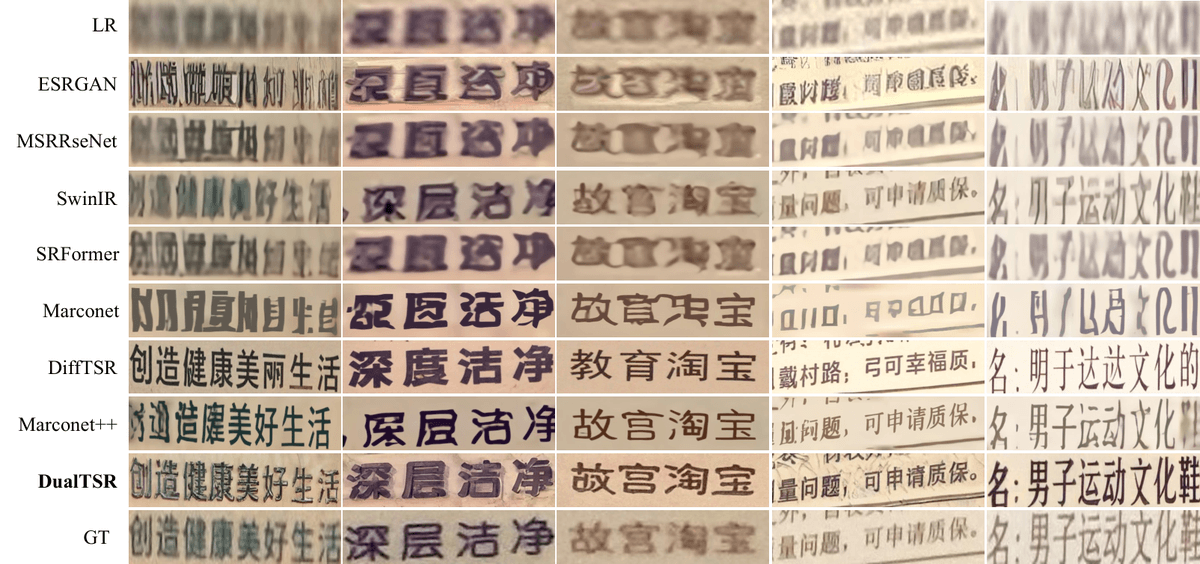
- Beats DiffTSR on CTR-TSR ×4 with FID 16.42 vs 22.24 and 57.65% vs 44.87% recognition accuracy.
- Achieves best ACC and NED on curated RealCE ×4 real-world subset among all tested methods.
- Trades PSNR for perceptual quality and text fidelity; four sampling steps beat forty for character legibility.
Restoring crisp text from a blurry, low-resolution image is a stubborn corner of super-resolution. General image models can sharpen textures fine, but text carries meaning encoded in the exact shape of strokes, so a single missing hook can flip one Chinese character into another. A new paper introduces DualTSR, a unified diffusion transformer that reconstructs the pixels and the underlying characters at the same time, inside one model.
Why text super-resolution keeps getting messy pipelines
Scene Text Image Super-Resolution aims to restore high-resolution details in low-resolution text images, but existing methods often depend on external OCR models for textual priors or rely on complex multi-component architectures that are difficult to train and reproduce. The OCR-guided route has a nasty failure mode: if the recognizer misreads the blurry input, that error propagates into the super-resolution network as hallucinated strokes and wrong glyphs.
Recent alternatives leaned on structural priors like character codebooks (MARCONet) or SAM-generated glyph masks (GlyphSR), but each fix added another stage to the pipeline. The strongest diffusion baseline, DiffTSR, splits image and text into separate diffusion branches connected by a fusion block, which works but is a three-stage system with its own auxiliary text recognizer.
One transformer, two diffusion processes
DualTSR collapses that pipeline into a single backbone. It employs a single multimodal transformer trained with a dual diffusion objective, simultaneously modeling the continuous distribution of high-resolution images via Conditional Flow Matching and the discrete distribution of textual content via discrete diffusion. This shared design enables visual and textual information to interact at every layer, allowing the model to infer text priors internally instead of relying on an external OCR module.
The architecture borrows the MM-DiT joint attention block from Stable Diffusion 3. Image latents and text tokens each get their own stream with adaLN modulation, but during attention they are concatenated into shared query, key, and value projections, then split back out. That means visual features can guide text prediction and predicted characters can steer stroke reconstruction at every layer, not just at a fusion point.

How the two diffusions work together
The two branches use fundamentally different noise processes because images are continuous and characters are not:
- Image branch: Conditional Flow Matching. The model learns a velocity field along a linear path between clean latent and Gaussian noise. At inference, an Euler ODE solver walks noise back to a clean latent, then a VAE decodes it to RGB.
- Text branch: Absorbing-state discrete diffusion. Characters get progressively replaced with a special
[MASK]token, and the model learns to unmask them. At inference the sequence starts fully masked and gets filled in synchronously with the image denoising steps. - Joint objective: Both modalities are corrupted with the same timestep, and the loss combines flow matching MSE, discrete cross-entropy, and a joint term. A classifier-free guidance variant with an EMA teacher supplies rectified velocity targets.
What the numbers say
Training ran on 4 A100s for 700k iterations on CTR-TSR, a Chinese scene text dataset the authors built from the CTR corpus using a BSRGAN and Real-ESRGAN style blind degradation pipeline. Evaluation also covered a curated 300-sample subset of RealCE for real-world text.
On the synthetic CTR-TSR ×4 setting, DualTSR reports FID 16.42 versus 22.24 for DiffTSR, and text recognition accuracy of 57.65% versus 44.87%. Interestingly, PSNR is lower than several baselines (20.54 vs. 25.05 for SRFormer), which reflects a real tradeoff: the model favors perceptually realistic strokes and correct characters over pixel-wise similarity to the ground truth. On RealCE ×4, it hits the best ACC (62.20%) and NED (88.49%) of any method tested.

Where it works and where it does not
An interesting ablation: more sampling steps improve FID (peaking around 40 steps) but hurt text accuracy, because extra refinement smooths out the high-frequency stroke details that distinguish similar characters. The authors settle on just 4 steps as a compromise. Similarly, classifier-free guidance above 1.0 makes things worse across the board, unlike typical image synthesis.
Limitations the paper is upfront about: results are Chinese-only, several baselines are compared using official checkpoints rather than retrained under the same degradation recipe, and under severe corruption the model may sacrifice font style to keep text legible. The authors present DualTSR as a unified STISR framework that jointly learns image super-resolution and text recognition within a single multimodal transformer, and the paper states that code, dataset construction scripts, and pretrained checkpoints will be released, though nothing is on public trackers yet.
The practical takeaway: if you are building an OCR pipeline that has to handle document scans, storefront photos, or receipts with fine scripts, a joint image-plus-text diffusion backbone can outperform recognizer-guided cascades without the ops burden of running an OCR pass twice. For anyone working on multimodal generation, the recipe of pairing flow matching on continuous data with masked discrete diffusion inside one MM-DiT stack is a template worth watching beyond text super-resolution.