
Dual-R-DETR Boosts Object Detection Accuracy by 1.7 mAP With Zero Inference Cost
A new DETR variant reshapes decoder self-attention with asymmetric routing biases, boosting DINO by 1.7 mAP on COCO with zero inference cost.
 Pro
Takeaways
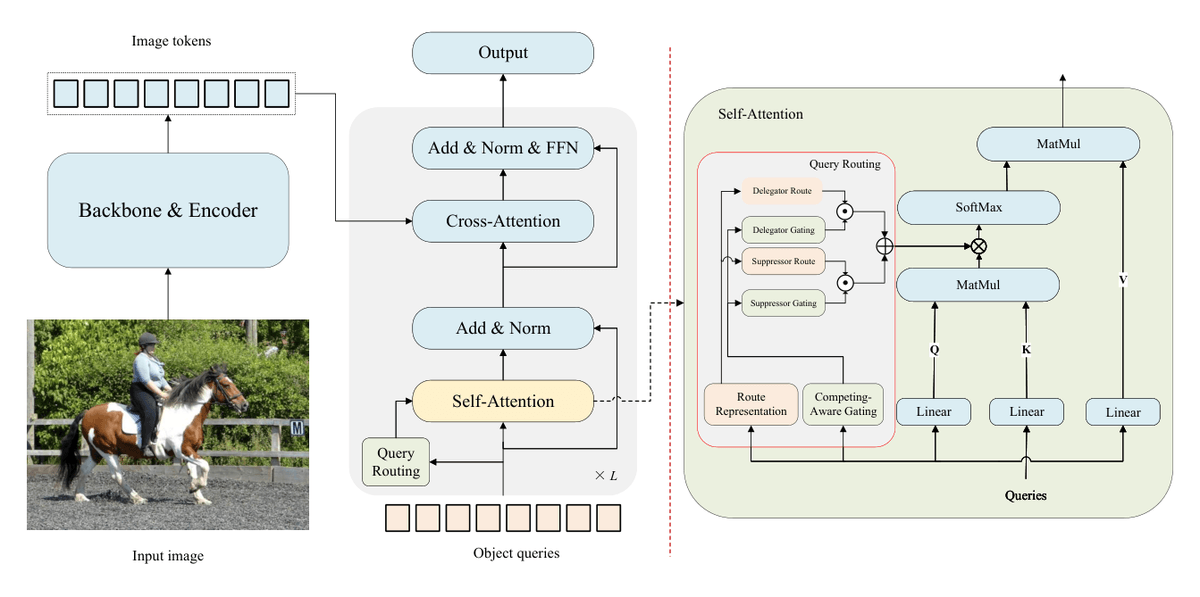
- Dual-R-DETR adds pairwise routing biases to DETR decoder self-attention to fix inefficient query competition dynamics.
- Two routes: suppressor dampens duplicate-targeting queries, delegator diversifies coverage across regions.
- Biases are low-rank, gated by similarity, confidence, and box geometry between each query pair.
- Dual-branch training keeps vanilla attention at inference, so zero added latency or parameters.
- Boosts DINO by +1.7 mAP on COCO with ResNet-50, hits 57.6 mAP with Swin-L.
- Code available; also improves Deformable-DETR, DAB-DETR, and instance segmentation on Cityscapes.
Object detection with Detection Transformers has a well-known efficiency problem hiding inside its decoder: object queries fight each other for the same targets, and the loser gets tossed out as background. A new paper, Dual-R-DETR, rewrites how queries interact, and it does so without adding a single FLOP at inference time.
When queries collide
DETR replaced non-maximum suppression with a set-prediction formulation, where a fixed pool of learnable object queries competes for objects under a one-to-one label assignment. In practice, that competition is messy. Cross-attention in decoder layers refines the localization of all queries, often attracting several toward the same target, but only one can win. The rest get pushed into the background class after burning compute refining a prediction they were never going to keep.
The authors argue this is a structural issue with standard self-attention in the decoder: it treats every pair of queries symmetrically, with no notion of whether they are competing for the same object or covering different regions of the image.

Suppressors and delegators
Dual-R-DETR (called Route-DETR in the paper text) adds a competition-aware routing mechanism to the decoder's self-attention. Every pair of queries gets classified on the fly as either competitive or cooperative, using three cheap signals: cosine similarity between query features, the predicted classification confidence, and a log-scale geometric area of each predicted box. Based on that classification, one of two routing behaviors kicks in: