
Dual Mirror Descent Beats Standard Optimizers by Orders of Magnitude on Sparse Problems
A new family of Mirror Descent optimizers built on group theory outperforms standard methods on sparse, constrained problems by 3.6x or more
 Pro
Takeaways
- New optimizer family: Dual Mirror Descent (DMD) uses group-theoretic link functions to generalize exponentiated gradient descent with tunable hyperparameters.
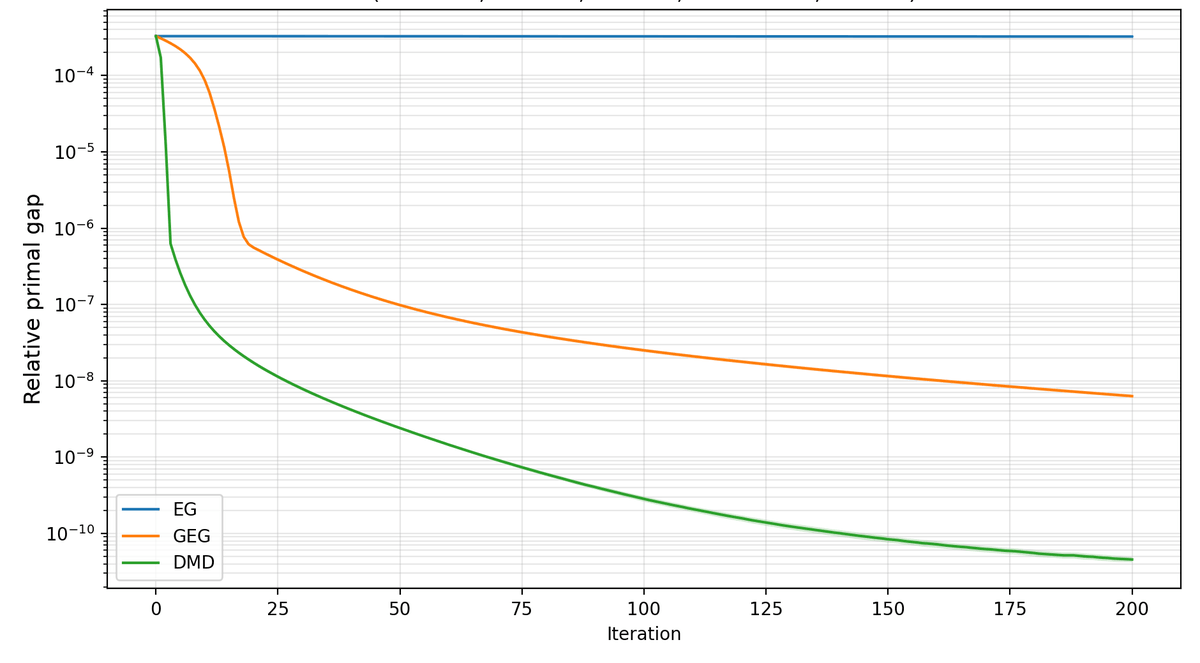
- 3.6x faster convergence: DMD reaches 10^-6 precision in 200 iterations where standard EG stalls at 10^-1 on sparse quadratic programs.
- Perfect sparsity recovery: DMD achieves exact support identification (IoU=1.0) in 2-15 iterations; EG fails within 100 iterations on the same problems.
- Dimension-free scaling: Iteration count grows only logarithmically with problem size n (tested up to n=50,000), unlike standard methods.
- Theoretical guarantee: DMD's condition number is provably bounded by Euler's number e for all valid hyperparameter settings; GEG's is unbounded near sparse boundaries.
- No code released yet: Experiments use only single-parameter Tsallis q-log; multi-parameter chain link functions are theorized but not yet benchmarked. Paper on arXiv.
Gradient descent is the engine of modern machine learning, but it has a well-known blind spot: problems where weights must stay non-negative, sparse, or constrained to a probability simplex. A new paper from researchers at the Polish Academy of Sciences and Universidad Complutense de Madrid proposes a principled fix, one that reaches all the way back to abstract algebra to build a richer, more flexible family of optimizers. The result is a framework they call Group Entropies and Mirror Duality, and its flagship algorithm, Dual Mirror Descent (DMD), beats standard methods by orders of magnitude on the problems it targets.
Why standard optimizers struggle at the boundary
Mirror Descent (MD) is a generalization of gradient descent designed for non-Euclidean settings. Instead of taking a step in the raw gradient direction, MD first maps the current weights into a "dual space" using a link function (the gradient of a convex potential), takes a gradient step there, then maps back. The classic example is Exponentiated Gradient (EG), which uses the natural logarithm as its link function and is naturally suited to probability distributions.
The problem is rigidity. Conventional exponentiated gradient (EG) updates are most naturally suited to domains whose geometry is governed by the Kullback-Leibler divergence, as is common when optimizing over probability distributions. A significant drawback of these classic EG schemes is their rigidity: the absence of adjustable hyperparameters prevents them from adapting to datasets with diverse distributional properties, thereby constraining both their convergence dynamics and practical performance.
There is also a deeper numerical issue. In sparse problems, EG keeps every weight strictly positive, hovering near a noise floor rather than snapping to zero. Noise prevents standard algorithms from driving inactive weights to zero; for example, multiplicative EG updates keep each weight hovering near w_i ≈ ησ, destroying sparsity and interpretability. This makes EG fundamentally unsuitable for tasks like sparse portfolio selection or compressed sensing, where identifying the correct zero entries is the whole point.
Group entropies: the algebraic toolkit
The authors' key insight is that the choice of link function is not arbitrary -- it can be grounded in a rich mathematical structure called group entropy. A group entropy is a generalized measure of information that satisfies the first three Shannon-Khinchin axioms (continuity, maximum principle, expansibility) plus a composability axiom: the entropy of a combined system must follow a formal group law. Shannon entropy satisfies simple additivity; Tsallis entropy satisfies a multiplicative law; the new framework encompasses all of these and infinitely more.
The theory of formal groups, a fundamental branch of algebraic topology, offers a rich source of link functions expressed in terms of generalized logarithms and exponentials. These generalized functions, in turn, find their primary physical motivation in the theory of group entropies. Each valid group law yields a distinct group logarithm -- a generalized log function with tunable hyperparameters -- which can then be plugged in as the link function for a Mirror Descent update. The catalog is enormous:
- Shannon: the standard natural log, recovered when the group law is simple addition
- Tsallis q-logarithm: log_q(x) = (x^(1-q) - 1)/(1-q), with one tunable parameter q
- Kaniadakis κ-logarithm: log_κ(x) = (x^κ - x^(-κ))/(2κ), originally from relativistic statistical mechanics
- Euler two-parameter logarithm: log_Euler(x) = (x^a - x^b)/(a-b), tied to the Abel formal group
- Chain logarithms: novel compositions of the above, creating multi-parameter link functions with independent control over boundary and interior behavior
Group entropies can depend on several hyperparameters, which can be tuned or learned to adapt to the statistical properties of data or the geometry of the optimization problem. This is the core promise: instead of picking a fixed optimizer geometry, you can shape it to your data.
Mirror duality: the key symmetry
The paper's central theoretical contribution is a symmetry they call mirror duality. Every group logarithm has an inverse -- the group exponential -- and the paper proves that you can swap the link function for its inverse and still get a valid Mirror Descent algorithm, as long as you adjust the learning rate accordingly.
This is not just a mathematical curiosity. A concave link function, such as those induced by group logarithms, reduces the growth of the associated Bregman divergence and lowers geometric curvature, improving algorithmic stability but potentially slowing convergence. Conversely, convex link functions, including group exponentials, increase curvature and may yield faster convergence. Mirror duality lets you switch between these two regimes in a principled way.
The authors exploit this to define Dual Mirror Descent (DMD), an algorithm with two branches:
- Dual branch (default): uses the group exponential as the link function -- convex, high curvature, fast convergence
- Primal fallback: switches to the group logarithm when gradients are very large, providing stability
Switching between DMD and GEG occurs only for large positive values of the gradient, whereas for relatively small gradient values the algorithm employs only the DMD branch. Consequently, branch switching is rare and occurs only during the first few iterations.

How it actually works, step by step
In practice, the paper uses the Tsallis q-logarithm as its proof-of-concept link function. The GEG (Generalized Exponentiated Gradient) update looks like this:
# GEG update using Tsallis q-log and q-exp
# log_q(x) = (x^(1-q) - 1) / (1-q)
# exp_q(x) = [1 + (1-q)*x]^(1/(1-q))
def geg_update(w, grad, eta, q):
    # Step in dual space using group log
    dual = log_q(w) - eta * grad
    # Map back with group exp
    w_new = exp_q(dual)
    # Project onto simplex
    return w_new / w_new.sum()
def dmd_update(w, grad, eta, q):
    # Dual branch: use exp_q as link function
    z = exp_q(w) - eta * grad
    w_new = log_q(z).clip(min=0)  # ReLU-like hard threshold
    # Fallback to GEG when z <= 0
    # Normalize
    return abs(w_new) / abs(w_new).sum()
The key mechanism in DMD is the clip(min=0) operation. The ReLU-like clipping operator acts as a hard thresholding mechanism. If the gradient drives a weight w_i towards zero, the operator instantly sets that weight to 0. This ensures both non-negativity and sparsity. Standard EG can never do this -- its exponential update always keeps weights positive.
Chain link functions take this further by composing multiple group logarithms and exponentials. For example, combining Tsallis and Kaniadakis gives a two-parameter update:
# Chain link: Tsallis q-log composed with Kaniadakis kappa-exp
# f_{q,kappa}(w) = log_q(exp_kappa(ln(w)))
# Gives a 2-parameter MD update with decoupled interior/boundary behavior
def chain_md_update(w, grad, eta, q, kappa):
    inner = exp_kappa(log(w))      # Kaniadakis transform
    dual  = log_q(inner) - eta * grad  # Tsallis step
    w_new = exp(log_kappa(exp_q(dual)))  # Inverse chain
    return w_new / w_new.sum()
Benchmarks: sparse quadratic programs
The experiments focus on Simplex-Constrained Quadratic Programming (SCQP) -- minimizing a quadratic objective over a probability simplex. This is a canonical problem that appears in sparse attention mechanisms, portfolio optimization, federated learning aggregation, and multiple kernel learning. The challenge is compounded by two factors: extreme spectral ill-conditioning (condition numbers up to 10^7) and additive Gaussian noise.
All three algorithms -- EG, GEG, and DMD -- were tested at problem dimensions from n=1,000 to n=50,000, with sparsity ranging from 5% to 70% and SNR from 60 dB down to -5 dB. The entropic index was set to q=0.25 for both GEG and DMD.

The results are striking. The DMD algorithm significantly outperforms both EG and GEG: the EG curve remains nearly flat at a relative primal gap of approximately 10^-1 even after 200 iterations, whereas DMD reaches 10^-6 within the same budget.
On support recovery (identifying which weights should be exactly zero), the gap is even more dramatic. DMD achieves perfect support recovery (IoU = 1.0) in as few as 2-15 iterations, whereas EG often fails to recover the true support within the iteration budget. In tabular form:
| Algorithm | n=1,000 (iters) | n=10,000 (iters) | n=50,000 (iters) | Scaling |
|---|---|---|---|---|
| DMD (q=0.25) | 124 ± 22 | 136 ± 9 | 148 ± 7 | Near-constant |
| GEG (q=0.25) | 458 ± 102 | 503 ± 61 | 542 ± 44 | Near-constant |
| EG (q=1.0) | >5000 | >5000 | >5000 | Stalled |
DMD consistently requires approximately 3.6x fewer iterations than GEG to reach high precision. Perhaps more importantly, the iteration count for DMD and GEG grows only logarithmically with n, confirming that the geometry of the Tsallis potential is the dominant convergence factor, effectively neutralizing the increased dimensionality of the search space.
Why DMD is theoretically better-conditioned
The paper provides a formal explanation for these results. The key metric is the condition number of the potential function -- the ratio of its maximum to minimum curvature. A well-conditioned potential allows large, stable learning rates; a poorly conditioned one forces tiny steps near sparse boundaries.
- DMD (convex link): condition number bounded by e (Euler's number, ≈2.718) for all q in (0,1). Stable learning rates are dimension-free constants.
- GEG (concave link): condition number is unbounded -- it diverges as weights approach zero, forcing the learning rate to shrink proportionally to w_min^q.
As the GEG algorithm successfully approaches a sparse solution (w_min → 0), its permissible step size shrinks to zero. Attempting to force a constant learning rate will violate the local stability threshold, resulting in chaotic divergence. DMD avoids this entirely because its curvature profile is monotonically increasing rather than singular at the boundary.
What this opens up
The immediate practical applications are problems where weights must be non-negative, sparse, or live on a simplex:
- Sparse attention in LLMs: replacing softmax with a sparsemax-like mechanism backed by a tunable group exponential
- Portfolio optimization: the simplex constraint is natural, and DMD's sparsity promotion aligns with real-world portfolio concentration
- Federated learning: robust aggregation under adversarial or noisy client updates
- Compressed sensing and feature selection: exact support recovery in very few iterations
- Natural gradient methods: the group-theoretic framework directly induces new Riemannian metrics beyond the standard Fisher information geometry
The longer-term vision is broader. Multi-parametric group entropies can be deployed as highly adaptive proximal regularizers to dynamically control sparsity, generalization robustness, and state-adaptivity in deep learning models, particularly within the unpredictable environments of deep reinforcement learning. The authors also flag that chain link functions -- compositions of multiple group logarithms and exponentials -- could decouple boundary sparsity behavior from interior curvature, something a single-parameter entropy cannot do.
One honest limitation: the paper uses only the single-parameter Tsallis q-logarithm in its experiments, explicitly calling it a "proof of concept lower bound." Demonstrating superior performance with only a single hyperparameter establishes a clear lower bound on the framework's capability. More sophisticated instances can be explored through computer simulations, which will be the focus of future work. No code repository is currently available, and the multi-parameter chain link functions remain theoretically characterized but not yet benchmarked.
Still, the core result is hard to argue with: a single tunable parameter (q=0.25) is enough to make DMD converge to 10^-6 precision in 200 iterations on problems where EG stalls at 10^-1. The full paper includes convergence proofs, curvature analysis, and sensitivity studies across condition numbers up to 10^7 and SNR as low as -5 dB. For anyone working on constrained or sparse optimization in ML, this is a framework worth watching as the multi-parameter experiments arrive.