
DTU's Marigold-SSD Cuts Depth Estimation 660x Without Losing Accuracy
A DTU and ETH Zürich team collapses Marigold's iterative depth completion into a single forward pass, delivering 66× faster zero-shot inference.
 Pro
Takeaways
- Marigold-SSD collapses iterative diffusion depth completion into a single forward pass, achieving 66× speedup over Marigold-DC.
- Fine-tuning cost is only 4.5 days on one NVIDIA H100 GPU, with no test-time ensembling required at inference.
- A ControlNet-style late-fusion conditional decoder injects sparse depth after the UNet instead of before it.
- Best average RMSE of 1.499 across six zero-shot indoor and outdoor benchmarks beats single-run Marigold-DC at 1.758.
- Simple barycentric interpolation beats both diffusion methods on DDAD at 5000 points, questioning standard evaluation protocols.
- Code and pretrained weights are available at github.com/dtu-pas/marigold-ssd.
Diffusion models have quietly taken over zero-shot depth estimation, but they carry a familiar tax: dozens of denoising steps per image, often multiplied by ensembling. A new method called Marigold-SSD from DTU and ETH Zürich argues the iterative loop is optional. By moving the work from inference into a one-time fine-tune, it produces dense depth maps in a single step while matching or beating its iterative parent on most benchmarks.
The iterative tax on depth completion
Depth completion turns a sparse set of measurements, typically from LiDAR or an RGB-D sensor, into a dense depth map guided by an RGB image. It is a core task for applications such as autonomous driving, robotics, and 3D reconstruction, and the recent state of the art has come from repurposing diffusion image models. Marigold-DC extended Marigold through test-time optimization for depth completion and consistently outperformed discriminative approaches in zero-shot settings. However, performance came at a significant computational cost, requiring tens or hundreds of denoising steps and often ensembling strategies.
In practice, Marigold-DC typically requires 50 optimization steps per inference and often ensembling 10 inferences for further improvements. That is fine for offline reconstruction and hopeless for a robot that needs depth at frame rate.
Moving the compute to training time
The core idea in Marigold-SSD is to distill that iterative behavior into a single forward pass through targeted fine-tuning. The authors fix the timestep to t=T and set noise to zero, exploiting the fact that at this point the input contains almost no signal, so the network can be tuned for single-step prediction. They then attach a new module to inject the sparse depth measurements.

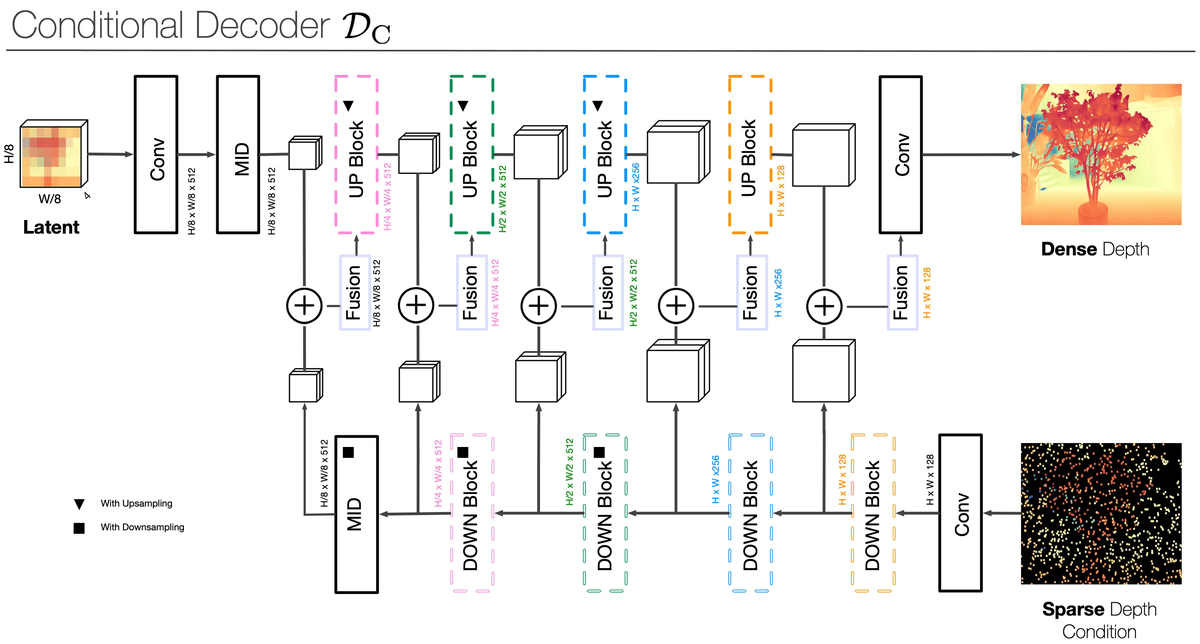
The key architectural change is a late-fusion conditional decoder. It takes the predicted depth latent and the sparse depth condition, normalized to the same range, and estimates a dense depth map. A trainable feature extractor processes the sparse input and produces five multi-scale feature maps that match the spatial resolutions of the decoder features. Those features are merged with 1×1 convolutions. Inspired by ControlNet, the fusion convolutions are initialized as zero convolutions, so the conditioning path outputs zero at initialization and preserves the behavior of the original VAE decoder. During fine-tuning, the conditioning contribution grows organically.
Training uses an L1 loss against dense targets on synthetic data. The model is initialized from Marigold-E2E with the VAE encoder frozen, and both the conditional decoder and the denoising UNet are fine-tuned. At test time the initial latent is set to zeros for deterministic inference, removing the need for test-time ensembling. Metric depth is then recovered with a global scale and shift computed by least-squares alignment to the sparse measurements.
What the numbers actually show
The runtime story is the easy part to sell:
- An average 66× speedup across indoor and outdoor datasets versus single-run Marigold-DC, and roughly 660× versus its 10-sample ensemble
- Fine-tuning takes only 4.5 days on a single NVIDIA H100
- Per-image inference around 0.38s indoors at 640×480 and 0.53s on KITTI
Zero-shot quality holds up. Across six benchmarks (ScanNet, IBims-1, VOID, NYUv2, KITTI, DDAD), Marigold-SSD achieves the best average RMSE of 1.499 and MAE of 0.473, versus 1.758 and 0.640 for Marigold-DC without ensembling. It wins against the ensemble on some datasets and stays competitive on the rest despite using an order of magnitude less compute.

The uncomfortable finding about benchmarks
Buried in the ablations is a result worth pausing on. The team compared both diffusion methods to a barycentric interpolation baseline over a Delaunay triangulation of the sparse points, which ignores the RGB image entirely. On DDAD, at 5000 points, interpolation appears to outperform both Marigold-DC and Marigold-SSD. At lower densities Marigold-SSD outperforms both Marigold-DC and simple interpolation, which is where a strong prior actually matters. It suggests common evaluation protocols may be too generous with input density to reveal real differences between models.
Where it falls short
Marigold-SSD is not a free lunch. Its fine-tuning requires committing to a sparsity range up front. Completion of out-of-distribution depth maps may exhibit a steep performance drop, though the default broad-range model generalizes well across the six benchmarks. It also inherits a known Marigold weakness: both Marigold-SSD and Marigold-DC tend to underestimate sky depth on KITTI and DDAD, consistent with prior Marigold limitations and limited conditioning information in the sky. And on some outdoor scenes the single-step output looks smoother, sometimes losing high-frequency detail that ensembled Marigold-DC preserves.
The code is on GitHub and the paper is on arXiv. For anyone running LiDAR-guided depth on a robot or a car, the practical takeaway is straightforward: you can now get diffusion-prior quality at roughly discriminative-model latency, without retraining per dataset.