
DToM-Track Reveals LLMs Forget What Others Believed Before Updating
A new evaluation framework called DToM-Track shows LLMs reliably infer current beliefs but forget prior ones after updates, mirroring human recency bias.
 Pro
Takeaways
- New DToM-Track framework evaluates LLMs on tracking belief changes across multi-turn conversations, not just single snapshots.
- Six models tested (GPT-4o-mini, Mistral Large, LLaMA 3.1/3.2/3.3, Ministral-14B) all show the same asymmetry.
- Post-update belief accuracy averages 63.9%, pre-update recall drops to 27.7%, worse than classical false-belief tests.
- Even LLaMA 3.3-70B, the strongest model, only reaches 40.9% on pre-update questions.
- Pattern mirrors human recency bias and retrieval interference; scaling parameters does not close the gap.
- Dataset contains 5,794 questions across beliefs, intentions, desires, emotions, and knowledge, generated with LLaMA-3-70B.
Large language models can pass many classic theory of mind tests, the puzzles that ask what someone else believes about a hidden state of the world. But a new study argues these tests miss something important: real social reasoning unfolds over time, and beliefs get revised. When researchers built a benchmark that specifically probes whether models can remember what an agent used to believe before an update, the answer turned out to be a fairly consistent no.
The paper introduces DToM-Track, an evaluation framework that treats theory of mind as a temporal memory problem rather than a single snapshot inference. Across six models spanning 3B to 70B parameters, the authors find a sharp asymmetry: models are good at telling you what an agent believes right now, and much worse at telling you what that same agent believed a few turns ago.
Why static false-belief tests fall short
Theory of Mind refers to the capacity to represent and reason about others' unobserved mental states, such as beliefs, intentions, and desires, as internal representations that guide social interaction. The canonical benchmark is the false-belief task, where a model has to reason that another agent holds an outdated view of the world. That formulation captures a single moment.
In real conversations, beliefs are corrected, contradicted, and displaced. Cognitive science research suggests that the success of such temporal belief tracking is shaped by general-purpose memory and judgment mechanisms that operate over time, including recency bias and interference, where updated representations crowd out earlier ones. The authors argue existing LLM benchmarks essentially ignore this dimension.
How DToM-Track builds a controlled belief trajectory
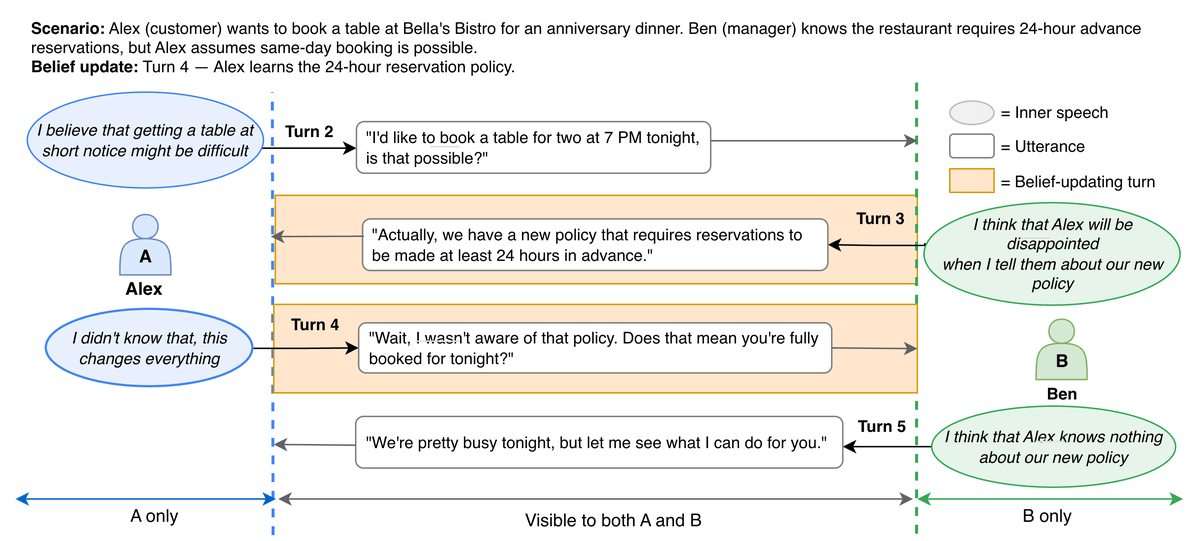
The framework generates multi-turn dialogues between two LLM agents using an inner-speech prompting setup. Each agent verbalizes a hidden thought before speaking, tagged with prefixes like (I believe that ...), (I want ...), or (I know ...). Importantly, inner-speech annotations are hidden from the conversational partner, inducing information asymmetry that mirrors human interaction.

The trick is that belief updates are scheduled in advance. DToM-Track explicitly plans belief updates at predetermined conversational turns prior to generation. This design ensures that belief changes occur at known points in the interaction, enabling evaluation of temporal belief tracking. Updates are signaled with naturalistic markers like "Actually..." or "I just realized..." drawn from ten implicit correction templates and five explicit negation patterns.
A structured belief tracker records, for each belief, the source turn, the mental state type, whether it has been superseded, and the prior content. That lets the framework generate three novel question types on top of standard ToM queries:
- Pre-update: What did the agent believe before the change?
- Post-update: What does the agent believe after the change?
- Update-detection: At which turn did the belief change?
A multi-stage LLM-based filtering pipeline verifies that planned updates actually appear in the generated dialogue and that each question is answerable and unambiguous. The resulting dataset includes 5,794 questions across six question types and five mental state categories. LLaMA-3-70B-Instruct is used to generate the conversations.
The recency gap
The authors evaluated GPT-4o-mini, Mistral Large, Ministral-14B, and three LLaMA models from 3B to 70B, zero-shot. Overall accuracy ranges from 35.7% (LLaMA 3.2-3B) to 63.3% (LLaMA 3.3-70B), with all models performing well above the random baseline of 25%. But breaking down by question type reveals the real story.
Update-detection questions yield the highest accuracy (67.5%), indicating that models can often identify when belief changes occur. Post-update questions also show strong performance (63.9%), suggesting effective inference of current beliefs. In contrast, pre-update questions are markedly more challenging (27.7%), revealing persistent difficulty in maintaining access to prior mental states after belief revision.
That is roughly a 36-point gap between reasoning about the current belief and recalling the one it replaced. This pattern holds across model families and scales. Even the strongest model in the set, LLaMA 3.3-70B, only reached 40.9% on pre-update questions. Pre-update recall was also substantially harder than the classical false-belief task (27.7% vs 44.7% overall), suggesting this is not just a rephrasing of the same difficulty.
What this actually tells us
The dissociation between current-belief inference and prior-belief recall lines up with recency bias and retrieval interference, both well-documented in human cognitive science. This pattern persists in larger models, suggesting limitations in temporal representation and retrieval rather than model scale alone. Scaling from 3B to 70B parameters narrowed the gap but did not close it.
For anyone building agents that hold long, evolving conversations, that has practical consequences:
- Customer-support or tutoring bots that need to remember what a user believed before a correction are likely to conflate the corrected state with the original one.
- Negotiation and planning agents that reason about how a counterpart's stance has shifted may misattribute the current position to earlier turns.
- Any system evaluating whether a user has actually learned or changed their mind will be biased toward the most recent utterance.
The authors are careful about limitations. The dialogues are synthetic role-plays with explicit linguistic markers that may cue the models, and they only test zero-shot behavior, leaving open whether fine-tuning or retrieval-augmented memory could mitigate the effect. They also flag the need to check whether humans show the same asymmetry on the same materials.
Code and dataset availability are not announced in the paper, though the framework is described in enough detail to reproduce. The larger contribution is conceptual: theory of mind benchmarks that only ask "what does X believe now" systematically overestimate how well models track other minds, because they never test the part where the mind changes.