
DS-DGA-GCN Catches Fake Review Rings Before They Hijack New Products
DS-DGA-GCN uses graph structure and temporal signals to catch coordinated fake reviewer rings, even on newly launched products with almost no review history
 Pro
Takeaways
- New model DS-DGA-GCN detects coordinated fake reviewer groups on dynamic e-commerce graphs, hitting 89.8% accuracy on Amazon and 88.3% on Xiaohongshu.
- Cold-start focus: explicitly designed for newly launched products with sparse reviews, where most existing detectors fail.
- NFS module converts graph structure (neighbor diversity + network self-similarity) into a single anomaly score per node, separating fake from real users with high statistical clarity.
- Dynamic attention fuses temporal gaps, NFS scores, and DeepWalk global embeddings into each attention weight, replacing static graph assumptions.
- Cross-platform transfer works well in same-language settings (Amazon↔Yelp, ~82% accuracy zero-shot) but degrades significantly across languages (Amazon→Xiaohongshu, ~70%).
- No public code released; paper available at arxiv.org/abs/2603.08332.
Fake reviews are no longer a fringe problem. Worldwide, fake reviews cost online consumers an estimated $770.7 billion in 2025 alone, and Amazon reported blocking 275 million suspected fake reviews in 2024 alone. Despite over a decade of research, the fraud keeps evolving -- and the hardest cases to crack are newly launched products, where there simply isn't enough data to catch the manipulation before it takes hold.
A team of researchers from Northwestern Polytechnical University and Xi'an University of Science and Technology has published a new approach to this problem. Their model, DS-DGA-GCN (Diversity- and Similarity-aware Dynamic Graph Attention-enhanced Graph Convolutional Network), treats the entire ecosystem of reviewers, reviews, and products as a living, evolving graph -- and hunts for fraud rings by looking at how that graph behaves over time, not just what individual reviews say.
Why text analysis isn't enough
Most existing fake review detectors fall into one of two camps: they either analyze review content and individual user behavior, or they look at static network structures. Both have a critical blind spot.
Fake reviewers often collaborate in groups organized via off-platform private channels, such as dedicated social media groups or messaging apps. They may deliberately misalign texts and ratings -- for example, negative text with a high star rating -- or coordinate to target the same products at different times to mimic organic review patterns and avoid burst detection. Content-based systems can't see this coordination because it happens outside the platform.
The second challenge is the cold-start problem. In the early stage of a product launch, only a few reviews are available. Traditional methods that rely on abundant content or static structural features perform poorly here: sparse content limits behavioral signals, and the reviewer-product subgraph is extremely small and star-shaped, which undermines static heuristics. Fake groups can flood a new product's first reviews before any detection system has enough signal to act.
The capability of Graph Neural Networks (GNNs) to handle data structured in graphs is a key advantage, enabling a nuanced representation of the complex relationships among reviews, users, and products. But even GNN-based approaches have struggled here, because they typically assume the graph is static -- a poor fit for platforms where thousands of new products launch every day.
The architecture: two modules working together
DS-DGA-GCN is built around two interlocking components that address the static-graph limitation head-on.

Module 1: Network Feature Scoring (NFS). Before any graph learning happens, NFS assigns every node in the graph a single anomaly score by measuring two structural properties:
- Neighbor Diversity -- how varied a node's connections are. A reviewer who only interacts with a narrow cluster of products has low diversity, a hallmark of coordinated spam. The model measures this using information entropy weighted by PageRank, so that low-authority spam rings can't fake high diversity scores.
- Network Self-Similarity -- whether a node's local network structure repeats itself at different scales. Collusive rings tend to create repetitive, fractal-like patterns. The model quantifies this using both fractal dimension (sensitive to star-shaped spam clusters) and spectral analysis of the graph's Laplacian eigenvalues (sensitive to ring structures).
These two scores are concatenated, standardized, reduced via PCA, and projected through a linear SVM to produce a final normalized anomaly score between 0 and 1. The threshold for flagging a node as suspicious is set using Youden's Index on a validation set -- a principled approach that maximizes the gap between true positive and false positive rates.
Module 2: Dynamic Graph Attention Mechanism. The NFS score feeds directly into a graph attention network that has been redesigned for dynamic graphs. The key innovation is in how attention weights are computed between nodes. Instead of just comparing feature vectors, the attention formula integrates three signals simultaneously:
- Temporal differences -- the time gap between when two nodes became active, encoded via learnable time matrices. This helps flag synchronized or near-synchronized review bursts.
- NFS anomaly scores -- nodes with high anomaly scores get higher attention weight, so the model naturally focuses on suspicious neighborhoods.
- Global structural embeddings -- DeepWalk random-walk embeddings capture each node's position in the full graph, so the model can identify nodes that are structurally similar even if they're not directly connected.
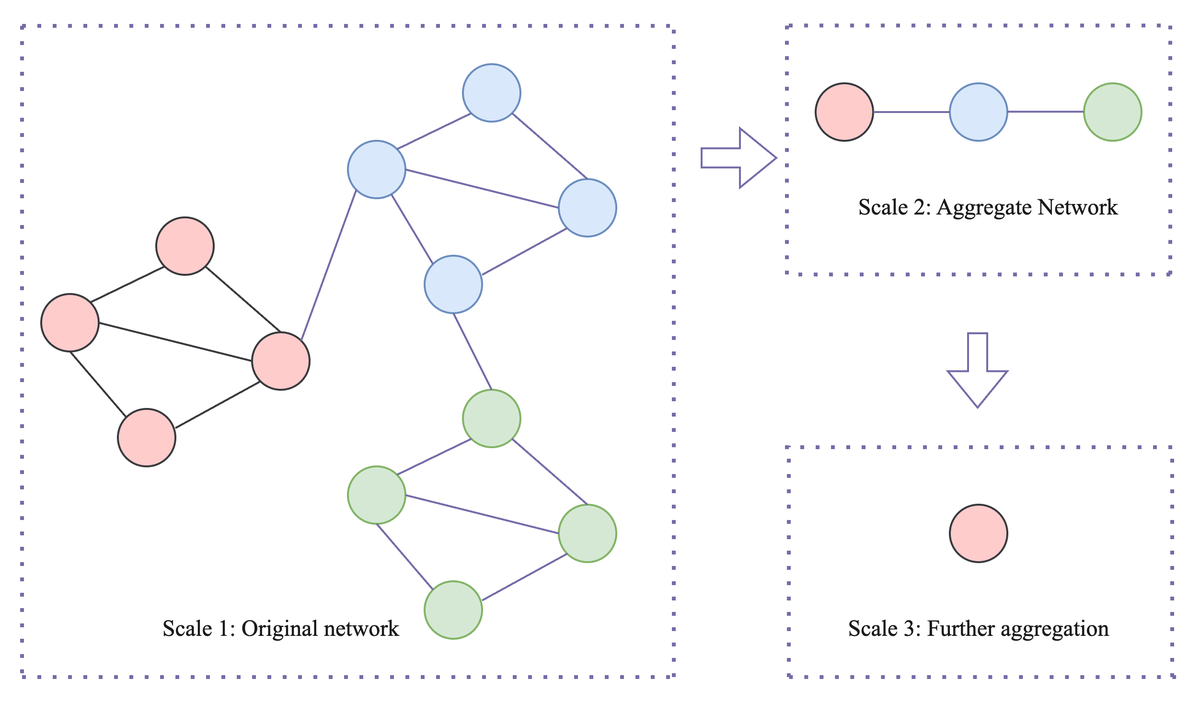
To keep this computationally tractable on large graphs, the model first runs a graph pooling and sampling step. The dynamic graph is divided into time windows, and within each window, nodes are scored by importance (combining NFS score, degree, and clustering coefficient). Only nodes above a threshold are kept, and similar nodes are merged. This dramatically reduces the graph size before the expensive attention computation runs, giving the model linear time complexity in the number of sampled nodes.
What the numbers show
The model was evaluated on two real-world datasets that represent very different operating conditions:
- Amazon: 35,593 products, 50,253 reviewers, 701,731 reviews across 15 product categories. Relatively low data dynamics (composite index D=0.32).
- Xiaohongshu: A Chinese lifestyle social platform. 76,923 video posts treated as "products," with users who liked or commented treated as "reviewers." Much higher data dynamics (D=0.78), closer to real-world adversarial conditions.
Extensive experiments demonstrate that DS-DGA-GCN significantly outperforms state-of-the-art baselines, achieving accuracies of up to 89.8% and 88.3% on Amazon and Xiaohongshu respectively. The AUROC scores -- a threshold-free measure of how well the model separates real from fake -- reached 0.945 on Amazon and 0.928 on Xiaohongshu, beating every attention variant tested including standard GAT, multi-head attention, gated attention (GaAN), and self-attention.

The cold-start results are particularly notable. On the Amazon small-scale group (products with fewer than 50 reviews), DS-DGA-GCN achieves an AUROC of 0.835 versus 0.810 for TGN (Temporal Graph Networks, the strongest temporal baseline) and 0.795 for HetGNN. The gap widens at larger scales, suggesting the structural signals captured by NFS become increasingly powerful as more graph context accumulates.
Where it struggles
The model's limitations are worth understanding before deploying it:
- Cross-lingual transfer is hard. When trained on Amazon (English) and tested on Xiaohongshu (Chinese), zero-shot accuracy drops to 0.696 and F1 to 0.658. The structural NFS features are partially platform-invariant, but the node feature distributions are too different across languages for the attention mechanism to generalize cleanly.
- Cold-start gains are modest. In the small-scale group, DS-DGA-GCN beats TGN by only about 2.5 AUROC points. The advantage is real but not dramatic -- the fundamental data sparsity problem is hard to fully overcome.
- No public code release. The paper does not link to an open-source implementation, which limits reproducibility and adoption.
- Static hyperparameters for attention. The weights balancing NFS scores and global embeddings in the attention formula (γ=0.5, λ=0.2) are fixed after grid search, not learned end-to-end. This could limit adaptability to new platforms without retuning.
The real breakthrough
The most significant contribution here isn't the accuracy numbers -- it's the framing. This is the first work that takes adaptability as the core optimization dimension of fake reviewer group detection, given dynamic product-review-reviewer networks in realistic e-commerce platforms. Previous graph-based detectors were trained on static snapshots and degraded as the platform evolved. DS-DGA-GCN is explicitly designed to handle a graph that changes every day.
The NFS module is also a practically useful standalone component. Its output -- a single normalized anomaly score per node derived from structural graph properties -- is interpretable, lightweight, and could be plugged into existing fraud pipelines without requiring the full GNN stack. The clear separation between fake and real NFS score distributions (fake nodes average 0.85 vs. 0.55 for real on Amazon, with smaller variance) suggests it could work as a fast pre-filter before more expensive analysis.
For teams building trust and safety systems on e-commerce or social platforms, the practical takeaway is that graph structure -- specifically how diverse a reviewer's connections are and how self-similar their local network looks -- carries strong fraud signal that text analysis alone misses. Combining that structural prior with a time-aware attention mechanism is what makes the cold-start case tractable. Same-language cross-platform transfer (Amazon to Yelp) works reasonably well with just 5% labeled target data for fine-tuning, which is a realistic deployment scenario for platforms that can label a small seed set of known fraudsters.