
DriveXQA Stress-Tests Self-Driving AI When Sensors Break in Bad Weather
A new academic benchmark stress-tests driving VQA models with fog, sensor failures and four fused sensor streams, exposing where current multimodal LLMs collapse.
 Pro
Takeaways
- Researchers release DriveXQA, a 102K-pair driving VQA benchmark focused on adverse weather and sensor failures.
- Companion model MVX-LLM fuses RGB, depth, event and LiDAR through a Dual Cross-Attention projector.
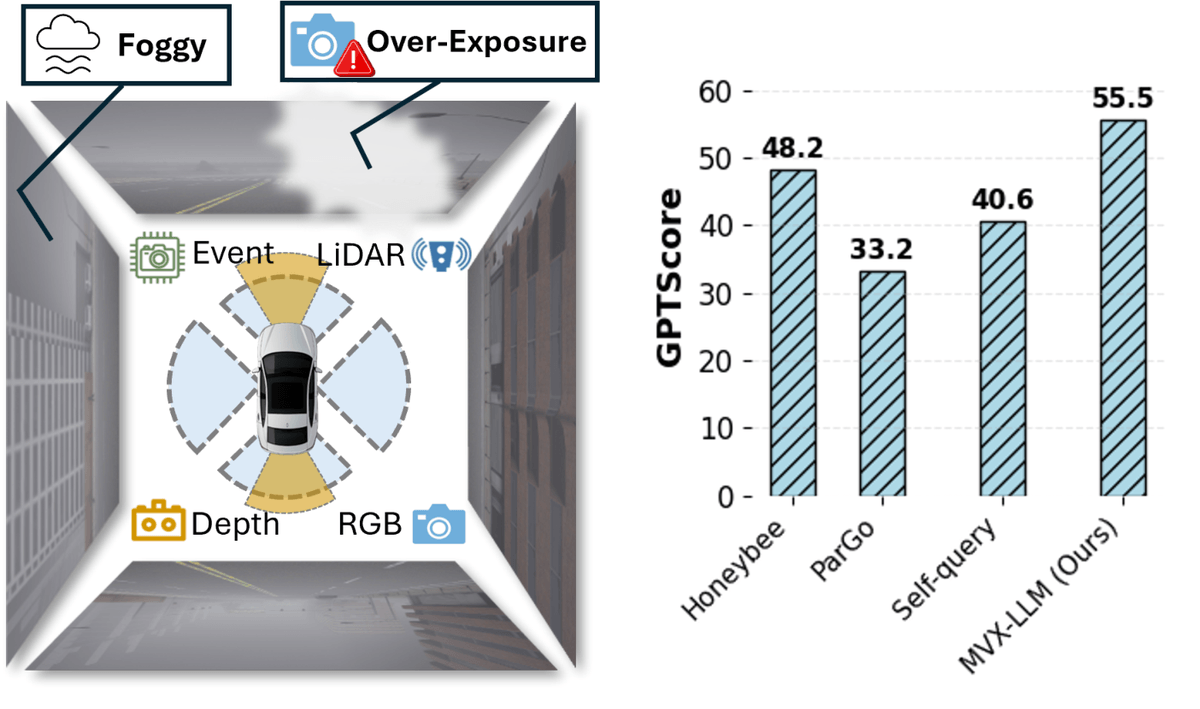
- Achieves GPTScore 55.5 average, and 53.5 vs 25.1 baseline on foggy scenes.
- Hierarchical questions span global scene, allocentric multi-view and ego-vehicle centric levels.
- DCA projector adds only 2.6M parameters, under 0.3% of total model size.
- Limitations: CARLA-only data, single-frame, no live sensor-dropout evaluation yet.
A team of researchers from Karlsruhe Institute of Technology, Hunan University and Mercedes-Benz Tech Innovation has released DriveXQA, a driving visual-question-answering benchmark that deliberately breaks the sensor stack. Fog, motion blur, over-exposed cameras, jittery LiDAR and low-resolution event cameras are all baked in, along with a companion model called MVX-LLM that tries to keep answering coherently when individual sensors go bad.
The pitch is simple: today's multimodal LLMs for autonomous driving are mostly evaluated on clean, RGB-only footage, and they fall apart the moment weather or hardware gets messy. This work packages a dataset, a hierarchical question taxonomy, and a fusion architecture into one open release aimed squarely at that gap.
Why clean-weather VQA is not enough
Existing driving VQA datasets like NuScenes-QA, DriveLM and LingoQA cover a lot of ground, but they share four critical gaps: lack of comprehensive multi-modal sensor coverage (particularly event cameras), absence of sensor failure scenarios, insufficient hierarchical question structures, and limited scale for training and evaluation. In practice that means a model trained on those benchmarks has no idea what to do when the front camera saturates in direct sun or the LiDAR returns get noisy in heavy rain.
The authors frame the core research problem this way: existing multi-modal LLM frameworks fundamentally cannot accept multiple complementary sensor modalities as input, making them inadequate for autonomous driving scenarios requiring robust performance under sensor failures and adverse conditions. Recent BEV transformers and vision-language-action models fuse many sensors for control, but almost none of them route that fused signal into a language model that can explain what it saw.
Inside DriveXQA
DriveXQA contains 7,885 frames of driving scenes, systematically covering diverse weather conditions including rainy, night, foggy, cloudy, and sunny scenarios, along with five types of sensor failures: motion blur (MB), overexposure (OE), underexposure (UE), LiDAR jitter (LJ), and event low-resolution (EL). Scenes are collected in CARLA (v0.9.14) and sensor failures are injected via post-processing, then QA pairs are generated by prompting GPT-4o with structured scene-metadata templates, followed by manual quality control on a stratified 5% sample.

The result is roughly 102,505 QA pairs categorized into three types: global scene level, allocentric level, and ego-vehicle centric level. Each scene comes with 13 questions distributed across those levels:
- Global scene level (2 per scene): weather impact, traffic density, macro-level visibility, the kind of context that no single sensor can resolve on its own.
- Allocentric level (8 per scene): spatial relationships between objects, distances, traffic signs, road conditions, drawn from four camera views (front, back, left, right).
- Ego-vehicle centric level (3 per scene): lane positioning, sensor health monitoring, and behavior prediction for surrounding vehicles.
Roughly a third of the data is deliberately degraded: representing 35.5% of total samples as corner cases. That imbalance is the whole point, since the benchmark is really a stress test.
MVX-LLM and the Dual Cross-Attention trick
The companion model, MVX-LLM, ingests four modalities from four viewpoints: RGB, depth, event camera and LiDAR. Specialized encoders are used: a shared CLIP-based Vision Transformer for RGB, depth, and event camera data from four perspectives, and a PointNet++ encoder for LiDAR point clouds. LiDAR is handled separately and projected to a 512-dimensional embedding, while the 2D modalities pass through a new Dual Cross-Attention (DCA) projector.

DCA runs two parallel attention pathways. A spatial branch lets RGB tokens attend to depth and event features at matching spatial positions, so if the RGB pixel is washed out, the model can still pull useful geometry from the other two streams. A channel branch operates on transposed features to mix information along the feature dimension rather than spatial locations. The two outputs are averaged into one fused representation.
To keep the language model's context short, all 49 patch tokens per modality get compressed down to a single query token via learned attention (called QAttn). That is the token-efficiency claim: adding modalities does not blow up the visual token count. The DCA projector adds only around 2.6M parameters, less than 0.3% of total model size, and the language backbone is fine-tuned with LoRA at rank 16.
The numbers
Scoring uses BLEU-4, ROUGE-L, METEOR, CIDEr, sentence-embedding similarity and a GPT-4o-mini judge scaled to 0-100. Human raters were brought in on a 360-sample subset, and Spearman correlation with the GPT judge stayed above 0.83 across conditions.
MVX-LLM lands at an average GPTScore of 55.5, versus 52.8 for the strongest token-fusion baseline (QAttn Spectral) and 48.2 for the best conventional projector setup (GAP + Honeybee). The most dramatic gap shows up in the corner cases the paper is designed to expose. The approach shows remarkable improvements in challenging conditions such as foggy (53.5 vs. 25.1 for prepend, 53.7 for QAttn(Spectral) token fusion, and 50.8 for GAP + Honeybee projector) and various sensor failure scenarios.
The ablations tell an interesting story about which sensors actually help:
- RGB is the anchor. Depth+Event without RGB collapses to a GPTScore of 18.9, worse than any RGB-inclusive pair.
- LiDAR carries geometry. RGB+Depth+LiDAR reaches 50.7, the strongest three-sensor combination, and remains the best partial config for object localization under camera overexposure.
- All four sensors together hit 55.5, confirming that the DCA design genuinely uses the extra modalities instead of just concatenating them.
Where it still breaks

The qualitative analysis is honest about failure modes. When the RGB camera is overexposed at night, MVX-LLM still correctly picks out a red car ahead of the ego vehicle, because LiDAR and depth provide the geometry. But it misidentifies the weather itself, since scene-level semantic cues live almost entirely in the visual channel. The paper's own summary: geometric sensors effectively compensate for object detection tasks, but semantic environmental understanding remains critically dependent on functional visual sensors.
Other caveats worth flagging before you build on this:
- Everything is CARLA-simulated. Physical effects like LiDAR scattering in heavy rain or dynamic-vision-sensor noise in low light are only approximated, and real-world sensor corruption remains untested.
- Single-frame only. There is no temporal reasoning yet, which is a significant limitation for a driving system where motion cues matter.
- No inference-time sensor dropout evaluation. The ablations vary which sensors are trained with, but do not test what happens if a sensor drops out live.
Getting the code
The dataset and source code are released on the DRIVEXQA GitHub repository. For anyone working on multimodal LLMs, robust perception or sensor fusion, DriveXQA is useful as a diagnostic: it will tell you fairly quickly whether your fancy fusion module is doing anything beyond leaning on RGB when the going gets clean, and whether it degrades gracefully when the sensor stack does not.