
DriveMind's Dual-VLM Reward System Teaches Self-Driving Cars to Adapt
DriveMind pairs a frozen CLIP encoder with a novelty-triggered SmolVLM to shape rewards on the fly, hitting 97% success in CARLA.
 Pro
Takeaways
- DriveMind pairs a frozen CLIP ViT-bigG-14 with a novelty-triggered SmolVLM-256M for adaptive semantic rewards.
- Hits 19.4 km/h average speed, 0.98 route completion, and 0.97 success rate on CARLA Town 2.
- Beats 14 baselines including VLM-RL, Revolve, and hand-crafted rewards on safety and efficiency.
- Semantic reward transfers zero-shot to BDD100K real dash-cam frames with Wasserstein distance of 0.028.
- SmolVLM is fine-tuned via chain-of-thought distillation from GPT-4o-mini using LoRA adapters.
- Amortized latency of 38.8 ms per step supports roughly 25 Hz real-time control on dual RTX 3070s.
Reinforcement learning agents for self-driving usually depend on hand-crafted reward functions or static language prompts that quickly fall out of sync with what is actually happening on the road. A new framework called DriveMind takes a different route: it uses two vision-language models working in tandem, one as a steady semantic anchor and one that wakes up only when the scene changes, to generate reward signals that adapt to the driving context.
The result is an agent that averages 19.4 km/h with 0.98 route completion, near-zero collision speed, and a 0.97 success rate on CARLA Town 2, and whose semantic rewards transfer zero-shot to real dash-cam footage from BDD100K.
Why static prompts break down on the road
End-to-end driving policies that map pixels straight to steering commands are notoriously opaque, hard to certify, and offer no guarantees on basic kinematic properties like staying under the speed limit or centered in a lane. Recent work has tried to inject semantic feedback by using vision-language models (VLMs) to score how well an image matches a text description of good driving. But methods like VLM-SR, VLM-RM, and RoboCLIP rely on static prompts that are unsuited to evolving road conditions and overlook vehicle dynamics, and calling a heavy VLM at every step is expensive.
DriveMind's authors argue that the reward itself needs to be context-aware. When a residential street turns into a tight urban intersection, the notion of an "ideal" action changes, so the language grounding the reward should change too.
A dual-VLM architecture with four moving parts

The framework wires together four components, each addressing a specific failure mode of prior approaches:
- Static contrastive VLM anchor. A frozen OpenCLIP ViT-bigG-14 encodes each bird's-eye-view frame into a 2,048-dimensional embedding, and two fixed text prompts ("the car is about to crash" vs. "no collisions occur") provide a stable baseline reward via cosine similarity.
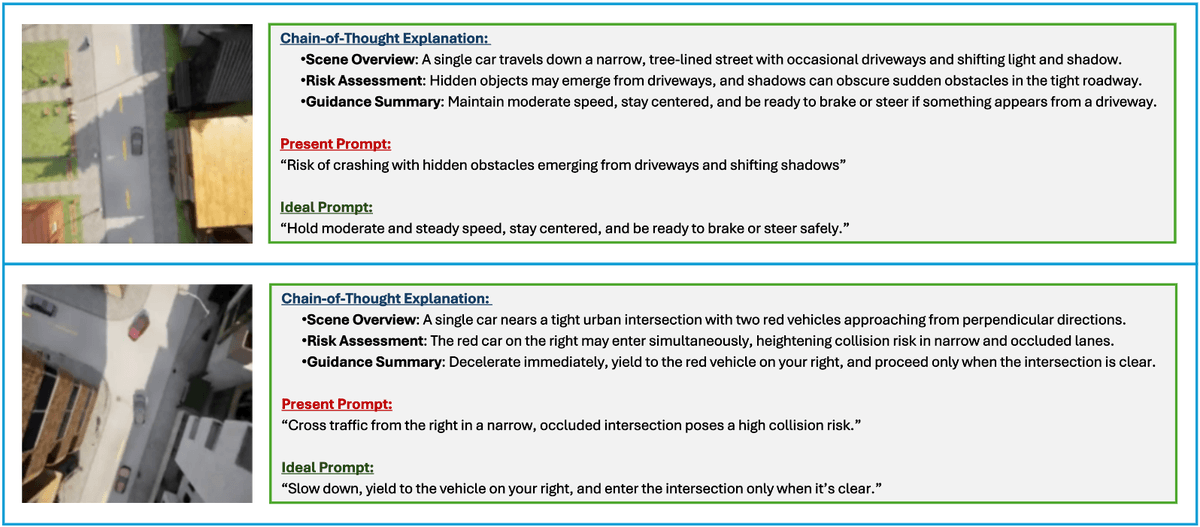
- Novelty-triggered dynamic VLM. A lightweight SmolVLM-256M encoder-decoder generates fresh "present" (hazard) and "ideal" (goal) prompts only when the scene embedding drifts beyond an L2 threshold from a sliding cache, avoiding per-step decoding cost.
- Hierarchical safety fusion. Four normalized kinematic scores (speed regulation, lane centering, heading alignment, lateral stability) are multiplied together, so any single violation collapses the entire term to zero, acting as a hard veto.
- Predictive contrastive foresight. A compact world model forecasts the next embedding given the current state and action, and rewards actions whose predicted future aligns with the ideal prompt.
The per-step reward is a weighted sum of a task term, the safety product, the adaptive contrastive score, and the foresight bonus, with the safety weight dominating so kinematic constraints can never be traded away for semantic points.
Teaching a small VLM to reason like GPT-4
The novelty branch is where things get interesting. SmolVLM is fine-tuned via chain-of-thought distillation, where a larger teacher model produces both the final prompts and the reasoning that led to them. In DriveMind, the dynamic SmolVLM encoder-decoder is fine-tuned online via GPT-4o-mini through structured chain-of-thought distillation, generating present and ideal prompts along with a natural language explanation in JSON format.
Training uses Low-Rank Adaptation (LoRA) with one-step updates per sample, using AdamW with a learning rate of 5x10^-5, and only the LoRA adapter parameters are trained while the base model and image encoder remain frozen. The idea is that decomposing a scene into Scene Overview, Risk Assessment, and Guidance Summary yields sharper, more actionable prompts than one-shot generation.
Benchmark: 14 baselines, one clear winner
The team trained exclusively on CARLA Town 2 across three traffic densities (empty, 20 vehicles, 40 vehicles) and evaluated zero-shot on Towns 1, 3, 4, and 5. They compared against expert-designed rewards (TIRL, Chen-SAC, ASAP-RL, ChatScene), LLM-designed rewards (Revolve, Revolve-Auto), and VLM-designed rewards (VLM-SR, RoboCLIP, VLM-RM, LORD, LORD-Speed, VLM-RL).
The pattern in the results is striking. Purely binary penalties (TIRL-SAC/PPO) fail to produce meaningful motion, hand-tuned summation rewards such as Chen-SAC achieve moderate speeds but incur significant collisions, ASAP-RL-PPO drives aggressively yet unsafely, and even VLM-RL, which combines positive and negative prompts, exhibits nonzero collision speeds. DriveMind is the only method that combines high route completion with essentially zero collision speed.
Ablations confirm each module pulls its weight. Removing hierarchical fusion collapses driving ability to 0.58 km/h average speed and zero success rate, omitting the contrastive reward drops success to 67% with elevated collision speeds, while removing predictive foresight only slightly reduces route completion. The safety veto is doing the heaviest lifting, but the semantic and predictive terms sharpen behavior.
Real-world transfer without retraining
The more surprising result is the domain transfer test. The team ran 10,000 BDD100K dash-cam frames through the reward pipeline without any fine-tuning. The mean reward drops slightly from 0.130 to 0.118 and the standard deviation rises modestly from 0.080 to 0.085, with the Wasserstein-1 distance at 0.028 and Kolmogorov-Smirnov statistic at 0.105 remaining low. In plain terms, the semantic reward distribution learned in simulation is nearly indistinguishable from what the same reward produces on real driving footage.
Can it actually run in real time?
The runtime numbers are honest about the tradeoff. A baseline step (SAC inference, static VLM embedding, novelty check, world model) takes about 9 ms, but when SmolVLM fires, prompt generation alone takes 2,975 ms. Because it only fires roughly once every 100 steps, the amortized cost lands around 38.8 ms per step, or about 25 Hz control, which the authors argue is fast enough for near real-time operation.
The remaining caveats are worth flagging for anyone considering this for deployment:
- The approach depends on accurate bird's-eye-view semantic segmentation; noisy masks corrupt both static and dynamic reward signals.
- The novelty detector uses a fixed L2 threshold, which may over-trigger in cluttered scenes or miss slowly evolving hazards.
- The world model provides only one-step lookahead, limiting planning for complex multi-step maneuvers.
- Evaluation is confined to CARLA simulation and static dash-cam frames; closed-loop real-vehicle testing remains future work.
DriveMind is not a drop-in replacement for a production autonomy stack, but it is a concrete demonstration that VLM-shaped rewards can be made adaptive, hierarchical, and cheap enough to run alongside continuous control, while producing behavior that generalizes across simulated maps and into real imagery.