
Drift2Act Turns ML Monitoring Alarms Into Safe Automated Actions
Drift2Act turns ML monitoring from passive alarms into a certified decision controller that knows when to recalibrate, retrain, or hand off — with provable safety guarantees.
 Pro
Takeaways
- Drift2Act is a new controller that turns ML drift monitoring from passive alarms into certified, cost-aware interventions — with provable safety guarantees. [Paper]
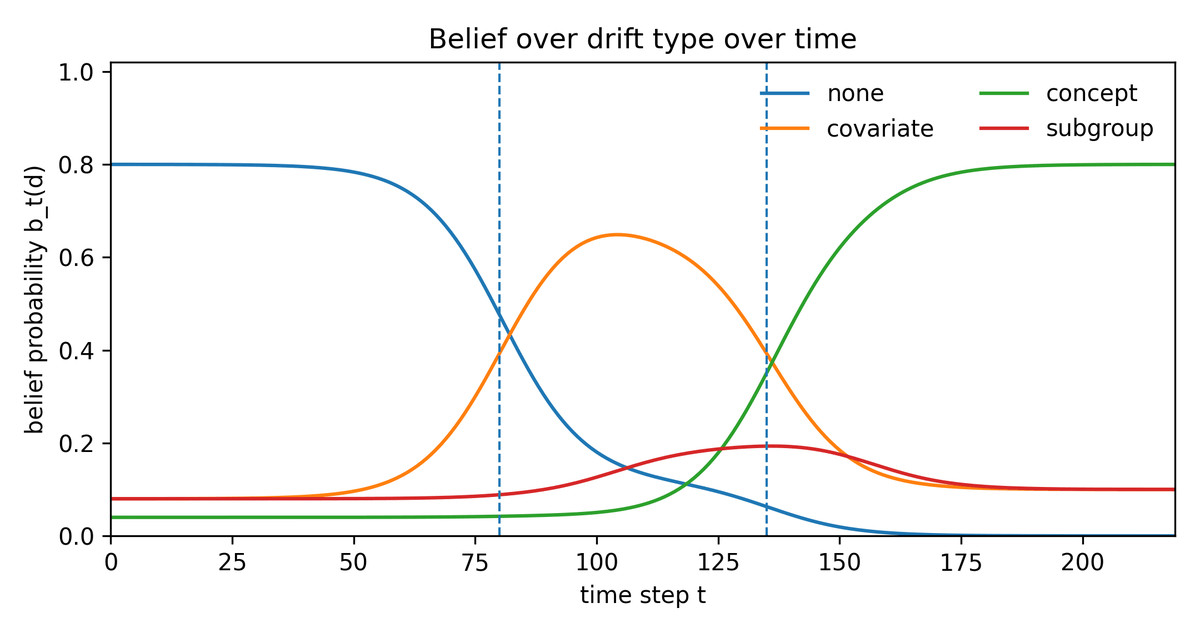
- The system maintains a Bayesian belief over four drift types (none, covariate, concept, subgroup) using unlabeled signals: MMD, entropy shift, calibration drift, and discriminator AUC.
- An active risk certificate queries a small random label sample to compute an anytime-valid upper bound on current risk; if the bound exceeds a threshold τ, the system forces abstain/handoff and escalates to rollback or retraining.
- On WILDS Camelyon17 and DomainNet, the certified controller achieves 0–1 safety violations versus 46–63 for alarm-only monitoring, at moderate cost compared to always-on adaptation (cost 58–64).
- Ablations confirm the certificate is the critical safety component: removing it while keeping the belief model raises violations from 0 to 7–8 on the same benchmarks.
- No code is released, but the full algorithm is specified in the paper; the main limitation is that certificate validity requires uniform random label sampling from the evaluation window.
Most production ML monitoring systems share the same fundamental flaw: they stop at the alarm. A statistical test fires, a dashboard turns red, and then a human has to figure out what to do next , recalibrate? retrain? roll back? , often without knowing what kind of drift is happening, how bad it actually is, or what the intervention will cost. A new paper from researchers at Mohammed First University and Sultan Moulay Slimane University proposes a principled fix: treat monitoring itself as a constrained decision-making problem with explicit safety guarantees.
The system they introduce, called Drift2Act, is a drift-to-action controller that combines three components , a sensing layer that classifies what kind of drift is occurring, an active risk certificate that verifies whether the model is currently safe using a small number of labels, and a cost-aware policy that selects the right intervention under real operational constraints like labeling budgets, compute limits, and cooldown periods.
The gap that actually matters in production
Model drift is the degradation of a deployed model's performance over time because the world has moved away from the conditions it was trained on. According to recent MLOps surveys, over 70% of organizations report experiencing significant data drift within the first six months of deploying ML models to production. Yet the standard response pipeline , detect, alarm, wait for a human , has two critical gaps.
First, drift detection often ends at an alarm. Alarms are not actions: they do not specify whether to recalibrate, adapt, request labels, retrain, or roll back, nor do they account for budgets, latency, cooldowns, and governance constraints. Second, adaptation is frequently applied without verified safety. Under delayed supervision, a system may silently operate in an unsafe regime, or may overreact and incur unnecessary cost.
The core insight of Drift2Act is that these two gaps can be closed together by reframing monitoring as constrained decision-making: the system must not only detect that something is wrong, but also certify the current risk level and select the cheapest action that restores safety.
Three types of drift, one belief state
The sensing layer of Drift2Act maintains a probabilistic belief over four drift types at every timestep: none, covariate (input distribution shifts, labels unchanged), concept (the relationship between inputs and labels changes), and subgroup (drift localized to a minority slice). This matters because the right response is different for each type , test-time adaptation works well for covariate drift but can destabilize under concept drift, while subgroup drift often requires targeted label acquisition.
The belief is computed using a lightweight Bayesian filter. At each step, the system computes a vector of monitoring signals from unlabeled data:
- MMD (Maximum Mean Discrepancy): a kernel two-sample statistic comparing recent vs. reference embeddings in representation space , measures how far the input distribution has moved
- Uncertainty shift: the change in mean predictive entropy between the recent window and the reference window , rises when the model encounters out-of-distribution inputs
- Calibration drift (ECE): when delayed labels arrive, the controller tracks whether the model's confidence scores still match its actual accuracy
- Discriminator AUC: a lightweight classifier trained to separate recent from reference embeddings, with AUC near 0.5 meaning no detectable shift
- Slice drift: per-subgroup MMD, taking the max across groups to catch localized shifts that global monitors miss
These signals are concatenated into an evidence vector and fed into a Markov belief filter, which maintains a probability distribution over drift types. The filter was trained offline on synthetic drift episodes generated from the base datasets , so it knows what covariate drift looks like in embedding space versus what concept drift looks like in calibration metrics.
The active risk certificate: safety with a small label budget
The most technically novel component is the active risk certificate. The problem it solves is fundamental: you cannot know whether your model is currently safe without labels, but labels are delayed and expensive. Drift2Act resolves this by actively requesting a small random sample of labels from the recent evaluation window and using them to compute a statistically valid upper bound on current risk.
Formally, the certificate U_t(δ) is an anytime-valid upper confidence bound on the true windowed risk R_t.
The certificate functions as a safety layer: if U_t(δ) ≤ τ the system can operate normally and apply inexpensive corrections, while if U_t(δ) > τ the system triggers an explicit fallback (abstain/handoff) and escalates to stronger interventions such as rollback or retraining.
The bound is constructed using a confidence-sequence approach , a technique from sequential statistics that remains valid even when the number of labels queried is chosen adaptively (i.e., you can stop querying early once you're confident the system is safe, without invalidating the guarantee). The key validity condition is that queried labels must be sampled uniformly at random from the current window. Under this condition, the paper proves:
With probability at least 1 - δ, the system never remains in an unsafe regime without the certificate indicating a violation: whenever R_t > τ, it holds that U_t(δ) > τ, and the gating rule activates fallback and escalation.
The label query size is itself adaptive: the controller requests more labels when drift evidence is strong or when the safety margin is thin, and fewer labels during stable periods. This makes the labeling budget a first-class operational resource.
The action menu and cost model
Once the belief and certificate are computed, the controller selects from a discrete action set with explicit costs:
- A0 , No-op: cost 0.0
- A1 , Recalibrate: update a temperature-scaling calibrator using available labels; cost 0.2
- A2 , Test-time adaptation (TTA): run entropy minimization on recent unlabeled inputs; cost 1.0
- A3 , Query labels: request k labels from recent inputs; cost 0.05 × k
- A4 , Retrain: trigger full retraining; cost 12.0, with a cooldown of 800 steps
- A5 , Rollback: revert to a previously validated checkpoint; cost 1.5, cooldown 400 steps
- A6 , Abstain/handoff: route uncertain inputs to human review; cost 0.3
The controller selects actions by maximizing a belief-weighted utility: the expected risk reduction from each action (computed as a dot product of the drift-type belief with a pre-calibrated gain table) minus its operational cost, minus a penalty for actions that would leave the system uncertified. When the certificate is violated, the controller immediately forces abstain/handoff and schedules rollback or retraining as soon as cooldowns allow.
Results: near-zero violations at moderate cost
In a realistic streaming protocol with label delay and explicit intervention costs, Drift2Act achieves near-zero safety violations and fast recovery at moderate cost on WILDS Camelyon17, DomainNet, and a controlled synthetic drift stream, outperforming alarm-only monitoring, adapt-always adaptation, schedule-based retraining, selective prediction alone, and an ablation without certification.

The numbers are striking. On Camelyon17 (a histopathology benchmark where hospitals act as domains), the certified controller achieves 0 safety violations and a recovery time of 62 steps , compared to 46 violations and 210 steps for alarm-only, and 3 violations at a cost of 58.0 for always-on TTA. On DomainNet (large domain gaps across sketch, clipart, painting, and real images), the controller achieves 1 violation versus 63 for alarm-only. On a synthetic CIFAR stream with mixed covariate, concept, and subgroup drift, it again achieves 0 violations with recovery time of 58 steps.
The ablation without the certificate (same controller, same belief, but no safety gating) shows 7 violations on Camelyon17 and 8 on SyntheticDrift-CIFAR , confirming that the certificate is what prevents unsafe operation under delayed labels, not just the belief model.
What it's good at , and where it struggles
Drift2Act is well-suited for long-lived classification services where:
- Labels arrive with a delay (e.g., medical outcomes, fraud labels, user feedback)
- Interventions have real costs (compute, human annotation, governance approvals)
- Safety violations have concrete consequences (regulated industries, high-stakes decisions)
- Drift is heterogeneous , different shifts require different responses
The system has two main limitations worth knowing. First, the certificate validity relies on random label sampling from the current evaluation window. If labels are obtained through heavily biased selection, the empirical risk may no longer represent the true window risk, weakening the bound. In practice, this means you need to reserve a portion of your labeling budget for uniform auditing, not just targeted spot-checks. Second, the choice of window length N remains a domain-dependent design choice. Under extreme non-stationarity, a short window reduces lag but increases variance, while a long window stabilizes estimates but can mix regimes and delay detection of rapid changes.
The gain table , which encodes how much each action helps under each drift type , is calibrated offline on synthetic episodes and then fixed. This is practical but means the controller's action preferences won't automatically update if your deployment environment changes significantly over time.
No code yet, but the algorithm is fully specified
The paper does not release code, but the algorithm is described in enough detail to implement. The full pseudocode (Algorithm 1 in the paper) specifies the complete online loop: update monitoring signals, update drift-type belief via Bayesian filter, compute the active risk certificate from a uniform random sample of delayed labels, gate actions on the certificate, select the highest-utility feasible action, apply it, and log everything for auditing. The confidence radius uses a Hoeffding-based stitching construction with failure probability allocated as δ_t = 6δ / (π² t²) across timesteps , a standard technique for making bounds valid under optional stopping.
The real contribution here is conceptual as much as technical: online risk certification enables reliable drift response and reframes monitoring as decision-making with safety. For teams running production ML systems that currently stop at alarms, this paper offers a concrete blueprint for what comes next.