
DQ-Ladder Cuts Video Streaming Bitrate by 10% While Slashing Decoding Time 22%
Researchers introduce DQ-Ladder, a deep Q-learning agent that builds per-segment bitrate ladders balancing quality, decoding time, and resolution stability.
 Pro
Takeaways
- DQ-Ladder uses a DQN agent to build per-segment bitrate ladders that jointly optimize quality, decoding time, and resolution stability.
- Achieves 10.3% BD-rate reduction on XPSNR and 22% decoding time cut versus Apple's HLS ladder.
- Lightweight XGBoost and Random Forest predictors estimate bitrate, quality, and decoding time without running the encoder.
- Evaluated on 750 UHD Inter-4K sequences with the VVenC/VVdeC VVC toolchain across six resolutions and 41 QPs.
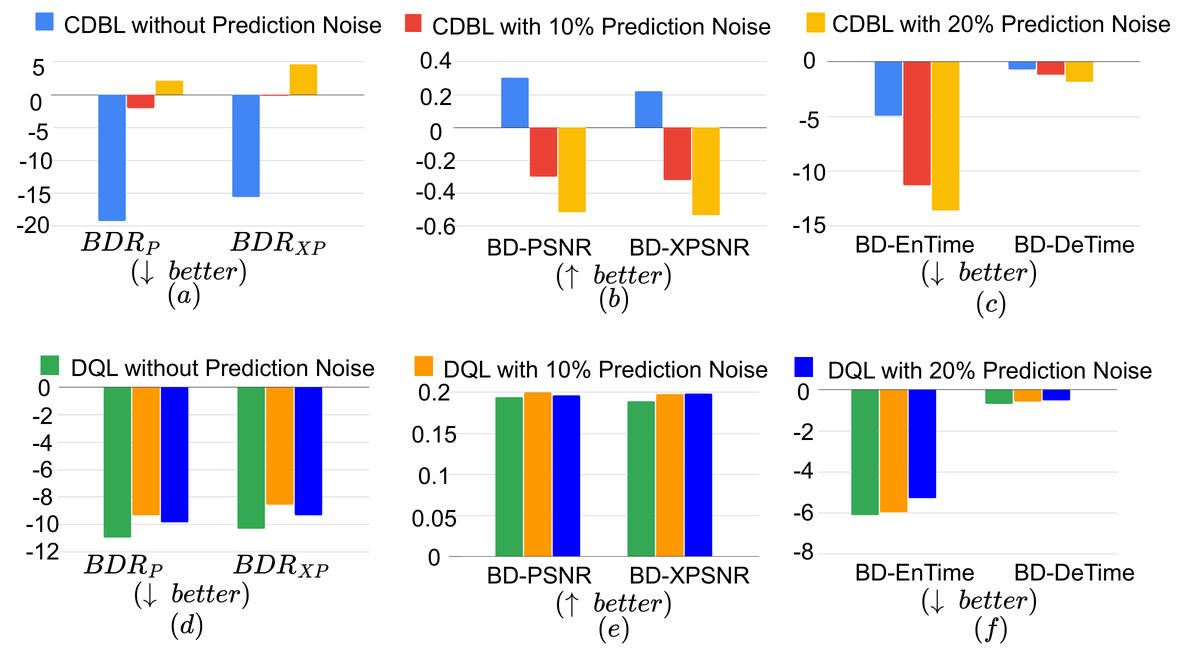
- Remains stable with up to 20% Gaussian noise on predictions, while CDBL's BD-rate flips positive.
- Full paper on arXiv; no public code release yet.
A team from the University of Klagenfurt, TU Cottbus-Senftenberg, University of Innsbruck, and TU Wien has published DQ-Ladder, a deep reinforcement learning framework that decides which resolution and quantization parameter to pair with each target bitrate when packaging video for adaptive streaming. Instead of shipping every viewer through the same fixed ladder, the agent learns to trade off perceptual quality, decoding cost on the client, and how often the resolution jumps between segments.
The headline numbers, measured against Apple's HLS reference ladder on the Versatile Video Coding (VVC) toolchain: BD-rate reductions of at least 10.3% for XPSNR compared to the HLS ladder, while reducing decoding time by 22%. The authors also report the system stays stable when its inputs are noisy, which is where a lot of learned ladder approaches quietly fall apart.
Why fixed ladders are a bad default
Adaptive streaming (DASH, HLS) chops a video into segments and stores each segment at several bitrate-resolution combinations. The client picks a rung based on bandwidth. Traditionally that rung set is a hard-coded table, which ignores that a static talking-head scene and a fast sports clip have wildly different rate-distortion curves and decoding costs.
Netflix's per-title encoding started fixing the quality side of this, but these approaches typically overlook decoding time, which is increasingly critical for resource-constrained end-user devices. VVC is more efficient than HEVC on bitrate, but decoding it in software on a phone or set-top box is expensive, so the ladder needs to care about the client too.
Prior heuristics also treat each rung independently. That leads to jarring resolution jumps between neighboring rungs and no long-term view of quality consistency. The authors frame ladder construction instead as a sequential decision problem, which is a natural fit for reinforcement learning.
How the agent is wired up

DQ-Ladder has three modules working in sequence:
- Complexity analyzer. Extracts three lightweight features per segment: luma texture complexity (E_Y), temporal complexity (h), and average luma brightness (L_Y).
- ML predictors. Three separate models estimate the decoding time, the resulting bitrate, and the quality score (XPSNR or VMAF) that a given resolution/QP choice would produce, without actually running the encoder.
- DQN agent. A three-layer MLP (256/128/64 with ReLU) approximates Q-values over the discrete action space of (resolution, QP) pairs.
The state passed to the agent is compact: the current target bitrate, plus the predicted bitrate, quality, and decoding time from the previous rung. That last part matters because it lets the agent reason about the ladder as a whole and penalize resolution flip-flops between adjacent rungs.
The reward is a weighted sum: Rew = λ1 · quality − λ2 · decoding_time − λ3 · resolution_switch_penalty. Two hard constraints keep the ladder sane: the predicted bitrate has to stay under the target, and quality must be monotonically non-decreasing as target bitrate goes up. The authors relax the usual λ1+λ2+λ3=1 rule because the normalized distributions of quality and decoding time are skewed differently, so equal weights would not actually balance them.
Picking the predictors
The predictor bake-off is worth noting because it drives the whole inference-time cost. The team tested seven models (linear regression, random forest, extra trees, AdaBoost, LightGBM, XGBoost, and an MLP) and picked winners per target:
- Decoding time: Random Forest, R²=0.96, ~0.31s inference.
- Bitrate: XGBoost, better absolute error than the MLP with lower latency.
- XPSNR and VMAF: XGBoost again, chosen over a marginally more accurate MLP because it runs faster.
SHAP analysis confirms that QP and resolution dominate the predictions, with spatial complexity mattering most for quality metrics and temporal complexity contributing most to bitrate and decoding time (motion is expensive to encode and decode). End-to-end overhead for building a full ladder is sub-second per 4-second segment, which is compatible with live workflows.
Benchmark setup and results
Training and evaluation used 750 UHD sequences from the Inter-4K dataset, encoded with VVenC at the faster preset and decoded with VVdeC. The action space covered six Apple HLS-compliant resolutions (360p through 2160p) and 41 QP values from 10 to 50, with a 70/30 video-level split to avoid leakage between train and test.
Against four baselines (the HLS fixed ladder, CDBL, RQT-PF, and VEXUS), DQ-Ladder at its recommended weighting (λ1=0.8, λ2=0.6, λ3=0.1) hits a BD-rate of -10.94% (PSNR) and -10.3% (XPSNR), saves 6.1s of encoding time versus CDBL, and produces the lowest resolution-switching score of any method tested. VEXUS beats it on raw BD-quality but at the cost of significantly higher encoding and decoding time. The paper also explores a VMAF-focused configuration that trades some balance for a larger BD-VMAF gain, but that is a tuning knob, not the main result.
Robustness is the underrated win
The more interesting story is what happens when predictions are wrong. Threshold-based methods like CDBL turn brittle: its BD-rate degrades from -19.26% under base predictions to -2.04% at 10% noise and becomes positive (2.10%) at 20% noise. Moreover, its BD-PSNR and BD-XPSNR simultaneously drop below zero, indicating loss of both compression efficiency and quality gains. DQ-Ladder, in contrast, keeps its BD-rate and quality numbers close to the noise-free baseline even at 20% injected Gaussian noise on decoding time and XPSNR.
That is the practical selling point. In a real streaming pipeline, decoding time and quality predictions are always going to drift from ground truth. A ladder builder that only works when its predictors are near-perfect is a lab result. One that tolerates a fifth of its inputs being wrong is closer to something you would put in front of paying users.
Where it fits, and where it does not
DQ-Ladder is aimed at VoD-style workflows where you can afford an offline training phase on a provider's own catalog. Training uses real encoding feedback and takes 2,000 episodes with experience replay; inference is fast enough for per-segment decisions. The authors flag that it does not yet consider network dynamics or client-side feedback, so if your bottleneck is ABR selection at playback rather than ladder construction at packaging, this is not that layer of the stack. Codec migration is also cheap in principle: the training loop is codec-agnostic, but you would need to retrain with measurements from the new encoder and decoder.
No code repository is linked in the paper. The evaluation stack is reproducible from open components: VVenC, VVdeC, and the Inter-4K dataset are all publicly available, but a reference implementation of the DQN agent and the predictors would have to come from the authors directly.