
DP Technology's Uni-Parser Reads 20 Scientific PDF Pages per Second
DP Technology's Uni-Parser chews through 20 PDF pages per second on 8 GPUs and extracts chemical structures where general OCR fails.
 Pro
Takeaways
- DP Technology released Uni-Parser, a modular multi-expert PDF parsing engine for scientific literature and patents.
- Hits 20 PDF pages per second on 8 RTX 4090D GPUs, scales near-linearly to 1,000 GPUs.
- Group-based layout detection preserves molecule-identifier and figure-caption pairings before OCR runs.
- Integrates MolParser 1.5 for chemical structures, scoring 0.994 mAP@50 versus 0 for general OCR competitors.
- Beats MinerU2-pipeline and PP-StructureV3 on scientific docs; trails PaddleOCR-VL on general documents.
- Weights not released; open-source Uni-Parser-Tools with remote API access promised as follow-up.
Parsing a scientific PDF sounds like a solved problem until you actually try to do it at scale. Between two-column layouts, footnotes wedged between equations, tables full of nested chemical structures, and figures whose captions live three columns away, most OCR pipelines quietly fall apart. A team from DP Technology has released Uni-Parser, a modular document parsing engine aimed squarely at scientific literature and patents, and the numbers are hard to ignore: up to 20 PDF pages per second on 8 NVIDIA RTX 4090D GPUs, with dedicated support for molecules and reaction schemes that most general-purpose parsers ignore entirely.
Why scientific PDFs break most parsers
The paper frames the problem bluntly. Current approaches, both pipeline-based and VLM-based, face three major challenges: they are computationally inefficient at the tens-of-millions scale, their performance on non-textual modalities such as formulas, tables, charts, and chemical structures remains limited, and complex heterogeneous layouts often lead to unreliable segmentation. Traditional pipelines are fast but brittle. Vision-language models generalize better but are prohibitively slow when you want to process a full patent corpus.
Then there is the chemistry problem. A patent page might contain a molecule, its identifier, a Markush structure (a generic structure with variable substituents used to claim broad chemical classes), an inline formula, and a caption referring to all of them. Standard OCR flattens this into garbled text. Uni-Parser is designed to keep those relationships intact.

A microservice mesh of specialists
Rather than one big model, Uni-Parser is built as a collection of specialized experts glued together by a scheduler. Each modality-specific expert (text, molecules, formulas, tables, reactions, charts) is deployed as an independent microservice, with multiple nodes running in parallel to process inference requests. Layout analysis chops a page into semantic blocks, then each block is routed to the right specialist.
The five-stage pipeline works like this:
- Pre-processing: validates the PDF, extracts embedded text if present, and identifies language. Uni-Parser supports over 80 languages for OCR mode.
- Group-based layout detection: locates semantic blocks and, crucially, pairs them (figure with caption, molecule with identifier, table with title).
- Semantic content parsing: each block goes to a specialist. Over ten sub-models and specialized procedures handle diverse content types, including text, tables, molecular structures, chemical reactions, formulas, and charts.
- Content gathering: filters out headers/footers, merges cross-column and cross-page fragments, and reintegrates inline elements like equations back into their paragraphs.
- Output formatting: exports as JSON, Markdown, HTML, or interleaved image-text, with section hierarchy preserved for RAG chunking.
Group-based layout detection is the real trick
Most layout detectors treat every box independently. Uni-Parser-LD, the layout model, instead outputs a two-layer tree that captures which elements belong together. The bottom layer covers all fundamental semantic components, serving as the parent nodes of the layout structure tree, whereas the top layer comprises content nested within the bottom layer or other top level semantic elements. An inline formula sitting inside a paragraph becomes a child of that paragraph; a molecule and its identifier are grouped before any OCR happens.
Under the hood, the team chose a modified DETR backbone at 1024x768 resolution after testing alternatives. Models such as RT-DETRv2, YOLOv12, and D-FINE can exhibit training instability in our layout detection task, and synthetic pretraining datasets like DocSynth300K actually hurt performance because they fail to capture the messy diversity of real scientific layouts. The team instead built an in-house layout detection dataset containing 500k pages, of which 220k pages are carefully human annotated with group-based layout labels.

Handling molecules with placeholders
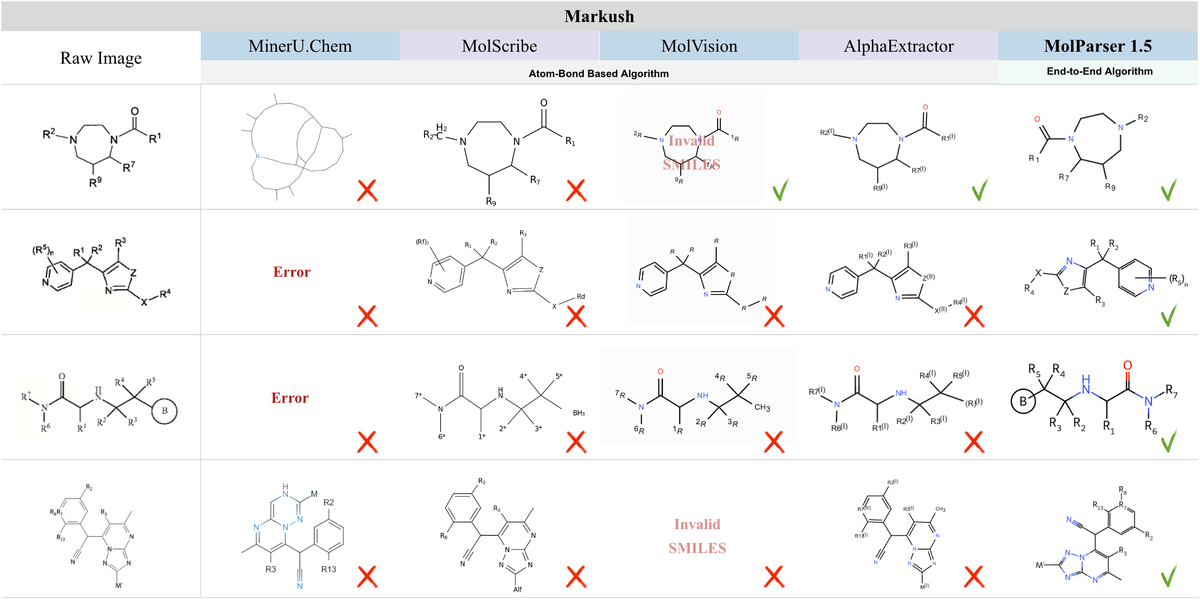
The OCR trick for chemistry-heavy text is elegant. When a top-layer element (like a molecule) overlaps a bottom-layer block (like a table cell), the system substitutes it with a placeholder before running OCR, then resolves the placeholder later with the dedicated optical chemical structure recognition (OCSR) model. The chemical recognizer itself is MolParser 1.5, an updated end-to-end model that translates molecular images into an Extended SMILES (E-SMILES) representation, trained on the original 7M synthetic corpus plus 10 million real-world images pseudo-labeled by an ensemble of models.
The benchmark numbers
On the Uni-Parser benchmark (150 patent and scientific PDFs, 2,887 pages), the high-quality mode hits an overall score of 89.74 excluding molecules, beating pipeline competitors like MinerU2-pipeline (83.24) and PP-StructureV3 (82.41), and matching the best specialized VLM PaddleOCR-VL (89.80). The gap widens on chemistry: Uni-Parser scores 0.994 mAP@50 for molecule localization and 0.886 OCSR accuracy, while every general-purpose competitor scores zero because they cannot detect molecules at all.
A small controlled test on 141 simple molecules made the practical difference stark. Uni-Parser handled all 141 with 96.5% recognition accuracy in 1.8 seconds. MathPix took 66.1 seconds with 59.6% accuracy, and MinerU.Chem needed roughly 7 minutes with 22.7% accuracy.

Throughput that actually scales
The infrastructure story is where this becomes an industrial tool rather than a research demo. Uni-Parser overlaps CPU pre/post-processing with GPU inference and inter-service transfer, so no expert sits idle while another chews on a batch. The team reports deploying on a cluster of 240 NVIDIA L40 GPUs, parsing over 16 million documents within 6 days in the fast mode, with near-linear scaling up to a 1,000-GPU hybrid cluster.
The decoupled architecture also means independent component upgrades that support rapid iteration without full system redeployment, with zero service interruption during updates. You can swap the layout model or the OCSR model without taking the pipeline down.
Where it falls short
The paper is refreshingly honest about limitations. Chart parsing remains an open problem: all existing Chart2Table models and general-purpose MLLMs fall far short of meeting industrial-level requirements for parsing charts in scientific literature, which exhibit a wide variety of types and styles. Chirality recognition in molecules is still difficult. And on OmniDocBench-1.5, which covers newspapers, slides, and other non-scientific documents, Uni-Parser trails specialized generalists like PaddleOCR-VL and MinerU2.5. The team explicitly notes this benchmark is not aligned with the system's core strengths.
The authors also share what didn't work: graph-based OCSR (atom-bond methods) turned out to be a dead end because their strong reliance on rigid, hand-crafted rules fundamentally limits scalability, and they require substantially more manual annotation effort, typically over 20x that of end-to-end approaches.
Availability
The paper does not ship model weights or a code repo alongside the technical report, but the team commits to releasing an open-source toolkit called Uni-Parser-Tools that will provide remote access to the hosted engine plus example pipelines for downstream tasks like building structured chemistry databases. For teams working on drug discovery pipelines, patent analysis, or curating pretraining data for AI4Science models, that hosted API is likely the most direct path to using it, given the multi-expert architecture is not trivial to redeploy locally.