
DoseRAD2026 Gives AI Researchers 121,500 Beams to Beat Slow Radiation Engines
A public benchmark of 40,500 photon beams and 81,000 proton beamlets paired with CT and MRI aims to make deep learning dose engines finally reproducible.
Takeaways
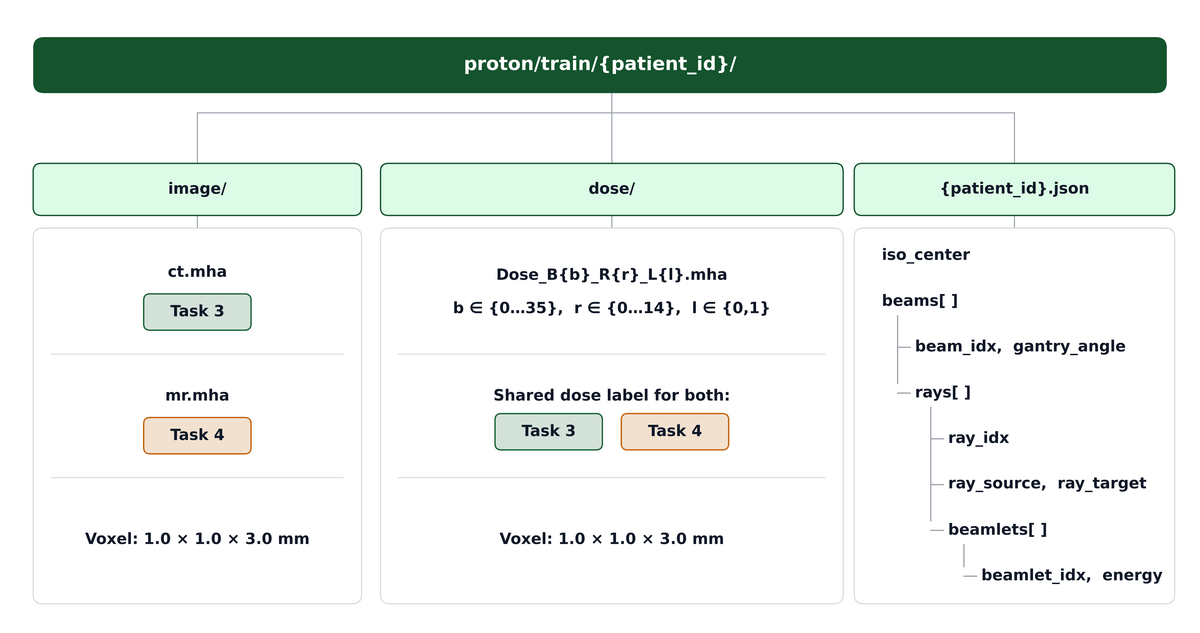
- DoseRAD2026 releases paired CT and MRI with 40,500 photon beams and 81,000 proton beamlets as Monte Carlo dose ground truth (paper).
- Four tasks span CT and MRI inputs across photon (6 MV VMAT) and proton (85 energies, 36 gantry angles) delivery.
- Data covers 115 patients with thoracic or abdominal lesions from an MRI-linac cohort derived from SynthRAD2025.
- Ground truth generated with Geant4 11.0.3 using roughly 2,000 CPU cores across three European computing centers.
- Preprocessing, simulation, and matRad VMAT planning scripts are open source at the DoseRAD2026 GitHub.
- Training set is out under CC BY-NC 4.0; test set embargoed until March 2030 to protect SynthRAD2025 evaluation.
Radiation oncology has been quietly running into a wall. Monte Carlo dose calculation, the gold standard for figuring out where radiation actually lands in a patient's body, is accurate but painfully slow. As MRI-guided linacs push toward real-time plan adaptation, the field needs sub-second dose engines that still match Monte Carlo accuracy. A new benchmark called DoseRAD2026 is trying to give deep learning researchers the raw material to close that gap.
The release is the first publicly available dataset that pairs CT and MRI scans with beam-level photon and proton Monte Carlo dose distributions. The imaging data was derived from Center B of the SynthRAD2025 dataset, a single-institution subset selected because MRI acquisitions were performed on an MRI-linac using a standardized protocol, ensuring consistent patient positioning between CT and MRI. That consistency turns out to be critical for training models that map directly from MRI to dose.
Why current dose engines fall short
Two facts frame the problem. General-purpose Monte Carlo implementations on a single CPU can take hours to tens of hours per plan, and even GPU-accelerated engines land in the seconds range. MRI, meanwhile, does not carry electron density information, so dose calculation on an MRI-linac normally goes through an intermediate synthetic CT step that adds latency and stacks up error sources. Deep learning dose prediction can hit sub-second inference, but progress has been stalled by the absence of large paired CT-MRI datasets with beam-level ground truth.