
DNA AI Models Are Memorizing Genomes and Leaking Patient Secrets
A new multi-vector audit framework reveals that genomic language models memorize training DNA sequences — with Evo's 7B-parameter model achieving perfect canary extraction on real genomes.
 Pro
Takeaways
- New audit framework: Researchers built a three-vector privacy evaluation pipeline for genomic language models combining perplexity detection, canary extraction, and membership inference into a single worst-case score.
- Evo (7B) achieves perfect memorization: The 7B-parameter Evo model, fine-tuned with LoRA, recovered 100% of planted canary sequences on all real genomic datasets — even from a single training exposure.
- LoRA does not protect privacy: Parameter-efficient fine-tuning (LoRA) failed to limit memorization in the large model, challenging a common assumption about its privacy benefits.
- No single attack is sufficient: Each architecture leaks through a different vector — DNABERT-2 leaks via perplexity but resists extraction; SimpleDNALM extracts easily but shows no perplexity gap; HyenaDNA leaks only via membership inference.
- Memorization scaling laws transfer to genomics: The duplication-driven memorization patterns established for NLP models hold in the genomic domain — more repetitions in training data means higher extraction success.
- Code available: The full evaluation framework is open-source, designed for use as a pre-release privacy audit tool for any fine-tuned GLM.
Genomic language models (GLMs) , AI systems that treat DNA like text and learn from nucleotide sequences the way GPT learns from words , are moving fast toward clinical deployment. They have emerged as powerful tools for learning representations of DNA sequences, enabling advances in variant prediction, regulatory element identification, and cross-task transfer learning. But a new paper from researchers at Case Western Reserve University, UTHealth, and Rutgers University raises a serious alarm: these models are memorizing the sequences they train on, and the privacy consequences could be permanent.
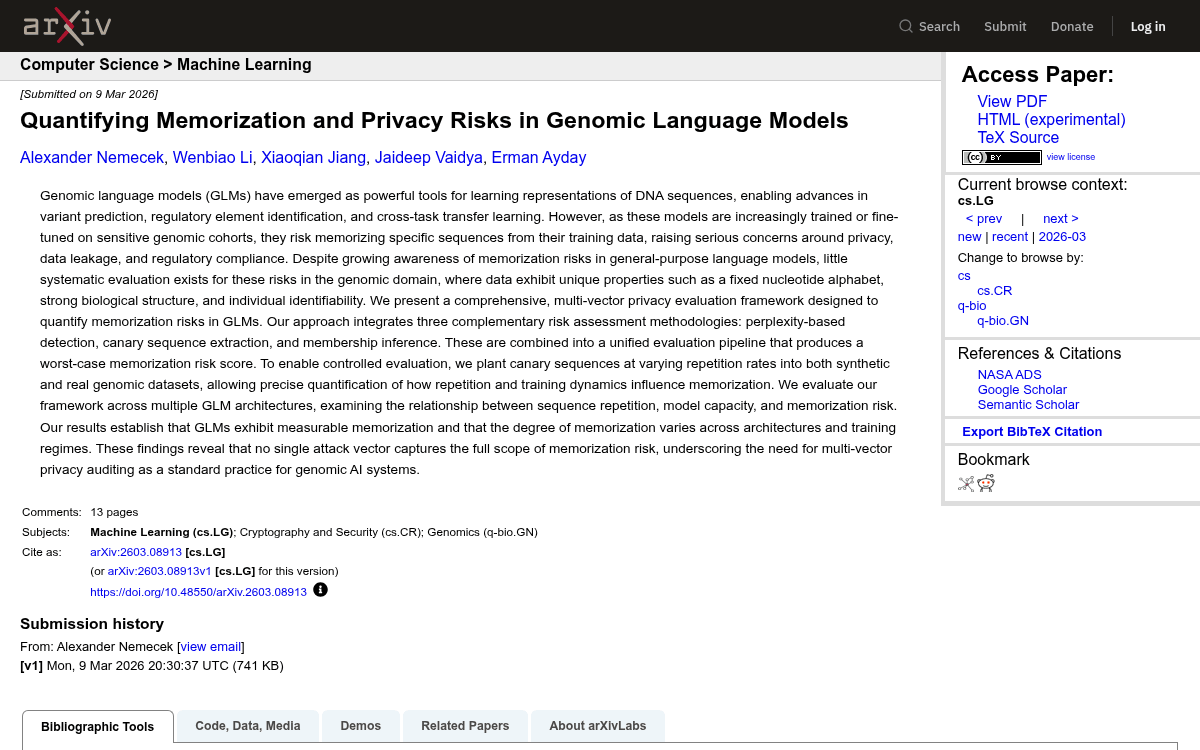
As GLMs are increasingly trained or fine-tuned on sensitive genomic cohorts, they risk memorizing specific sequences from their training data. Despite growing awareness of memorization risks in general-purpose language models, little systematic evaluation exists for these risks in the genomic domain, where data exhibit unique properties such as a fixed nucleotide alphabet, strong biological structure, and individual identifiability.
Why DNA Leakage Is Uniquely Dangerous
Memorization in a language model is bad. Memorization of someone's genome is categorically worse. Three properties of genomic data make memorization uniquely consequential: sequences are immutable and cannot be reissued once compromised, identifiable from as few as several hundred variants, and heritable, exposing biological relatives who never consented to data collection. A leaked password can be changed. A leaked genome cannot.
New ethical concerns emerge as GLMs advance, particularly around privacy and consent, dual-use risks, and access and equity. Once GLMs can accurately detect clinically relevant DNA variants, they are likely to be applied in clinical settings on individual human DNA. That makes the question of what these models remember a regulatory and ethical emergency, not just an academic one.

The Framework: Three Attacks, One Score
The paper introduces a unified privacy auditing pipeline that runs three complementary attacks on a fine-tuned GLM and combines them into a single worst-case Maximum Vulnerability Score between 0 and 1. The key insight is that no single attack tells the whole story , a model can look safe on one metric while leaking badly on another.
The three attack vectors are:
- Perplexity-based detection: A memorized sequence will feel "familiar" to the model , it assigns it lower loss (lower perplexity) than unseen sequences of comparable composition. A large gap between canary perplexity and test perplexity signals memorization.
- Canary sequence extraction: The auditor plants synthetic probe sequences ("canaries") into the training data at controlled repetition rates, then at inference time gives the model a prefix and tries to recover the rest via beam search. If the true canary ranks near the top of 1,000 candidates, the model has memorized it.
- Membership inference attack (MIA): Given any sequence, can an attacker determine whether it was in the training set? The paper uses a Likelihood Ratio Attack (LiRA) , a state-of-the-art method that compares the target model's behavior against reference models and reports an AUC-ROC score. A score of 0.5 means random guessing; 1.0 means perfect discrimination.
The final score is simply the maximum across all three vectors: S_config = max(s_ppl, s_ext, s_mia). This worst-case formulation follows standard security auditing practice , a system is only as private as its weakest link.
Canaries in the DNA Mine
To measure how data repetition drives memorization, the researchers plant canary sequences at varying repetition rates into both synthetic and real genomic datasets, allowing precise quantification of how repetition and training dynamics influence memorization. Each canary is a 64-nucleotide random string with no biological structure , inserted 1, 5, 10, or 20 times into a training corpus of 1,000 sequences. If the model later ranks the canary at the top of its beam search candidates, it has memorized it verbatim.
The four models tested span the main GLM architectures in use today:
- SimpleDNALM , a custom 12.9M-parameter causal transformer baseline
- DNABERT-2 , 117M parameters, masked language modeling, the most widely used GLM for downstream tasks
- HyenaDNA , 14.2M parameters, long-range convolutional architecture operating at single-nucleotide resolution
- Evo , 7B parameters, StripedHyena state-space model, fine-tuned with LoRA (Low-Rank Adaptation , a technique that freezes most model weights and only trains a small low-rank update matrix)
Experiments ran across four datasets of increasing biological complexity: purely synthetic random sequences, E. coli prokaryotic genome, S. cerevisiae (yeast) eukaryotic genome, and the GUE benchmark of curated multi-species promoter regions.
The Results: One Model Breaks Away from the Pack
The results reveal a sharp separation between Evo (LoRA) and the remaining architectures. Evo achieves a maximum vulnerability score of 1.00 ± 0.00, driven entirely by canary extraction on all three real genomic datasets. That means it recovered 100% of planted canary sequences on E. coli, yeast, and GUE data , regardless of how many times the canary appeared in training. Even a single insertion was enough.
This is the paper's most counterintuitive finding. LoRA is often assumed to reduce memorization because it only updates a small fraction of the model's parameters. This result is notable given that Evo is the only model fine-tuned with LoRA rather than full parameter updates, indicating that parameter-efficient fine-tuning alone is insufficient to limit memorization risk relative to full fine-tuning of smaller models. The hypothesis is that Evo's 7B pretrained parameters already encode so much knowledge of nucleotide sequences that fine-tuning on a small corpus concentrates updates on memorizing specific examples rather than learning generalizable patterns.
The other three models clustered in a moderate risk band (scores 0.48–0.55), but their vulnerability profiles were strikingly different from each other:
- SimpleDNALM showed the clearest scaling with repetition , extraction success rose monotonically from ~8–12% at one insertion to 88–100% at 20 insertions, directly confirming that memorization scaling laws from NLP transfer to genomics.
- DNABERT-2 was the most resistant to extraction (only 9–14% success) but showed the strongest perplexity gap (test/canary ratio of 1.51–1.61), meaning the memorized information is encoded in its representations but not recoverable via prefix-based generation , likely because masked language modeling distributes information bidirectionally rather than left-to-right.
- HyenaDNA showed near-zero perplexity signal and low extraction, but retained a detectable membership inference signal (AUC 0.73–0.74) , comparable to the other models despite its lower overall vulnerability.
No Single Metric Is Enough
The core scientific contribution here is not just the results , it is the demonstration that memorization is not a single, unified phenomenon. Different architectures reveal memorization through different vectors, demonstrating that single-metric evaluations can systematically underestimate privacy exposure. DNABERT-2 would look safe if you only ran extraction attacks. SimpleDNALM would look safe if you only measured perplexity gaps. HyenaDNA would look safe on both , but membership inference still leaks.
Across all 16 model-dataset configurations, AUC values for membership inference range from 0.70 to 0.79, confirming that a detectable membership signal persists across all architectures regardless of their extraction or perplexity profiles. Even the "safest" model in the study still leaks enough that an attacker can determine training set membership better than random chance.
What This Means in Practice
The practical stakes are high. Biobanks, clinical genomics pipelines, and research consortia are increasingly fine-tuning foundation models on small, sensitive cohorts , exactly the regime this paper targets. For practitioners operating under regulatory frameworks, these findings suggest that releasing fine-tuned GLMs without privacy auditing constitutes a non-trivial compliance risk.
The paper's framework is directly usable as a pre-release audit tool. Before deploying a fine-tuned GLM, a team can:
- Plant canary sequences at multiple repetition rates into the training data
- Fine-tune the model as normal
- Run all three attack vectors (perplexity, extraction, MIA)
- Compute the Maximum Vulnerability Score and identify which vector drives the risk
- Apply targeted mitigations , deduplication, differential privacy, or architecture changes , based on the dominant attack vector
The authors note that all code is available (currently anonymized for review). On the defense side, the paper confirms that only differential privacy provides a formal guarantee against memorization, though at a utility cost , and that data deduplication is the most practical first-line mitigation for reducing extraction risk.
What the Framework Does Not Cover
There are real limitations to acknowledge. The canary sequences are random 64-nucleotide strings , not real patient sequences with pathogenic variants or population-stratified SNPs. Whether memorization of biologically realistic sequences follows the same patterns remains an open question. The study also uses a fixed corpus of only 1,000 training sequences, which is deliberately small to simulate fine-tuning on sensitive cohorts, but memorization dynamics may shift at biobank scale. And Evo was only tested with LoRA at a single rank , full fine-tuning of a 7B model may behave differently.
The paper also explicitly excludes attribute inference attacks (inferring phenotypic properties from model outputs) and gradient leakage attacks, both of which represent additional threat surfaces not captured by the current framework. As GLMs grow toward the 40-billion-parameter scale already reached by models like Evo 2, the memorization risks quantified here are likely a lower bound on what the next generation of models will exhibit.