
DiveUp Makes Vision AI Models Argue to Fix Blurry Spatial Features
DiveUp treats multiple vision backbones as a panel of experts, using their structural agreement to upsample features without overfitting to any one model's flaws.
 Pro
Takeaways
- DiveUp is a feature upsampler for vision foundation models trained with guidance from multiple VFMs rather than self-reconstruction.
- It replaces incompatible feature vectors with local center-of-mass fields that encode geometry across models.
- A spikiness-aware selector picks the most reliable expert per region to filter high-norm token artifacts.
- One jointly-trained model upsamples features from DINOv2, SigLIP and others with no per-model retraining.
- Reports state-of-the-art results on semantic segmentation and depth estimation against JAFAR, AnyUp and NAF.
- Inference code and weights available on GitHub and Hugging Face.
Vision foundation models like DINOv2, CLIP, and SigLIP produce rich semantic features, but at a punishingly low spatial resolution. A ViT with 14 pixel patches turns a 224x224 image into a 16x16 feature grid, which is fine for classification but useless for pixel-level tasks like segmentation or depth estimation. Feature upsampling has become the standard fix, and a new method called DiveUp proposes a different way to train those upsamplers by letting several foundation models argue with each other about where things are.
The self-reconstruction trap
Most modern feature upsamplers, from FeatUp to LoftUp and JAFAR, learn by self-reconstruction: take high-resolution features from a foundation model, downsample them, and train a network to reverse the process. These approaches typically leverage the high-resolution features from the same foundation model to achieve upsampling through self-reconstruction by optimizing a pixel-wise distance (e.g., L2-based or Cosine similarity-based loss).
The problem is that the target and the student come from the same teacher. If the source VFM has systematic quirks, like patches that answer for the wrong pixel location or a handful of tokens with pathologically large norms, the upsampler happily learns to reproduce those quirks. The authors argue that this intra-model dependency forces upsamplers to overfit to the source model's inherent location misalignment and high-norm artifacts, propagating exactly the errors you were hoping to fix.
A panel of experts instead of a single teacher
DiveUp breaks the single-model loop by pulling in several different VFMs as external referees. The idea is that DINOv2, SigLIP, CLIP and their cousins were trained with different objectives on different data, so they fail in different ways. Where they agree on the spatial structure of a scene, that consensus is probably real; where they disagree, one of them is likely hallucinating.
The tricky part is that these models live in incompatible feature spaces. You cannot average a DINOv2 embedding with a SigLIP one and get anything meaningful. DiveUp sidesteps this by throwing away the feature vectors and keeping only their geometric relationships.

Center-of-mass fields as a universal language
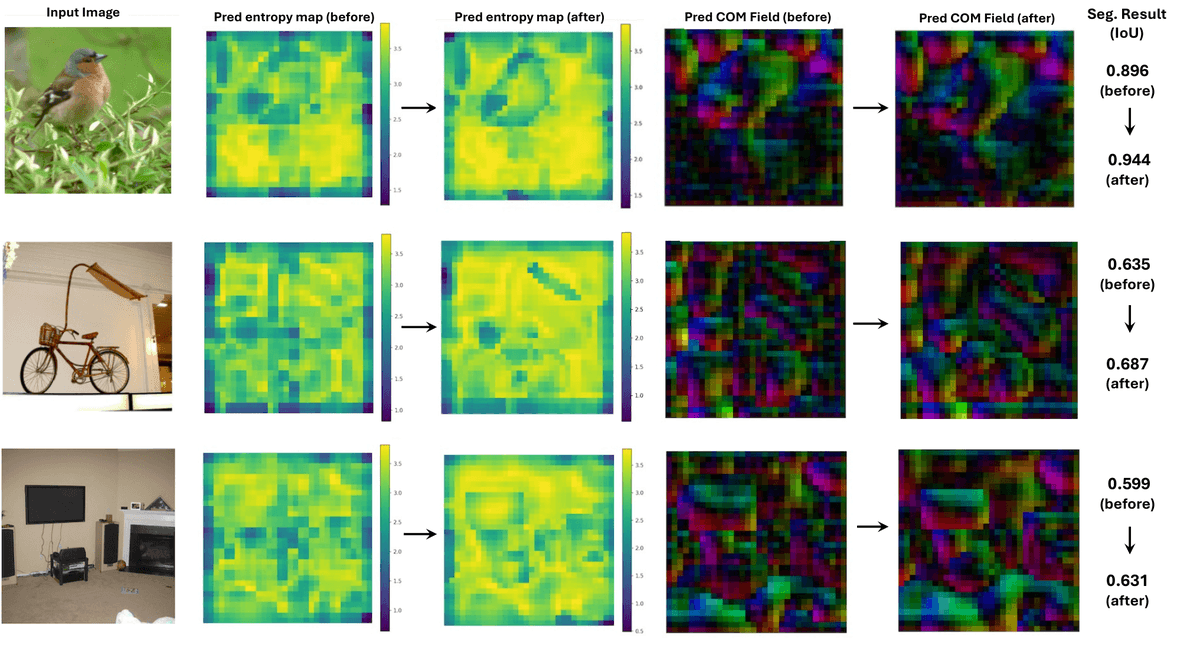
The core representation is what the paper calls a local center-of-mass (COM) field. For every location in the feature map, you compute a similarity-weighted average of the coordinates of its neighbors. In plain terms, you ask, given how this patch relates to nearby patches, where does its structural centroid sit? The answer is a 2D offset, and offsets are comparable across models even when the underlying feature dimensions are not.
This turns any VFM into a stream of coordinate fields describing local geometry. Two models with wildly different embeddings can now be compared directly, because both are reporting spatial structure in the same units.
Filtering out the loudmouth tokens
The second ingredient handles the well-documented high-norm artifact problem, where a few tokens dominate attention with abnormally large activations and mislead any averaging step. DiveUp adds a spikiness-aware selection strategy that scores each VFM's spatial reliability at every local region, using entropy over self-affinity maps as the signal. A confidently peaked affinity is treated as trustworthy; a flat or spiky one is downweighted.
At each region, the framework picks guidance from the most reliable expert rather than blending everyone equally. This is the difference from naive feature fusion: instead of averaging noise into signal, DiveUp routes to whichever backbone has the cleanest view of that particular patch.

One upsampler for many backbones
The payoff is that DiveUp is encoder-agnostic. A single jointly-trained model can upsample features from diverse VFMs like SigLIP and DINOv2 without per-model retraining, which is a real operational win compared to methods that need a dedicated upsampler per backbone. The authors report state-of-the-art performance on dense prediction benchmarks including semantic segmentation and depth estimation, outperforming JAFAR, AnyUp, NAF and bilinear baselines in their qualitative comparisons.
Trying it
The code and pretrained weights are on GitHub, with the model also mirrored on Hugging Face. Loading is a one-liner through torch.hub, with the only external dependency being NATTEN for neighborhood attention:
import torch
diveup = torch.hub.load("Xiaoqiong-Liu/DiveUp", "diveup",
                        pretrained=True, device="cuda")
diveup.eval()
# image: (B, 3, H, W), lr_features: (B, C, h, w) from any VFM
upsampled = diveup(image, lr_features, target_size=(H_o, W_o))
The public repository currently ships inference only, with full training and evaluation code marked as TBD. Architecturally, DiveUp builds on NAF's neighborhood attention filtering and borrows ideas from JAFAR, so if you have used either you will find the API familiar.
Where it fits
DiveUp is worth reaching for when you are using a frozen VFM as a backbone for dense prediction and the native 14 or 16 pixel patch grid is too coarse. Interactive segmentation, unsupervised object discovery, materials analysis on micrographs, and depth or normal estimation are the natural targets. If your pipeline runs a single custom backbone that no one else uses, the multi-expert framing loses some of its punch, because the consensus signal at training time comes from popular VFMs. But for anyone plugging DINOv2, CLIP, or SigLIP into a segmentation head, this is a drop-in improvement that does not require retraining a separate upsampler for each new backbone you try.