
Distinction Engine DE11 Grows Its Own Logic Rules and Knows When to Stop
A new framework reframes learning as a coupled dynamical system where structure, parameters, and an internal energy budget evolve together under constraint.
 Pro
Takeaways
- Teleodynamic Learning reframes ML as coupled dynamics over structure, parameters, and an endogenous resource variable.
- The Distinction Engine (DE11) combines Laws of Form logic, natural gradients, and tropical selection.
- Hits 93.3% on IRIS, 92.6% on WINE, 94.7% on Breast Cancer with interpretable logical rules.
- Structure self-terminates without external stopping, reaching 96% of final accuracy before caps bind.
- Ablations show every component matters: removing structure alone drops IRIS from 93% to 67%.
- Fails on DIGITS (55.9%), no code release, and greedy local action selection lacks global guarantees.
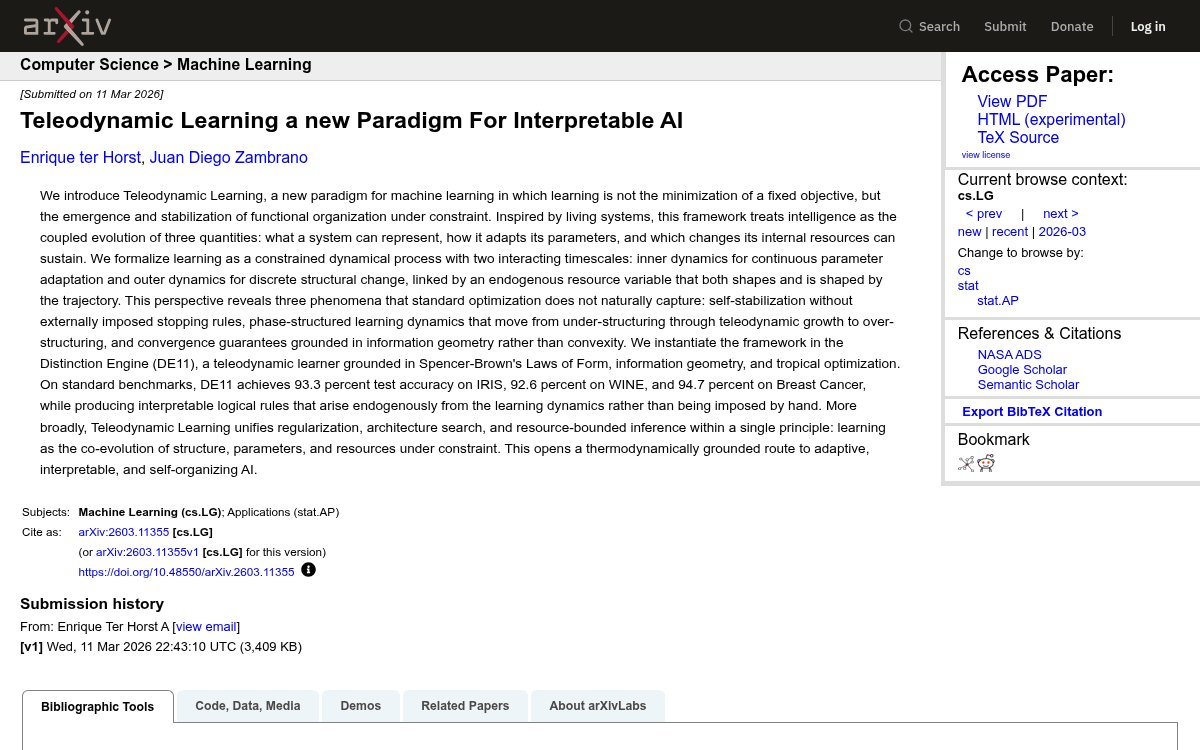
Most machine learning starts from the same assumption: fix a hypothesis class, pick a loss, and grind out parameters that minimize it. A new paper called Teleodynamic Learning argues that this framing is too narrow for adaptive systems and proposes a replacement in which the architecture, its weights, and a self-generated resource budget all evolve together.
The authors instantiate the idea in a concrete rule learner called the Distinction Engine (DE11) and show that it grows its own interpretable logic on small UCI benchmarks, stopping when further growth is no longer worth the cost. It is not a state of the art claim. It is a proposal to reconfigure how we think about the learning problem itself.
Why the optimization frame breaks
The paper opens with a structural complaint about standard ML. Neural architecture search, program synthesis, and rule learning all interleave discrete structural changes with continuous parameter adaptation. Optimization theory struggles with the mixture, so the usual workaround is to freeze structure first, then tune parameters, a split that is mathematically convenient but biologically and computationally implausible.
There is a second complaint about resources. Compute budgets, parameter counts, and deadlines are usually imposed from outside the algorithm. A regularization term turns a hard constraint into a soft preference, Lagrangian methods need the constraint value up front, and neither approach makes the resource endogenous, a quantity the system itself generates and depletes.
The five commitments
Teleodynamic learning is defined by a specific set of properties rather than a single algorithm. A system qualifies only if it exhibits all of them:
- Two timescales. Fast continuous updates to parameters, sparse discrete edits to structure, with parameters still adapting after structure freezes.
- Endogenous resource. An internal scalar
Ethat all actions spend or replenish and that gates which actions are viable. - Local objective. Each candidate action is scored by
J = L + λ_c ΔC + λ_e ΔE, evaluated on the current sample rather than globally. - Emergent halt. A no-op action wins when no structural change beats it, so growth stops without an externally imposed budget.
- Phase structure. The trajectory passes through under-structuring, teleodynamic growth, and equilibrium, diagnosable from dynamical signatures.
The framing borrows from Terrence Deacon's teleodynamics, where end-directed behavior arises because constraints and processes mutually sustain each other. In DE11 the beneficiary is the hypothesis ensemble itself: hypotheses that predict correctly earn energy and persist, while poor performers drain energy and get pruned.
How DE11 actually works
The concrete instantiation rests on three ingredients that most ML engineers will find unfamiliar in combination. Logical structure is expressed in Spencer-Brown's Laws of Form, a distinction calculus that generalizes Boolean algebra. Atoms are sigmoidal halfspaces over the input, disjunctions become noisy-OR, and negation flips the probability. Complexity is defined by counting primitive distinctions in a form.
Parameters live on a statistical manifold, and updates use the natural gradient with a diagonal Fisher approximation. This is the same empirical Fisher estimator used in AdaGrad, RMSProp, and Adam, reinterpreted through the lens of information geometry. The state and its evolution are described coalgebraically, giving a clean transition function γ(s, x, y) = (o, s') with no hidden mutable state.
Structural change comes from just three actions:
- Genesis creates a new hypothesis from the void when no existing rule covers the true class, costing 5 energy units.
- Wedge refines a mispredicting rule by fitting a separator via ridge regression and splitting it into an intersected version plus an exception, costing 8 units.
- Noop leaves structure alone and lets parameters keep adapting for free.
Correct predictions pay out +10, wrong ones cost -10. The loop picks whichever action minimizes J subject to cost(a) ≤ E. When noop consistently wins, structure freezes and the system settles into a parametric-only phase.
Results and what they actually show
The empirical section is deliberately modest. Experiments run on IRIS, WINE, Breast Cancer, and DIGITS with 10 seeds each. DE11 hits 93.3 percent test accuracy on IRIS versus 91.1 for logistic regression, 92.6 on WINE, and 94.7 on Breast Cancer, while producing interpretable logical rules that arise endogenously from the coupled dynamics rather than being imposed by design. Random Forest still beats it on IRIS at 95.6 percent, and the paper is upfront that DIGITS, with 10 classes and 64 features, exceeds the capacity of the rule-based representation.
The ablations are where the framework earns its keep. Removing natural gradients drops accuracy roughly six points, killing the complexity penalty drops it four, removing structural freeze drops it seven, and removing structure entirely collapses accuracy from 93.3 to 66.7 percent on IRIS. The pieces are not decorative.
The more interesting empirical claim concerns emergent halt. In the mature regime, structural freeze occurs at a median of step 450 out of a 500-step structural phase, and the system reaches 96 percent of its final accuracy before external caps would have forced a freeze. The external caps are rarely binding, the system would have frozen anyway.
The real breakthrough is conceptual
The paper is explicit that DE11 is not competing on ImageNet or language modeling. What it offers is a vocabulary and a mathematical scaffold for treating regularization, architecture search, and resource-bounded inference as facets of one principle rather than three unrelated hacks. A regularized loss has no dynamics, its solution is fully determined by the objective and the initial condition. Teleodynamic systems are path dependent: same data, same initialization, different action sequence, potentially different final structure.
Convergence is also handled differently. The authors prove that inner parameter dynamics converge under natural gradient descent independent of whether structure has stabilized, with the bound resting on the Fisher geometry rather than convexity of the loss.
What it is good for and what it is not
Useful when:
- Interpretability is a hard requirement, since the output is a small set of logical rules over halfspaces that a domain expert can read.
- Deployment environments are resource constrained and you want energy or compute to be a first-class variable rather than a wallclock hack.
- You care about online model selection instead of running cross-validation over separate architectures.
Not useful when:
- You need to scale to high-dimensional inputs or many classes. The DIGITS run at 55.9 percent shows the rule-based representation cracks quickly.
- You need calibrated probabilities out of the box. Tropical inference uses a fixed 0.5 activation threshold that the authors flag as needing better calibration.
- You need the strong global optimality guarantees that come with convex objectives, since action selection is greedy and myopic.
There is no code release referenced in the paper and no public repository or model weights are mentioned alongside it. Anyone wanting to reproduce DE11 will need to implement the algorithms from the appendix, which does at least spell out the full learning loop, inference, genesis, wedge, and objective evaluation in pseudocode. The Semantic Scholar entry currently lists zero citations, so this is very early in its lifecycle.
Whether teleodynamic learning becomes a working paradigm or stays a philosophically appealing footnote depends on whether someone can push it past toy datasets. Replacing sigmoidal halfspace atoms with neural modules, adding hierarchical composition, and moving beyond the diagonal Fisher approximation are the obvious next steps the authors themselves list.