
DINOSAUR's Slot Merging Fix Beats AdaSlot by 5 Points on COCO
A new drop-in operator for slot attention detects overlapping slot pairs and merges them mid-training, lifting DINOSAUR's segmentation quality on four benchmarks.
 Pro
Takeaways
- Slot merging adds a drop-in operator to slot attention that fuses overlapping slots during training.
- Overlap is measured with Soft-IoU on attention maps; merged slots use a mass-weighted convex combination.
- The merge threshold is picked automatically from overlap histograms via triangle thresholding, no new learnable params.
- Built into DINOSAUR, mBOc rises from 51.2 to 55.34 on VOC and 38.8 to 42.78 on COCO.
- Beats adaptive-cardinality methods AdaSlot and MetaSlot across VOC, COCO, MOVi-C, and MOVi-E.
- Training overhead is roughly 30 seconds on VOC and 6 minutes on MOVi-C; no code released yet.
Slot attention has been the go-to bottleneck for unsupervised object discovery for years, but it comes with an awkward constraint: you have to pick the number of slots ahead of time. Pick too few and objects get glued together. Pick too many and something worse happens: multiple slots end up fighting to explain the same object, splitting it into fragments. A new paper titled When Slots Compete: Slot Merging in Object-Centric Learning proposes a fix that is almost embarrassingly simple: when two slots start attending to the same region, just merge them.
The fixed-K problem, in plain terms
Slot-based object-centric learning represents an image as a set of latent slots with a decoder that combines them into an image or features. The decoder specifies how slots are combined into an output, but the slot set is typically fixed: the number of slots is chosen upfront and slots are only refined. That upfront choice is a bad fit for real photos, where the number of objects varies wildly from image to image.
The dominant fix so far has been to over-provision slots and then prune. Adaslot learns a scoring module that predicts which slots are informative and discards the rest, and MetaSlot clusters slots against a vector-quantization codebook of prototypes to suppress duplicates. Both approaches treat redundant slots as garbage. The authors argue that's the wrong mental model: overlapping slots are not junk, they are fragments of the same object that should be glued back together.
How slot merging works
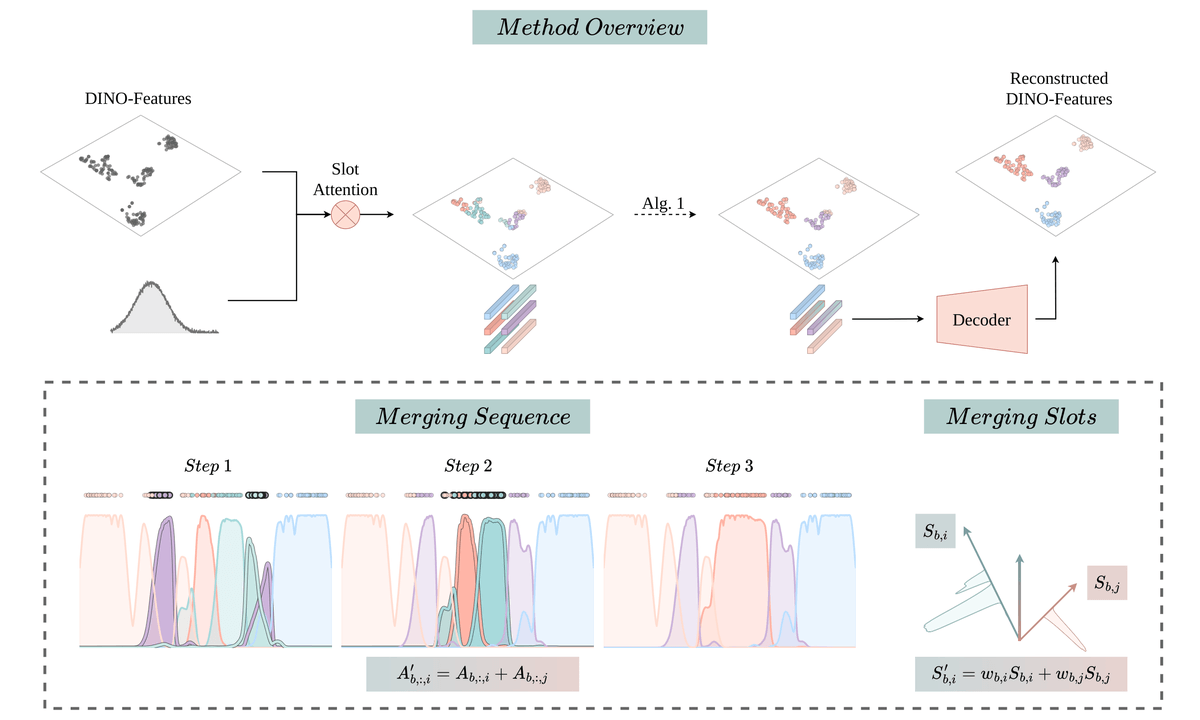
The mechanism has three parts, and none of them add learnable parameters. First, a similarity signal between slots. Overlap is quantified with a Soft-IoU score between slot-attention maps, treating each slot's attention map as a soft spatial mask over image patches and computing a differentiable intersection-over-union.
Second, the actual merge. Once the pair with the highest overlap is selected, the two slot vectors are combined with a mass-weighted convex interpolation: each slot's weight is proportional to how much attention mass it holds, and the merged slot inherits the sum of both attention maps. Slot j is then dropped from the set. Crucially, gradients flow through the whole operation. An ablation where gradients are detached from the merged slots drops mBOi on VOC from 47.83 to 45.75, confirming that the merge is doing real optimization work, not just cleaning up outputs.

Third, a stopping rule. Merging keeps repeating on the pair with highest overlap until no pair exceeds a threshold. The threshold isn't a magic hyperparameter: it's inferred from overlap statistics, requiring no additional learnable modules. The authors build a histogram of pairwise Soft-IoU values one epoch before merging turns on, then use a classic triangle thresholding method from a 1977 histology paper to pick the split point between low-overlap and high-overlap pairs. Values used were 0.036 for VOC, 0.04 for COCO, 0.035 for MOVi-C, and 0.019 for MOVi-E.
One important schedule detail: merging is not on from step zero. It kicks in after slots have stabilized, roughly 70% into training, so that early merging doesn't collapse slots before they have specialized.
What it beats and by how much
The method is dropped into the DINOSAUR pipeline, which reconstructs frozen DINO features rather than raw pixels. Evaluation covers PASCAL VOC 2012, MS COCO 2017, MOVi-C, and MOVi-E, using mean best overlap (mBO) at instance and class levels plus mIoU. The gains over the DINOSAUR baseline:
- VOC: mBOc jumps from 51.2 to 55.34, mBOi from 44.0 to 47.83
- COCO: mBOc from 38.8 to 42.78, beating extensions like DINOSAUR+FS+RC
- MOVi-C: mBOi from 42.4 to 48.35
- MOVi-E: mBOi reaches 39.56 starting from 25 initial slots
Against adaptive-cardinality methods on COCO, the paper reports 32.88 mBOi versus 27.4 for AdaSlot and 29.5 for MetaSlot-MLP. It also stays competitive with more elaborate teacher-student setups like SPOT and, on MOVi-C, edges past most non-diffusion methods.

Cost, caveats, and what this really shows
The overhead is basically free. On VOC, training takes about 53 minutes for DINOSAUR versus 53.5 minutes with merging. On MOVi-C, roughly 4h44m becomes 4h50m. The paper reports the extra work as O(NK2) per image with incremental updates, dominated by the O(TDNK) cost of slot attention itself.
The real breakthrough is conceptual rather than architectural. The community has been treating the fixed-K problem as a discrete selection problem: which slots to keep, which to drop. Reframing it as continuous representation consolidation, where competing slots blend into one via a differentiable operator that gradients pass through, turns a hard combinatorial choice into a smooth part of training. It's also a reminder that slot attention itself only defines how slots refine, never operations on the slot set as a whole.
Limitations are honest. The merge policy only looks at pairwise overlap and does not explicitly model higher-order relations among multiple slots, so complex multi-object scenes where three or four slots co-fragment an entity may still be handled sub-optimally. The stopping threshold is fixed for a given dataset rather than adapting per image. And the paper does not release code alongside the preprint, so anyone wanting to reproduce will need to implement Algorithm 1 on top of an existing DINOSAUR codebase such as the unofficial PyTorch DINOSAUR implementation. The algorithm itself is short enough that this is a weekend project rather than a research effort.