
DINN Fixes Warped AI Vision Without Retraining Your Whole Model
A math-heavy plug-in module fixes geometric distortion in images by learning bijective quasiconformal maps, beating GAN-based restoration on turbulence benchmarks.
 Pro
Takeaways
- DINN adds a lightweight quasiconformal transformer to existing networks to undo geometric image distortion.
- Predicts a Beltrami coefficient with magnitude below 1, guaranteeing a bijective, fold-free warp.
- Beats Pix2Pix, DeblurGAN, CycleGAN, TurbNet, PiRN, LiGAN, and DTDGAN on air and water turbulence.
- Face verification under strong turbulence jumps from 81.23% to 90.15% accuracy.
- Downstream classifier stays frozen, avoiding expensive fine-tuning on distorted data.
- Struggles with extreme deformations; published in Neural Networks journal.
Long-range cameras, underwater photography, and any imaging pipeline that shoots through moving air or water have the same nasty problem: the image is not just blurry, it is geometrically warped. Pixels get pulled around by the medium, and downstream models trained on clean data quietly break. A new paper in Neural Networks proposes a fix that leans on complex analysis rather than piling on more GAN tricks, and it does it with a module small enough to bolt onto networks you already have.
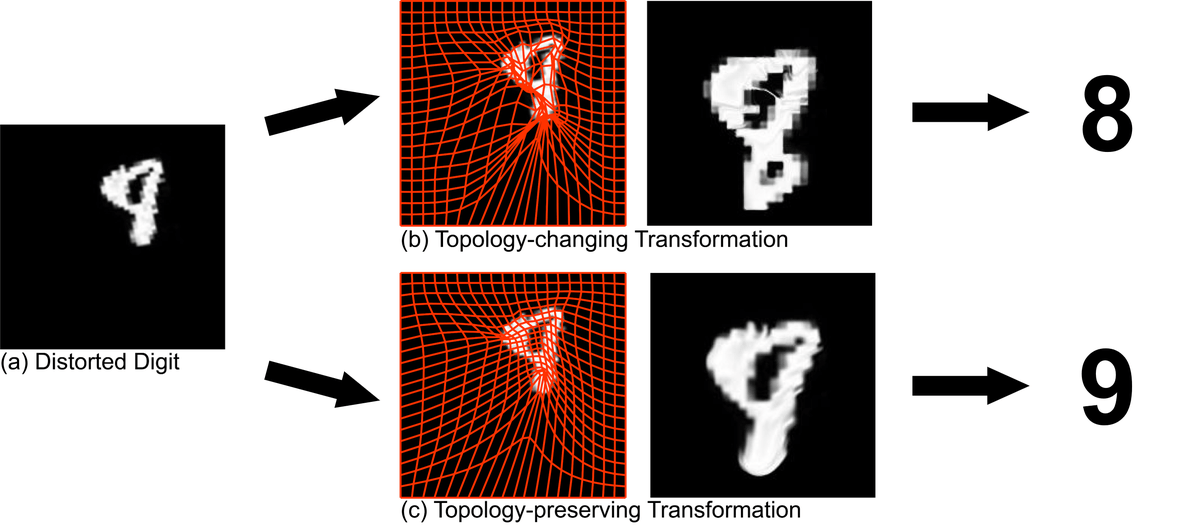
The Deformation-Invariant Neural Network (DINN) from Han Zhang, Qiguang Chen, and Lok Ming Lui introduces a component called the Quasiconformal Transformer Network (QCTN) that learns to undo geometric distortion before the distorted image reaches your classifier or restoration network. The QCTN is a deep neural network that outputs a quasiconformal map, which can transform a geometrically distorted image into an improved version that is closer to the distribution of natural or good images. Crucially, the map it produces is guaranteed to be bijective, meaning no pixel gets folded onto another and no topology is destroyed.
Why bijectivity is the whole ballgame
The paper opens with a striking example: a distorted digit 9. If you let a network warp it freely, it can accidentally close the loop and turn it into an 8. A classifier will then confidently label it wrong, even though the pixels have technically been "restored." Preventing that class of failure is what quasiconformal theory buys you.
The QCTN does not directly predict a displacement field. Instead, it predicts a Beltrami coefficient, a complex-valued function that measures how much a mapping locally stretches shapes away from a pure rotation-plus-scaling. The QCTN achieves this by first outputting a Beltrami coefficient, which measures the quasiconformality of the associated deformation map. By controlling the Beltrami coefficient, the local geometric distortion under the quasiconformal mapping can be controlled. As long as the coefficient's magnitude stays below 1 everywhere, the resulting map is provably bijective. The network enforces this with a custom activation that squashes the coefficient's magnitude into the open unit disk using a hyperbolic-tangent-style function while preserving its phase.