
DiFlowDubber Beats Every Dubbing System While Running in Real Time
A new video dubbing framework combines discrete flow matching with facial-expression-driven prosody and dual cross-modal alignment to fix synchronization and expressiveness.
 Pro
Takeaways
- DiFlowDubber is the first video dubbing framework built on a discrete flow matching backbone.
- A dual-alignment Synchronizer replaces duration predictors with direct video-text and speech-text contrastive alignment.
- A Face-to-Prosody Mapper turns facial expressions into a global prosody prior guiding speech generation.
- Beats prior SOTA (EmoDubber, ProDubber, StyleDubber) on lip-sync, WER, and UTMOS across Chem and GRID.
- Runs at RTF 0.05 with 8 sampling steps on a single A100, matching EmoDubber's speed.
- Project page | Paper
Video dubbing sits at an awkward intersection: it needs the naturalness of modern text-to-speech, the emotional expressiveness cued by an actor's face, and the frame-accurate lip alignment demanded by film. A new system called DiFlowDubber, from researchers at FPT Software AI Center, KAIST, and the University of Alabama at Birmingham, attacks all three at once using a discrete flow matching backbone and a novel dual-alignment mechanism between text, video, and speech.
On the two standard dubbing benchmarks, Chem and GRID, it beats prior systems including StyleDubber, Speaker2Dubber, ProDubber, and EmoDubber on lip-sync, pronunciation accuracy, and naturalness scores, while running at a real-time factor of roughly 0.05 with only 8 sampling steps.
Why dubbing keeps breaking
The core problem is data. A primary bottleneck is the scarcity of large-scale legally shareable dubbing data, which is constrained by copyright issues. Meanwhile, TTS models trained on huge speech corpora sound great but have no idea what a face is doing.
Recent work has tried to bridge that gap by adapting pretrained TTS models. Speaker2Dubber pre-trains on a large TTS corpus and then adapts its phoneme encoder for the dubbing task, which improves pronunciation but underuses the prosody and acoustic knowledge in the pretrained model. ProDubber went further with prosody-enhanced pretraining, but it relies on a duration predictor to estimate lip movements that are not constrained by the actual video length, resulting in poor audio-visual synchronization.
In other words, the previous generation of dubbing models either sounded flat or drifted out of sync with the mouth on screen. DiFlowDubber's contribution is a design that keeps the TTS knowledge intact while forcing the output to obey the actual timing of the video.
The architecture, in plain terms

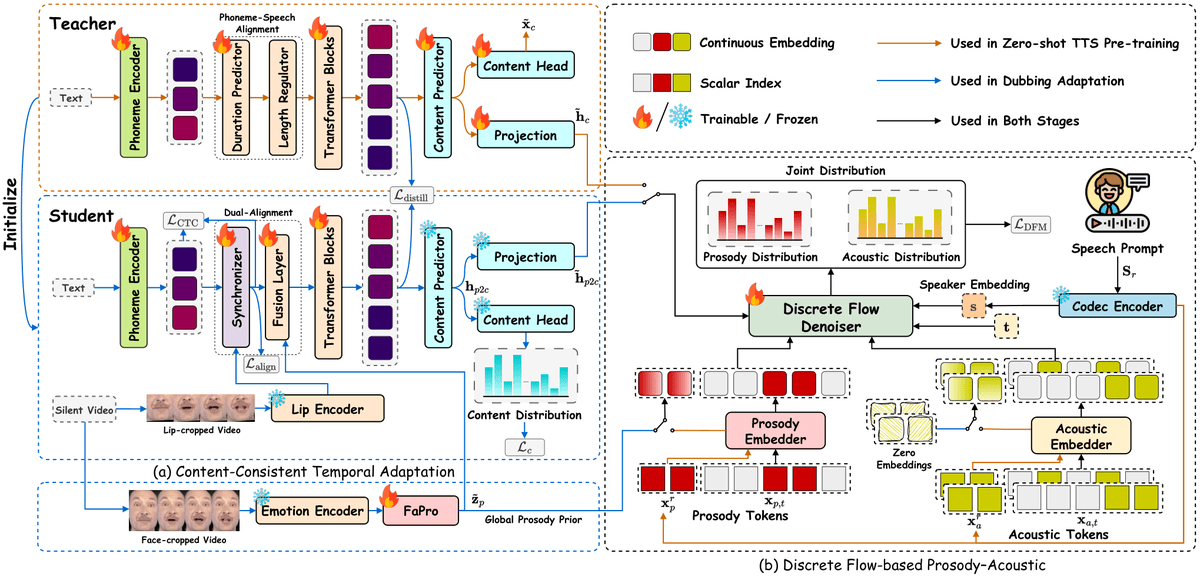
The system builds on FACodec, a neural speech codec that factorizes speech attributes such as prosody, content, and acoustic information, making them easier to control and model. Each audio clip becomes three separate streams of discrete tokens (prosody, content, acoustic) plus a speaker embedding. DiFlowDubber generates those tokens and then hands them back to FACodec's decoder to reconstruct the waveform.
Training happens in two stages:
- Zero-shot TTS pretraining on 470 hours of LibriTTS. A deterministic phoneme model handles linguistic content, while a Diffusion Transformer trained with discrete flow matching (DFM) generates the prosody and acoustic tokens together.
- Video dubbing adaptation on Chem and GRID. The pretrained model is fine-tuned with three new modules that inject face and lip information without discarding the TTS backbone.
Discrete flow matching is the interesting choice here. Instead of continuous diffusion over spectrograms, the model learns a probability velocity field that gradually transforms fully masked token sequences into realistic prosody and acoustic tokens. That means fewer sampling steps at inference and native handling of the codec's discrete outputs.
The three modules that make it work
FaPro (Face-to-Prosody Mapper). Takes cropped face frames and predicts a global prosody prior, the emotional and stylistic "vibe" the speech should carry. It upsamples the video features to match speech length using a learnable interpolation-convolution block, refines them with ConvNeXt V2 blocks, then produces one representation per residual codebook of prosody tokens.
Synchronizer. This is the piece that replaces the flawed duration predictor. It enforces alignment twice: once between lip frames and phonemes, then again between speech tokens and phonemes. Each alignment is trained with a contrastive loss against a binary ground-truth alignment matrix built from Montreal Forced Aligner phoneme durations. The attention weights from the first stage are also converted, via Monotonic Alignment Search, into phoneme-to-frame durations, so each phoneme embedding gets stretched to match the actual video timeline.

The ablation is clear: dropping both alignment losses tanks synchronization the hardest, and the speech-text loss turns out to be the primary driver of the AVSync score. Video-text alignment helps pronunciation because lip motion carries phonetic information.
CCTA (Content-Consistent Temporal Adaptation). Distills the pretrained TTS content model into the dubbing model using cosine similarity between intermediate features, then fuses the prosody prior from FaPro with the aligned content from the Synchronizer. A CTC auxiliary loss keeps linguistic information rich. The fused representation conditions the DFPA denoiser, which is initialized from the pretrained TTS weights and fine-tuned to produce prosody and acoustic tokens jointly.
The numbers
On Chem under Setting 2.0 (a non-ground-truth reference from the same speaker), DiFlowDubber posts:
- LSE-C of 8.37 and LSE-D of 6.70, both better than the ground truth's own SyncNet scores (8.12 / 6.59) and well ahead of EmoDubber (8.09 / 6.96).
- WER of 11.12, second only to ProDubber, which itself has poor lip sync.
- UTMOS of 4.03, matching ground-truth naturalness of 4.18 more closely than any baseline.
- MOS-S of 4.18 in a 20-listener subjective study, the highest among all four recent baselines.
On GRID the story is similar: SOTA on LSE-C, LSE-D, WER, and UTMOS in both settings. The one metric where it lags is SECS (speaker cosine similarity), which the authors attribute to a measurement bias, since baselines use the same speaker encoder for both generation and evaluation. The subjective MOS-S contradicts SECS and puts DiFlowDubber on top.
The speed story
Discrete flow matching pays off at inference. DiFlowDubber achieves competitive results across metrics and maintains an RTF equivalent to EmoDubber (0.05) at only 8 (RTF = 0.05) or 10 (RTF = 0.06) NFEs, despite a larger parameter count. UTMOS drops sharply below 4 NFEs, so the useful range is roughly 8 to 128 steps depending on how much quality matters versus latency. At 250M parameters (excluding video encoders), that puts it in real-time territory on a single A100.
What it is good and bad at
Strengths line up with the design goals: precise lip synchronization, natural prosody driven by facial expression, and clean pronunciation because the TTS backbone was trained on clean, large-scale data. The mel-spectrogram comparisons show cleaner harmonic structure and fewer temporal drift artifacts than competitors.
The limitations are honest. The authors note the system inherits constraints from the third-party FACodec and that the current design does not fully meet expectations in voice cloning. In other words, matching a specific target speaker's timbre from short audio is still an open problem in this framework. It is also trained on relatively narrow domains (a chemistry lecturer, GRID's clean studio recordings), so cinematic dubbing in the wild would require more data.
Where this lands
For anyone building automated dubbing pipelines, the practical takeaway is that duration predictors are the wrong abstraction when a video already dictates timing. Direct dual-alignment against actual frame indices, combined with facial-expression-driven prosody, produces speech that both sounds right and lines up with the mouth. Combined with the discrete flow matching backbone, it hits a quality-speed point that continuous flow and diffusion dubbing systems have struggled to reach.
The paper does not currently list a code release, though the project page at nngocson2002.github.io/projects/diflowdubber is the place to watch. Given the framework depends on the open FACodec and standard components like ConvNeXt V2 and DiT, a reference implementation would be reproducible for teams working on assistive speech tech, animation pipelines, or localization tooling.