
DiagnosUs Study Shows Biased Labels Quietly Break Rare-Event AI Models
A field experiment on a medical crowdsourcing app shows how prevalence tuning, probability elicitation, and recalibration cut rare-event misses in training labels.
 Pro
Takeaways
- Rare-event labeling biases annotators toward false negatives, and correlated errors break naive wisdom-of-crowds aggregation.
- Field experiment on DiagnosUs with 290 annotators classifying blast vs. non-blast white blood cells.
- Balanced 50% gold-standard feedback rebalances miss/false-alarm even when production prevalence stays at 20%.
- Eliciting probabilities beats binary labels; enables downstream recalibration via linear-in-log-odds transform.
- Crowd-level recalibration cut miss rate to 9% with 3% false alarms in low-prevalence conditions.
- Improvements propagate to CNNs trained on recalibrated labels; full paper on arXiv.
Rare-event detection is where a lot of production AI quietly falls apart. Fraud, defects, tumors, policy violations, all share the same pain: positives are scarce, and the humans labeling training data start guessing "no" too often. A new field experiment on the DiagnosUs medical crowdsourcing platform quantifies how much this bias contaminates downstream models, and shows three cheap knobs that fix it.
The bias hiding in your labeling pipeline
The paper studies the prevalence effect, a well-documented cognitive quirk from radiology and airport screening research. When positives are rare, the prevalence effect induces systematic cognitive biases that inflate misses and can propagate through the AI lifecycle via biased training labels. The scary part for ML pipelines: these errors are not random noise. Because every annotator sees the same skewed base rate, their mistakes become correlated, which breaks the core assumption behind wisdom-of-crowds aggregation and majority voting.
The authors first replay data from earlier lab experiments where 96 undergrads classified white blood cell images as blast (cancerous) or non-blast under 10%, 25%, 50%, 75%, and 90% positive rates. Individual miss rates climb sharply as prevalence drops, and simple majority vote can actually amplify the error in extreme regimes. The likelihood of the crowd being correct with a crowd size of one is greater than the likelihood of the crowd being correct with a crowd size of three when p is less than 0.5. Adding more annotators to a biased crowd makes things worse, not better.

Three levers, tested in the wild
Study 2 ran actual paid contests with 290 DiagnosUs annotators classifying blood cells. The true rate in the unlabeled stream stayed pinned at 20% blasts, but the researchers varied two design choices in a 2x2:
- Gold-standard feedback prevalence: 20% (matching production) vs. 50% (balanced)
- Response interface: binary yes/no vs. a slider eliciting a probability
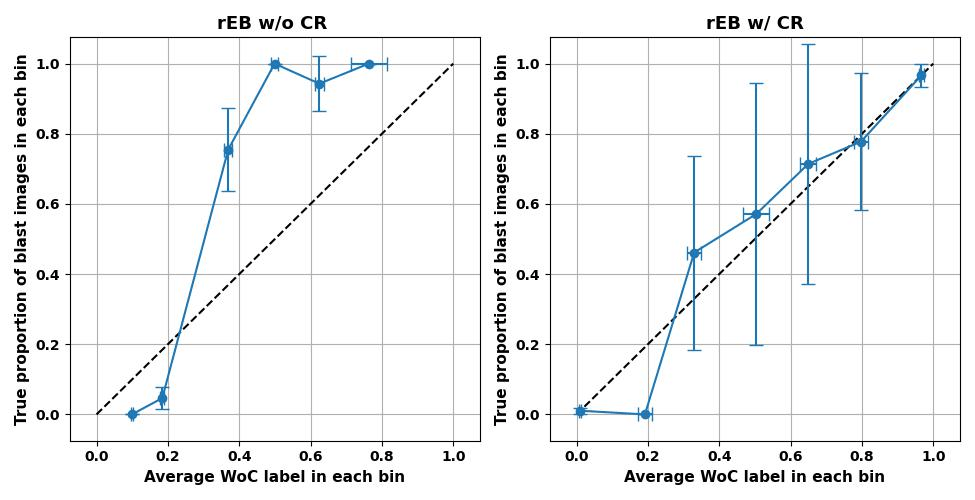
Then they added a third lever after the fact: recalibration of the elicited probabilities using a linear-in-log-odds (LLO) transform. LLO fits two parameters, alpha and beta, that stretch or shift the annotator's probabilities in log-odds space to better match ground truth. It was applied both per-worker (using each worker's own gold-standard trials) and at the crowd level (fitting on the aggregated crowd probabilities). Labels were then used to train GoogLeNet CNNs via transfer learning under stratified 5-fold cross-validation.
What actually moved the needle
Balanced 50% feedback consistently rebalanced the miss/false-alarm tradeoff at both individual and crowd levels, even though the unlabeled stream was still 20% positive. Elicited probabilities beat binary labels in the low-prevalence conditions, apparently because uncertain "maybe blast" votes carry information that a binary threshold throws away.
The biggest win came from crowd-level recalibration. In our lowest-prevalence feedback regime, crowd-level recalibration of aggregated probabilities reduces the crowd miss rate to roughly 9% while keeping false alarms near 3%. Per-worker recalibration was less reliable, because each annotator only sees a modest number of gold-standard trials and the fit gets unstable, sometimes making the bias worse. Pooling calibration data at the pipeline level was more robust.
Does it survive model training?
Mostly, yes. The miss/false-alarm patterns observed in the crowd labels largely carry through to convolutional neural networks trained on those labels, implying that annotation design choices propagate into model behavior. CNNs trained on recalibrated labels showed the lowest miss rates and best expected calibration error on out-of-sample test images. One caveat: model training tended to degrade calibration relative to the training labels, so the authors argue data-side and model-side calibration are complementary, not substitutes.
Practical takeaways
- Split your gold-standard set: use one stream with production prevalence for unbiased monitoring, and a separate feedback/training stream deliberately balanced to counteract cognitive bias.
- Ask for probabilities, not just labels, and score them with a proper scoring rule so annotators are incentivized to be honest about uncertainty.
- Recalibrate at the pipeline level, not per worker, using pooled gold-standard responses as your calibration set.
- Track misses, false alarms, and ECE jointly instead of raw accuracy, which hides miss-heavy failure modes.
Where this stops working
The study is a single binary medical task on one platform, so the exact numbers won't transfer to content moderation, security screening, or multi-class labeling without new experiments. The two feedback prevalence points (20% vs. 50%) also don't map out an optimal policy under different miss/false-alarm cost ratios. The raw behavioral data from Study 1 is available on OSF, but there's no released code repository or trained model for the CNN pipeline, so teams wanting to adopt the LLO recalibration will need to reimplement it from the equations in the paper.