
DFKI Finds a Stopwatch Can Reveal How Much Energy ChatGPT Burns
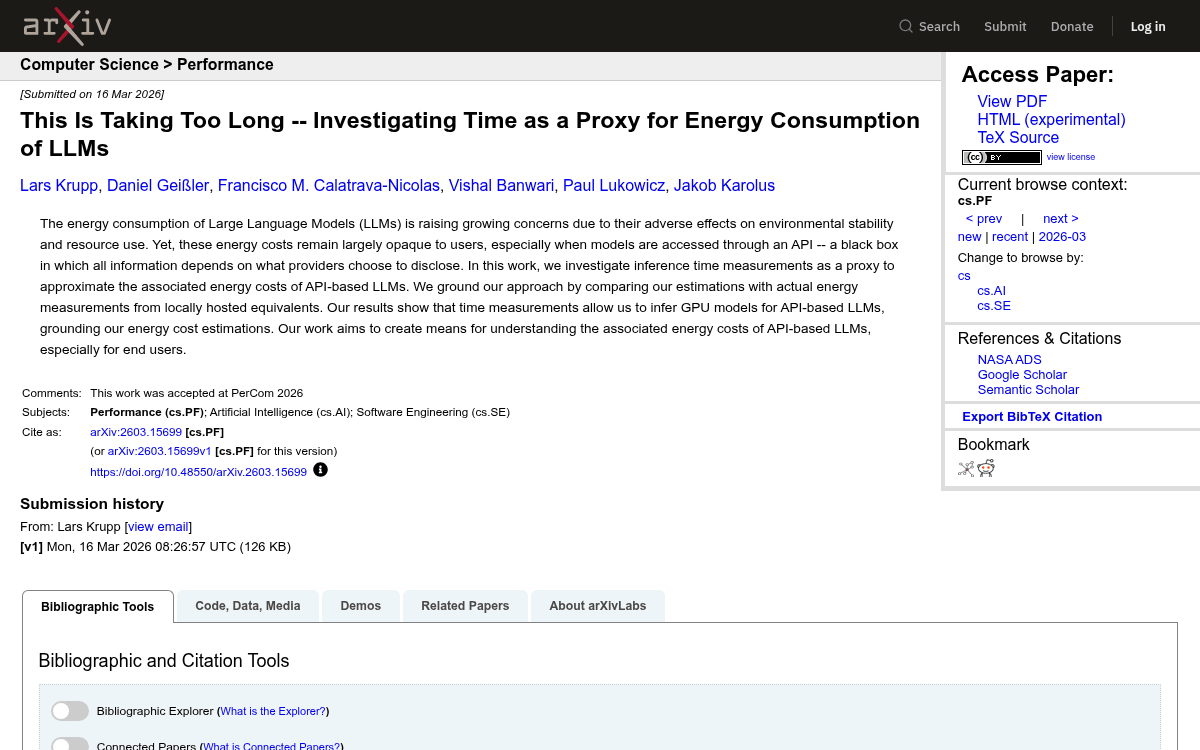
A new benchmark uses inference time as a proxy for estimating the energy cost of API-based LLMs, grounded by local GPU measurements.
 Pro
Takeaways
- Inference time per token can serve as a usable proxy for API LLM energy consumption.
- Method grounds estimates by benchmarking open-weight Mistral models locally on known GPUs.
- Tested across six NVIDIA GPUs spanning Ampere and Hopper, both SXM and PCIe variants.
- Mistral API times cluster with H100/H200 hardware, with H100-PCI as a strong representative proxy.
- TDP-only energy estimates undershoot real board-level measurements by up to 43 percent on PCIe cards.
- Code and results released on GitHub; paper on arXiv.
How much energy does one ChatGPT-style API call actually burn? For anyone hitting a hosted endpoint, the honest answer is a shrug. Providers rarely publish per-token energy figures, GPU fleets are undisclosed, and the model weights themselves are locked away. A new paper from researchers at DFKI, RPTU, and Örebro University tries to close that gap with a simple lever everyone already has: a stopwatch.
The team behind This Is Taking Too Long shows that inference completion time, when grounded against locally hosted equivalents of the same model on known hardware, can be used to infer which class of GPU is likely serving an API and, from there, approximate its energy consumption. The code and evaluation results are public.
The black box problem
Closed-source models and sparse details on data center infrastructure make robust energy estimation impossible, and there is no access to weights or inference configuration to run transparent measurements. Yet one metric can be directly measured: task completion time, the time it takes for a model to process a single token.
That matters because inference is no longer a rounding error. A single LLM query may consume only 0.3 to 1 Wh, but the cumulative demand of millions of daily requests may scale to annual petawatt-hour levels by 2026. Companies are already building dedicated power infrastructure to feed the fleet, so a user-side estimator has real utility for procurement, sustainability reporting, and picking between providers.
The core assumption
The methodology rests on one clean idea: when computational hardware operates at or near optimal utilization, its power draw remains approximately constant, allowing total energy consumption to be estimated as a function of execution time. If you know the average power a model pulls locally on a given GPU, and you know how long the API took to answer the same prompts, you can multiply the two.
Concretely, for N local runs the authors compute average power as
P_local = mean(E_local_i / T_local_i)   # from CarbonTracker + wall clock
E_api_hat = P_local * T_api_mean        # predicted API energy
Everything is normalized per output token because API and local deployments do not produce identical token counts.
How the benchmark is built
The setup is deliberately narrow so the signal is not swamped by confounders:
- Models are chosen because they are available in both open-weight and API-based variants: Mistral-7B-Instruct-v0.3 paired with Open-Mistral-7B, and Mistral-NeMo-Instruct-2407 paired with Open-Mistral-NeMo.
- Each run processes a fixed sequence of 100 synthetic prompts, and every configuration runs ten times across four task types (technical, creative, educational, business) at 2,048 and 8,192 token lengths.
- Local hardware spans six NVIDIA GPUs across the Ampere and Hopper generations in SXM and PCIe form factors: A100-40GB, A100-80GB, A100-PCI, H100, H100-PCI, and H200.
- Models run in FP16 precision with TF32 acceleration, KV-caching, left-padding, temperature fixed at 0.7, and seed 42 synchronized across Python, NumPy, PyTorch, and CUDA.
- Energy is captured with CarbonTracker, which samples GPU power via NVIDIA SMI and integrates full board-level energy rather than just the chip TDP.
What the numbers say
The APIs are fast. Compared to the best-performing local setup, API execution achieves a reduction in computation time of approximately 54% for Mistral-7B and approximately 43% for Mistral-NeMo, hinting at server-side parallelism or trimmed system prompts. The marginal difference between free and paid APIs suggests both rely on similar backend resources.
The more interesting result is clustering. On a per-token basis, local runs split into two clean groups: an A-cluster (A100 variants) and an H-cluster (H100 and H200). The Mistral API times sit inside or just above the H-cluster, with H100-PCI turning out to be a solid proxy for both models. That maps to public information: Mistral reports training on H100 GPUs, and MLPerf v4.1 shows H100/H200-class accelerators dominate datacenter LLM inference.
TDP-only estimates undersell reality. On PCIe cards, board-level measurements ran roughly 39 to 43 percent above TDP-derived numbers because of less efficient power delivery and higher conversion losses, while SXM server cards tracked much closer to their chip envelope. Anyone estimating datacenter energy from spec sheets alone is likely low by a meaningful margin.
Where this breaks
The authors are upfront about the ceiling. The approach assumes API-measured time is dominated by GPU computation, with other contributions negligible, which lets them ignore batching, multi-GPU execution, and expert or pipeline parallelism. In production, those choices reshuffle the runtime-versus-power tradeoff: hosting Mistral-7B across multiple GPUs shortens runtime but proportionally increases total energy consumption per second. So the technique yields a gross estimate, not a forensic number.
It is also confined to models that fit on a single GPU and to providers whose weights are actually available in open form. A closed API for a fully proprietary model has no local twin to calibrate against.
Why it is still useful
For anyone building on hosted LLMs, this is a first defensible way to put a Wh figure next to an API bill. The pattern is repeatable: pick a model with an open-weights sibling, run the benchmark locally on a GPU you trust, measure the API under similar prompts, and use the per-token power number to translate future traffic into energy. It will not satisfy an auditor, but it is far better than the current default, which is no number at all.