
Delightful Policy Gradient Beats PPO and REINFORCE With One Extra Multiply
A new policy gradient variant multiplies each update by advantage times surprisal, then squashes through a sigmoid, beating REINFORCE and PPO across three domains.
 Pro
Takeaways
- New Delightful Policy Gradient gates each update by sigmoid of advantage times action surprisal, a one-line drop-in for REINFORCE.
- The paper proves DG shifts the expected gradient closer to the supervised cross-entropy oracle, even with infinite samples.
- On MNIST-as-bandit, DG closes roughly half the gap between REINFORCE and full supervised cross-entropy training.
- On Token Reversal with transformers, DG achieves a smaller power-law scaling exponent than REINFORCE, PPO, and PMPO.
- Across 28 DeepMind Control Suite environments, DG is never the worst method and avoids catastrophic PPO/REINFORCE failures.
- Requires no importance ratios or trust regions; temperature η=1 works across all reported experiments.
Policy gradients have powered everything from AlphaGo to RLHF, but they rest on a weighting rule that treats every sampled action the same regardless of how probable it was. A new paper from Ian Osband argues that this rule is quietly suboptimal, and proposes a one-line fix that consistently beats REINFORCE, PPO, and advantage-weighted baselines on MNIST, transformer sequence tasks, and continuous control.
The method is called the Delightful Policy Gradient (DG). It gates each per-sample gradient term by a sigmoid of delight, defined as the product of advantage and action surprisal (the negative log-probability of the sampled action). The whole change is one sigmoid and one multiply per sample.
Why the standard rule leaks gradient budget
Standard policy gradients form per-sample updates by weighting the score by an advantage estimate, so each score term is weighted by advantage alone, regardless of how likely the sampled action was under the current policy. The paper identifies two failure modes this creates:
- Within a single context (one image, one prompt), a rare action with negative advantage can inject large perpendicular noise into the update, even though the policy already avoids it.
- Across contexts in a batch, the expected policy-gradient direction systematically over-allocates gradient budget to contexts the policy already solves well.
The second point is the sharper one. A classifier allocates more gradient budget to an image it already gets right 99% of the time than to one it gets right 50%; likewise, an easy prompt dominates a harder one simply because the model already succeeds on it. This bias is not a finite-sample artifact: it persists even with infinite data.
The delight gate, in one equation
Let U be the advantage and ℓ = -log π(a|s) the surprisal of the chosen action. Delight is χ = U·ℓ, and DG multiplies the usual score term by σ(χ/η) with temperature η=1 fixed throughout the paper. The asymmetry is intuitive:
- Breakthroughs (rare action, positive advantage): the gate opens,
w ≈ 1, so the update passes through. - Blunders (rare action, negative advantage): the gate closes,
w ≈ 0, so noisy corrections to already-unlikely actions are muted. - Familiar actions: surprisal is small, so the gate sits near 1/2 and DG behaves like a scaled REINFORCE.

The intuition is simple: a blunder is already being avoided, so pushing it down further has limited value, while a breakthrough is a discovery the policy should exploit. The sigmoid also drops out of a small entropy-regularized optimization over gate values, which the paper works through in the appendix.
Two mechanisms, not just variance reduction
In the tabular K-armed bandit case, the author proves two distinct effects. First, in a symmetric single-context bandit, DG reduces perpendicular variance by exactly a factor of w-squared relative to PG. Second, and more interesting, across multiple contexts DG shifts the expected gradient strictly closer to the supervised cross-entropy oracle, even in the infinite-sample limit.
That second effect is the real breakthrough. Variance reduction methods like control variates and leave-one-out baselines don't change the expected update direction. DG does. It changes the bias of the gradient, and the induced bias happens to point toward the cross-entropy target that fully supervised training would use.
How it performs
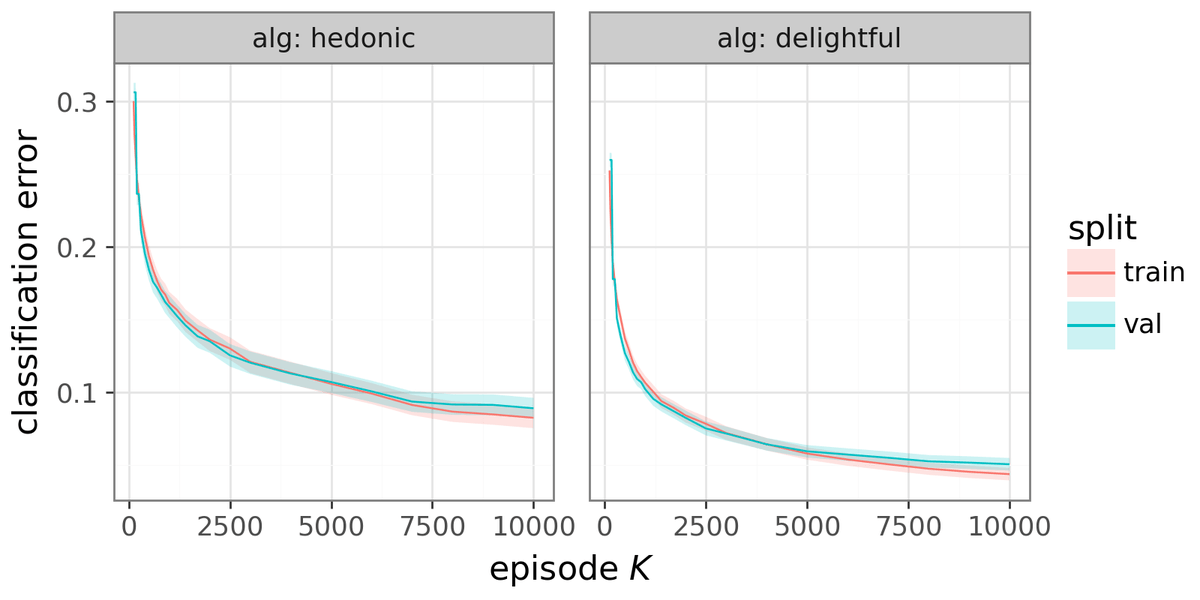
The paper runs three experiments to make sure the mechanism isn't a tabular artifact. On MNIST cast as a contextual bandit, where the agent only sees whether its digit prediction was correct rather than the true label, DG closes roughly half the gap between REINFORCE and full supervised cross-entropy. Critically, this advantage persists even at 100 action samples per image, confirming the effect isn't just noise reduction.

On a Token Reversal task with a small decoder-only transformer, DG beats REINFORCE, PPO, and PMPO. The scaling story is the interesting bit: as horizon and vocabulary grow, correct output sequences become exponentially rarer, and on Token Reversal, DG exhibits a smaller empirical scaling exponent than all baselines. Baselines degrade sharply past a complexity threshold while DG degrades gracefully.
On the DeepMind Control Suite (28 environments, 10M steps), DG matches or exceeds the best baseline on a majority of environments and avoids catastrophic failures: PPO collapses on humanoid:run, while REINFORCE fails on hopper:hop. For continuous actions, log-densities are clipped to [-10, 10] before computing delight to handle scale sensitivity.
What to know before using it
- Drop-in replacement: DG adds one sigmoid and one multiply per sample, no importance ratios or trust regions.
- Temperature:
η=1is used throughout and the results appear robust across learning rates, batch sizes, and network widths. - Continuous actions: density-based surprisal is scale-sensitive, so clip log-densities or whiten delight across the batch.
- Open questions: formal convergence guarantees aren't provided, and behavior on sparse rewards, offline RL, and large-scale RLHF remains untested.
The bigger takeaway is conceptual. Standard policy gradients ask how to estimate a fixed direction more accurately. This paper argues the direction itself is wrong, and that reweighting by surprisal recovers a better one , one that rebalances gradient budget from contexts the model already handles well toward the ones where it's still learning.