
Delft's CON Framework Controls Soft Robots Using Only a Camera Feed
A NeurIPS 2024 Spotlight paper introduces Coupled Oscillator Networks that bring provable stability guarantees to latent-space robot control from raw pixels
 Pro
Takeaways
- What: Coupled Oscillator Network (CON) is a new latent-space dynamics model with provable stability guarantees, accepted as a Spotlight at NeurIPS 2024.
- Core idea: The latent space is structured as a bank of spring-mass-damper oscillators, making it a Lagrangian system compatible with classical control theory.
- Stability proof: Global Input-to-State Stability (ISS) is formally proven using Lyapunov arguments -- a first for learned latent-space models of this type.
- Key result: CON achieves state-of-the-art dynamics prediction from raw pixels on mechanical benchmarks (double pendulum, soft robot) with fewer parameters than RNN/NODE baselines.
- Control demo: A PID controller with potential force compensation successfully steers a continuum soft robot using only a camera feed, no proprioceptive sensors.
- Code: Full JAX implementation available at GitHub (tud-phi), including training, control, and visualization scripts.
Controlling a soft robot with nothing but a camera feed sounds like a reinforcement learning problem. But a NeurIPS 2024 Spotlight paper from Delft University of Technology takes a different bet: what if you could compress a robot's visual observations into a small latent space, and then apply classical control theory directly inside that space -- with formal mathematical guarantees? That is exactly what the Coupled Oscillator Network (CON) achieves.
The wall that stopped latent-space control
The idea of learning a compact, low-dimensional representation of a physical system and then controlling it there is not new. Methods like Neural ODEs, RNNs, and variational autoencoders have all been tried. The problem is that none of them were built with control in mind. Existing latent-space models suffer three fundamental shortcomings: they lack the mathematical structure of a physical system, they do not inherently conserve the stability properties of the real systems, and they do not have an invertible mapping between input and latent-space forcing.
Each of these gaps is a showstopper for classical control. Without physical structure, you cannot apply energy-based controllers. Without stability guarantees, a small disturbance can send the latent state spiraling. Without an invertible input mapping, you cannot translate a force computed in latent space back into an actual motor command.
Springs, dampers, and a neural network
The proposed Coupled Oscillator Network (CON) simultaneously tackles all these issues, and the authors show analytically that CON is a Lagrangian system -- meaning it possesses well-defined potential and kinetic energy terms. Think of it as a bank of virtual spring-mass-damper systems, each oscillator governed by:
# Each oscillator i follows:
# x_i''(t) + d_i * x_i'(t) + k_i * x_i(t) = tau_i(t)
#
# where:
#   x_i(t)   = position of oscillator i (latent coordinate)
#   d_i      = damping coefficient (learned)
#   k_i      = stiffness coefficient (learned)
#   tau_i(t) = external forcing from the control input
The oscillators are interconnected through learned nonlinear functions, and the full latent state is the vector of all positions and velocities. Because the structure is explicitly that of a mechanical system, the math of classical control theory applies directly.

Stability that you can prove, not just hope for
Input-to-State Stability (ISS) is a concept from control theory: it means the system's state stays bounded as long as the inputs stay bounded, and returns to equilibrium when inputs go to zero. It is the formal way of saying the system will not blow up under realistic conditions. The authors provide a formal proof of global Input-to-State stability using Lyapunov arguments. A Lyapunov function is essentially a mathematical energy measure that, if you can show it always decreases over time, proves the system is stable -- no simulation required.
This is the real breakthrough. Prior work could learn dynamics that looked stable on training data, but had no guarantee of behaving well on new inputs or after small perturbations. CON bakes stability in by construction.
How it all fits together
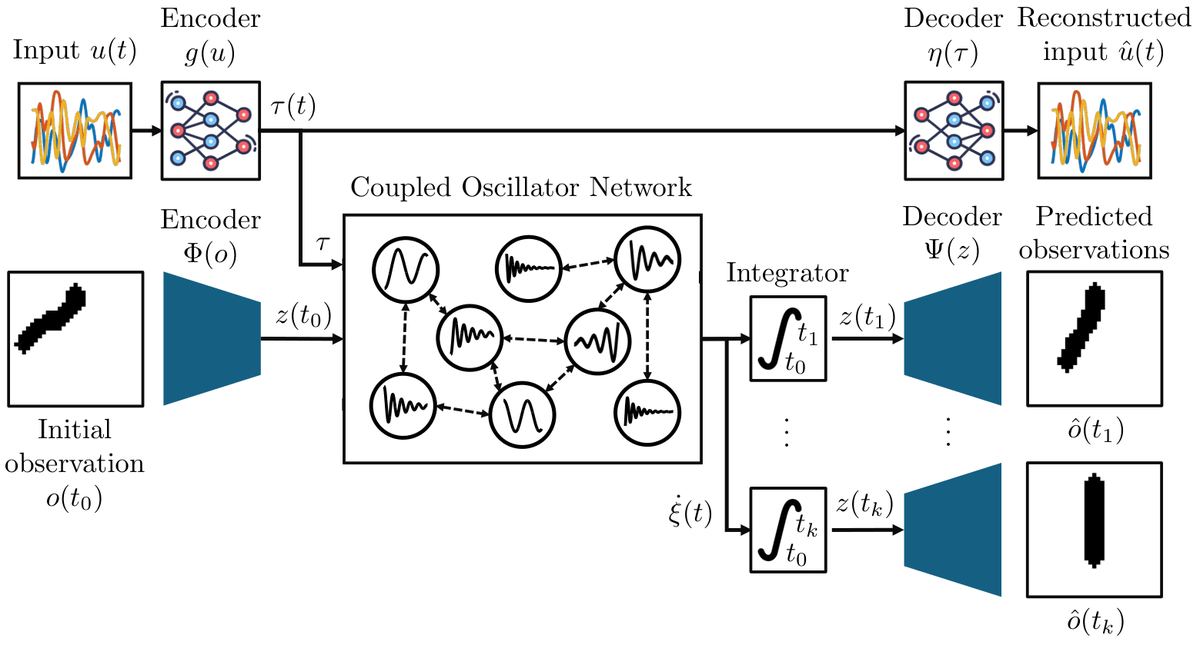
The full pipeline is an autoencoder wrapped around the CON dynamics. The encoder maps high-dimensional inputs from physical systems into a lower-dimensional latent space, and the corresponding decoder reconstructs the original inputs from the latent representation, enabling smooth transitions and the modeling of dynamics. The whole thing is trained end-to-end.
There is also a key engineering contribution that makes training practical. Simulating a system of differential equations at every training step is expensive. An approximated closed-form solution for efficient integration of network dynamics eases efficient training -- essentially replacing the numerical ODE solver with a fast analytical approximation that is accurate enough for learning but far cheaper to compute.
Closing the control loop requires one more piece: translating a force computed in latent space back into a real actuator command. The authors tackle this by approximating the forcing-to-input mapping with a decoder that is trained to reconstruct the input based on the encoded latent space force.

What it was tested on
The benchmarks span a range of mechanical complexity:
- Mass-spring with friction -- a canonical 1D system
- Double pendulum with friction -- chaotic, highly nonlinear dynamics
- Continuum soft robot -- a real-world planar robot with complex deformation modes
- Reaction-diffusion patterns -- a non-mechanical system used to probe generalization
The authors demonstrate the effectiveness of CON against various benchmarks using both synthetic datasets related to mechanical systems and real-world applications such as continuum soft robots, with results showing competitive performance on predicting dynamics from raw pixels. Crucially, CON achieves this while using significantly fewer parameters than competing baselines like Neural ODEs, RNNs, and GRUs.
Closing the loop on a real robot
The authors leverage these properties to enable latent-space control, using an integral-saturated PID with potential force compensation and demonstrating high-quality performance on a soft robot using raw pixels as the only feedback information. Potential force compensation is a classical technique that cancels out the gravitational or elastic forces acting on a system at a desired setpoint -- it works here because CON's Lagrangian structure gives you an explicit expression for those forces in latent space.
This is the payoff: a controller that requires no joint encoders, no force sensors, and no hand-crafted state estimator. Just a camera, a learned model, and a PID loop.
Where it falls short
The stability guarantees come with assumptions. The current framework is best suited to systems with a single stable equilibrium. The authors themselves flag that extending CON to systems with multiple equilibria -- think a robot that can fold into different configurations -- or to nonholonomic systems (where motion constraints depend on velocity, like wheeled robots) remains open work. The reaction-diffusion experiment also hints that the approach generalizes beyond mechanics, but that territory is less explored.
Getting the code
The codebase, presented as a Spotlight paper at NeurIPS 2024, includes a JAX implementation of the CON and CFA-CON models, along with training code for learning latent-space dynamics with CONs and other baselines such as NODE, RNN, GRU, and coRNN. The repository also ships latent-space controllers and visualization scripts. It requires Python 3.10+ and uses JAX for GPU-accelerated training. Note that deterministic GPU runs require setting XLA_FLAGS=--xla_gpu_deterministic_ops=true, which the provided setup script handles automatically.
For anyone building perception-based controllers for soft robots, deformable structures, or other systems where getting a clean state estimate is the hardest part of the problem, CON offers something rare: a learned dynamics model that a control theorist would actually trust.