
DeepThinkVLA's Hidden Weak Spot Lets Attackers Hijack Robot Actions Without Touching the Model
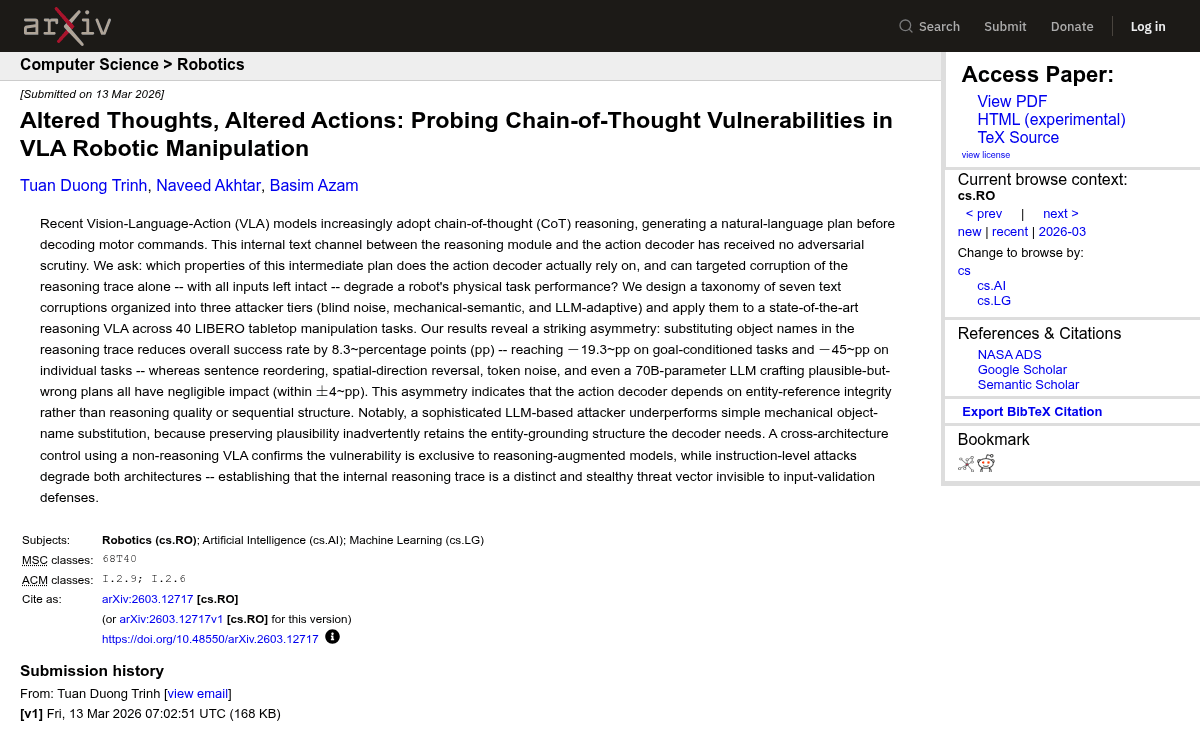
New research shows that swapping object names inside a robot's own reasoning trace can silently cut task success by up to 45 percentage points.
 Pro
Takeaways
- Researchers Trinh, Akhtar, and Azam publish first systematic study of chain-of-thought attacks on reasoning-augmented VLAs.
- Only object-name swapping in the CoT meaningfully degrades performance: 8.3 pp overall, 45 pp worst case.
- Sentence shuffling, spatial-direction flips, token noise, and 70B LLM-crafted rewrites all stay within 4 pp of baseline.
- A sophisticated LLM attacker underperforms mechanical entity swapping because plausibility preserves entity-grounding structure.
- Non-reasoning OpenVLA-OFT is immune to CoT attacks, confirming reasoning-specific vulnerability invisible to input-validation defenses.
- A zero-cost entity-reference validator flags 100% of entity-swap traces with 3.3% false-positive rate.
Vision-Language-Action (VLA) models have been quietly picking up a habit from large language models: thinking out loud before acting. Systems like DeepThinkVLA, ECoT, and NVIDIA's GR00T N1 first generate a natural-language plan, then hand that text to an action decoder that produces motor commands. A new preprint from Tuan-Duong Trinh, Naveed Akhtar, and Basim Azam argues that this internal text channel is an unguarded attack surface, and their systematic probe reveals a very specific weak spot.
An attack surface hiding between modules
The researchers frame the problem around modular reasoning pipelines where chain-of-thought text flows as an interpretable interface between the reasoning module and the action decoder. An adversary who intercepts this text channel, without any access to model weights, gradients, or training data, can substitute corrupted reasoning and thereby alter the robot's physical behavior. This is a different threat than classic adversarial perturbations on pixels or instructions: all inputs stay clean, so input-validation defenses see nothing wrong.
Prior work on chain-of-thought hijacking, H-CoT safety bypass, and training-time trace poisoning has focused on language outputs like unsafe text or wrong answers. This paper extends the question to embodied AI, where a corrupted plan translates into a robot reaching for the wrong object or fumbling a multi-step task.
Seven ways to corrupt a plan
The authors build a taxonomy of seven text corruptions organized into three tiers of attacker capability:
- Tier 1 (blind noise):
random_tokensreplaces half of the CoT tokens with random vocabulary picks;paddingswaps the whole trace for length-matched filler. - Tier 2 (mechanical-semantic):
shuffledpermutes sentences,entity_swapsubstitutes every object name with another LIBERO object, andnegation_flipreverses spatial terms like left/right and top/bottom. - Tier 3 (LLM-adaptive):
llm_adversarialuses a frozen Llama-3.1-70B-Instruct to rewrite the CoT into plausible-but-wrong reasoning.
Their primary target is DeepThinkVLA, a 2.9B-parameter reasoning VLA with a 95.4% baseline on LIBERO. For each of 40 tabletop tasks across four suites, they run 20 episodes across 3 seeds, then compare corrupted-CoT success rates to clean ones. As a control, they inject the same text into OpenVLA-OFT, a non-reasoning VLA that generates no CoT.
Only one corruption actually breaks the robot
The headline result is a striking asymmetry. Entity_swap degrades mean success rate from 95.4% to 87.0%, an 8.3 percentage-point drop, with LIBERO-Goal suffering the most at 19.3 pp. The single hardest task, "put wine bottle on rack," collapses by 45 pp when the CoT is rewritten to talk about a caddy and salad dressing instead.

Everything else lands within about 4 pp of the clean baseline. Sentence shuffling, spatial-direction flipping, and even padding the entire trace with filler tokens leave the robot mostly unfazed. The 70B LLM adversary is arguably the most surprising failure: llm_adversarial produces a 0.5 pp change overall, making it less damaging than every mechanical corruption except shuffled and padding.
Why? Because the LLM tries to keep its rewrite plausible, which means it keeps referencing objects that actually exist in the scene. Systematically swapping every object name is more destructive than crafting a coherent lie.
What the decoder actually uses
The paper reads the pattern as evidence of selective causal sensitivity: the action decoder cares about entity references, not about reasoning quality, sentence order, or spatial vocabulary. Negation-flip works cleanly because the decoder appears to rely on visual grounding rather than textual spatial terms for directional decisions. Padding works because empty tokens still supply attention context without misleading references.
A cross-architecture control seals the case. Instruction-level entity swaps hurt both DeepThinkVLA and OpenVLA-OFT, but CoT-level attacks only affect the reasoning model. There is a twist in the discussion though: reasoning-augmented VLAs are more fragile to instruction-level entity attacks than their non-reasoning counterparts, likely because a corrupted instruction produces a corrupted CoT, which the decoder then executes faithfully. Two stages of error stack up.
Dose-response and a cheap defense
A graded experiment on random-token replacement shows that LIBERO-Goal exhibits clear monotonic degradation from 96.7 down to 80.2 percent as replacement climbs from 0 to 100 percent, roughly linear at about 4 pp per 25% increment. That contradicts the "snowball" prediction from prior LLM CoT work and points to an architectural difference: bidirectional action decoders degrade proportionally rather than catastrophically.
The good news is that the fix may be almost free. The authors prototype a runtime validator that cross-references entity mentions in the CoT against the instruction, and report it flagging 100% of entity_swap traces with a 3.3% false-positive rate on their evaluation set. More sophisticated options like generating the CoT twice, signing traces, or RL-based reasoning recovery remain open work.
The paper does not release code or model weights, and its main experiments cover a single reasoning VLA on a single benchmark. But the vulnerability is architectural: any system that conditions actions on a text CoT flowing between components, including GR00T N1 and Cosmos Reason style dual-system pipelines, exposes the same channel. As think-then-act robots edge toward deployment, the middleware between reasoning and action becomes something worth locking down.