
DeepHistoViT Hits 100% Cancer Detection Accuracy, Showing Doctors What It Sees
A customized Vision Transformer with a rebuilt classification head hits near-perfect accuracy on three cancer histopathology datasets while surfacing attention maps for pathologist review.
 Pro
Takeaways
- DeepHistoViT is a customized ViT-16 framework for histopathology cancer classification.
- Achieves 100% accuracy on LC25000 lung and colon, 99.85% on ALL leukaemia dataset.
- Fine-tunes only the last two transformer blocks plus a custom 768-512-256 classification head.
- Skips stain normalization entirely, relying on augmentation for cross-lab robustness.
- Built-in attention maps localize diagnostic tissue regions without post-hoc Grad-CAM.
- Authors flag LC25000 augmentation artefacts and lack of multi-centre clinical validation.
A team from the University of Exeter and UCL has released DeepHistoViT, a Vision Transformer framework that pushes histopathology classification numbers to the ceiling on three public cancer datasets while giving pathologists an attention-based view into what the model is looking at.
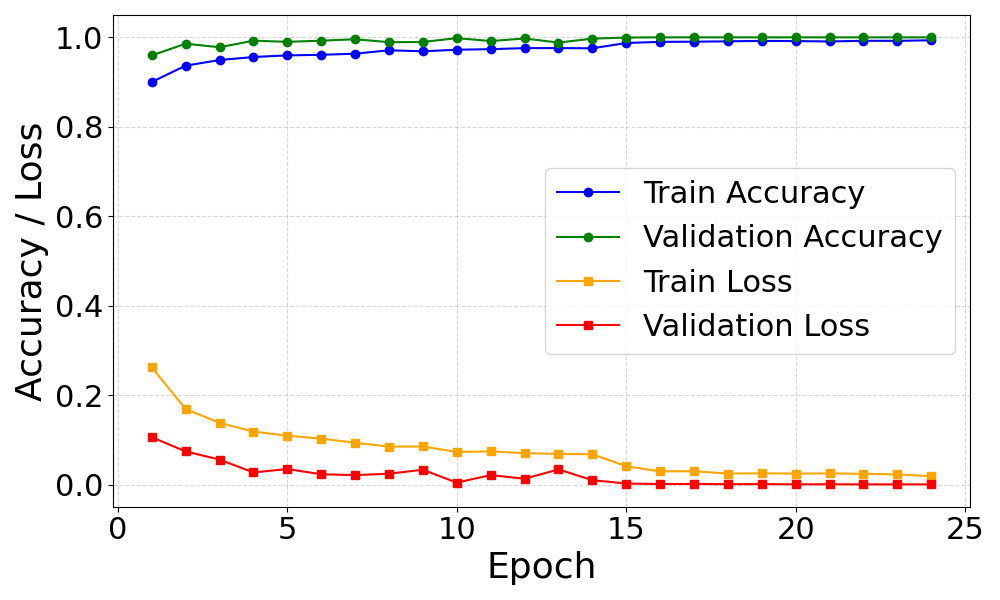
The paper reports 100% accuracy on lung and colon cancer subsets of LC25000, and 99.85% accuracy with 99.99% ROC-AUC on an acute lymphoblastic leukaemia (ALL) dataset. All metrics come with 95% confidence intervals from stratified five-fold cross-validation plus a held-out test set.
Why manual histopathology is a bottleneck
Histopathology remains the gold standard for definitive cancer diagnosis, as it enables detailed microscopic examination of tissue morphology and cellular architecture by trained pathologists. The catch is throughput and consistency: manual assessment is labour-intensive, time-consuming, and subject to inter- and intra-observer variability, particularly when large volumes of whole-slide images must be analysed.
CNNs became the default automation tool, but they have a known ceiling. Although CNNs excel at feature extraction, they struggle in capturing the spatial relationships among different features, which matters because a tumour's diagnostic signal is often spread across distant regions of a slide. Vision Transformers, with their global self-attention, are a natural fit, and this paper leans into that.
What is actually new in DeepHistoViT
The backbone is a standard ViT-base-patch16-224 pretrained on ImageNet, but the authors modify it in three specific ways:
- Selective fine-tuning: only the final two transformer encoder blocks are unfrozen. General visual features stay intact, and only the top layers adapt to tissue morphology.
- Custom classification head: the CLS token embedding runs through two dense layers with progressive dimensionality reduction (768 to 512 to 256), each followed by batch normalization, ReLU, and dropout, before a softmax output.
- No stain normalization: the pipeline deliberately skips the usual colour harmonization step, keeping the natural variance from different scanners and labs.

Preprocessing is minimal: resize to 256, centre-crop to 224, ImageNet normalization, and standard augmentation (random resized crop, horizontal flip, rotation up to 20 degrees, colour jitter). Training uses Adam with grid-searched hyperparameters, a ReduceLROnPlateau scheduler, and early stopping after eight epochs of no improvement.
The numbers, in context
The three benchmarks span very different tissue types. The LC25000 dataset contains 25,000 histopathological images of lung and colon tissues, split into lung adenocarcinoma, lung squamous cell carcinoma, and benign lung tissue for the lung task, with 5,000 RGB images per class at 768x768 resolution. The ALL dataset is smaller and harder: 3,562 peripheral blood smear images from 89 patients, covering benign hematogone cells and malignant lymphoblast cells across Early Pre-B, Pre-B, and Pro-B subtypes.
| Dataset | DeepHistoViT | Best prior reported |
|---|---|---|
| LC25000 Lung | 100.00% | 100.00% (Shahadat et al.) |
| LC25000 Colon | 100.00% | 100.00% (Shahadat et al.) |
| ALL leukaemia | 99.85% | 99.32% (ALL-Net) |
The authors are refreshingly candid about the LC25000 result. LC25000 is derived from a limited number of original whole-slide images, which are expanded through extensive augmentation, meaning augmented samples may share substantial visual similarity, potentially simplifying the classification task. The ALL result is the more meaningful signal, since it involves independent patient samples and real morphological variability.
Attention maps as a built-in explainer
Interpretability is where transformers get to flex over CNNs. Instead of bolting on Grad-CAM after the fact, DeepHistoViT pulls attention weights from the final encoder layer and projects them onto the input image. The resulting heat maps highlight glandular structures and nuclear features that a pathologist would independently flag as diagnostic.

Where it fits, and where it does not
Practical use cases are pathologist-assistive rather than autonomous: pre-screening slides, flagging suspicious regions for review, and providing a second opinion on subtype classification (particularly the four-way ALL split, which is time-consuming manually). The absence of a stain normalization step is a plus for deployment across labs with different H&E protocols.
Limitations the authors call out directly:
- Evaluation is on public datasets that may not fully reflect the variability encountered in clinical practice. Multi-centre validation is still pending.
- No uncertainty estimation or calibration analysis, both of which matter for safety-critical deployment.
- The perfect LC25000 numbers are partly an artefact of dataset construction, not proof of clinical readiness.
The paper does not currently link a public code repository or model checkpoint, which is a gap for anyone wanting to reproduce or fine-tune on their own slides. The architecture recipe is specific enough to rebuild from the description, but weights and training scripts would need to come from a follow-up release.